It began as a headache, but by the end of the rabbit hole I fell down, I was staring at the possibility of a deadly brain tumor. Just weeks later, a slight cough spiraled into fears that I’d contracted a first-of-its-kind, pandemic-style illness that would bring about my own — and the world’s — demise.
I’m a wellness writer with health anxiety. Otherwise known as hypochondria or illness anxiety disorder, it’s a condition that makes me worry I am or may become ill even when I’m healthy.
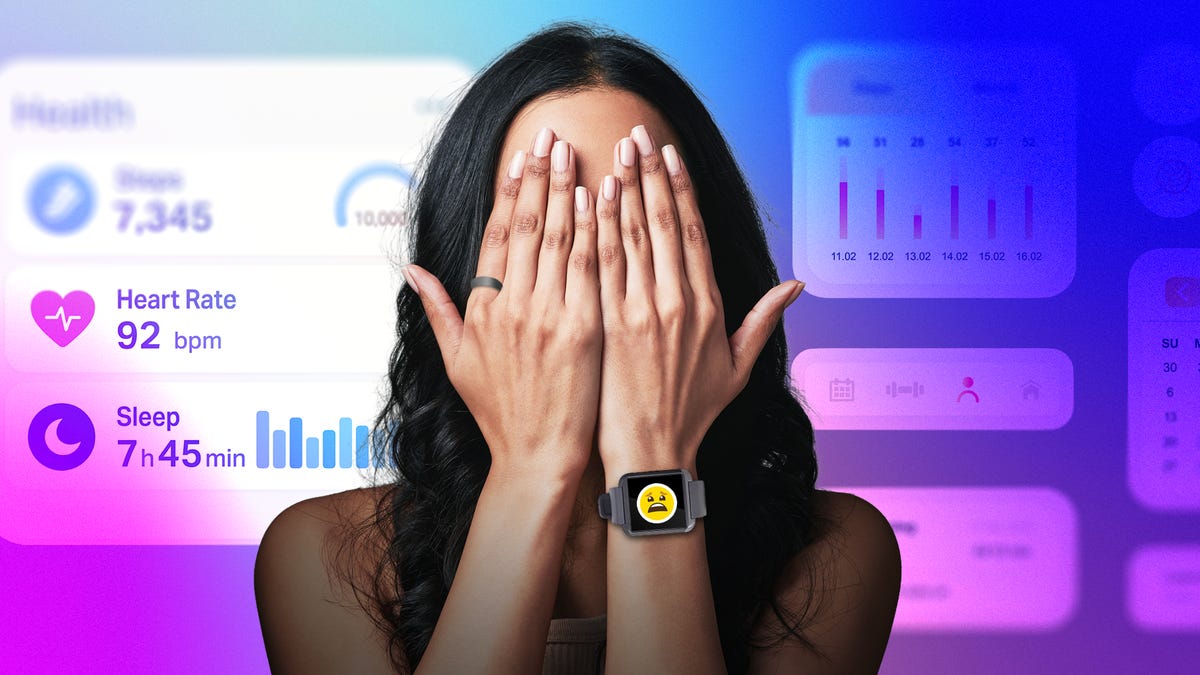
What’s ironic is that part of my job involves testing devices that monitor my health, wearables including fitness trackers and smart rings. While I love exploring this technology and do think it can help you learn more about your body, I have to be careful about how I use it so my anxiety isn’t triggered. I know I’m not alone.
“Healthy adults and individuals with pre-existing medical conditions are increasingly using these devices to manage their health,” says Dr. Lindsey Rosman, assistant professor of medicine in the Division of Cardiology and co-director of the Cardiovascular Device and Data Science Lab at the University of North Carolina School of Medicine. “Whether 24/7 access to health information from a wearable actually helps or potentially harms people is really unclear.”
To collect health data, you used to have to visit your doctor or rely on single-purpose devices such as blood pressure or heart rate monitors. Now, advancements in wearable technology over the last decade have built an entire industry focused on around-the-clock health tracking that can help you train more efficiently or even alert you to signs of potential illness.
Yet, being inundated with health data isn’t just bothersome; it can be harmful. Especially when you consider the widespread impact: About one in five US adults regularly wear a smartwatch or a wearable fitness tracker, according to a July 2019 Pew Research Center survey. That number has likely grown as the number of wearables on the market continues to increase.
When you add in the ability to search your symptoms online or ask an AI chatbot in your wearable’s app every health question under the sun, it becomes even more difficult to discern between what’s helpful and harmful.
To help myself and others with health anxiety navigate the world of wearables so we can either enjoy using them or know when it’s time to stop, I reached out to experts for their advice.
1. Turn off the alerts that cause panic
Rosman has observed clinically that it can be beneficial to either scale back or turn off the features that make you anxious. This can be especially helpful for people with pre-existing conditions that are already being treated, such as atrial fibrillation (AFib, an irregular heartbeat), as your wearable’s irregular heart rhythm notifications will only make you anxious and can prompt you to see your doctor when it’s not medically necessary.
Plus, certain medications can affect the accuracy of wearable sensors, provoking false alarms.
“We published a case report on a patient who performed over 900 EKGs [electrocardiograms or ECGs, which measure the heart’s electrical activity] on her smartwatch in a single year,” says Rosman. While most of the EKGs were normal, inconclusive alerts fueled her anxiety, leading to multiple ER visits, spousal conflict and the need for therapy to reclaim her daily life. The patient had no psychiatric history prior to getting a smartwatch.
When you get an unexpected health alert on your device, it can understandably cause panic.
Dr. Karen Cassiday, author of Freedom from Health Anxiety and owner and managing director of the Anxiety Treatment Center of Greater Chicago, says that even patients who don’t have health anxiety can find wearables to be intrusive when they get too many alerts. “They discover they want to be less aware of every moment of their body’s functioning,” she says.
Thankfully, most wearable health features can be turned off completely or customized.
For instance, Shyamal Patel, SVP of science at Oura, maker of the Oura Ring, shares that the device’s Personalized Activity Goals allow you to choose to see steps instead of calories, adjust your daily activity goal or hide calories completely, which can be necessary for anyone who finds calorie counting triggering or overly rigid.
2. Be intentional about checking your device
Referring to a 2024 study she worked on that examined the impact of wearables on the psychological well-being of patients with AFib, Rosman says that about half of the participants were checking their heart rate every day out of habit, not because they felt symptoms.
Cassidy explains that while people with health anxiety may initially find wearables helpful, compulsively checking to make sure their vitals are normal can accidentally become a form of negative reinforcement that further propels the anxiety.
“Often when I work with anxious people, we try to cut back or eliminate the need to compulsively check for reassurance on their wearables, as well as with ChapGPT or other digital ‘doctors,’” says Cassiday.
When people refrain from compulsively checking, wearables can provide useful feedback that counters the false belief that something terrible will happen to their health.
If checking your health metrics causes anxiety, try reducing how often you view them on your device or in its app. Setting an alert to check weekly, at a minimum, could help — especially since it’ll give you a broader picture, making you less likely to hyperfocus on a single data point that seems off.
You should also avoid checking your wearable’s health information right after you wake up or before you go to bed, as this can set the tone for an anxious day or make it harder to fall asleep.
If having a screen on your wrist makes it difficult for you to stop checking, a screenless smart ring or fitness tracker such as the Whoop 5.0 may be a better option, since they rely on apps instead of screens.
A screenless smart ring may help you stop compusively checking your device.
“You choose how much or how little you engage with the app, which gives those who might be anxious about their health the option to limit the amount of time they spend with their data,” says Patel.
3. Focus on long-term trends, not one-off metrics
When I asked both Patel and Dr. Jacqueline Shreibati, head of clinical for platforms and devices at Google, how people who wear their devices can reduce health anxiety, they emphasized the importance of tracking trends — not individual metrics.
“We focus on long-term trends (rather than isolated metrics) to help users maintain a balanced relationship with their data,” says Shreibati. “What being healthy means differs for everyone, and we encourage users to consult their physician if they have any concerns.”
Patel points to the Tags and Trends features in the Oura app. Tags lets you tag lifestyle factors such as travel, alcohol, meditation or late meals, which you can then view in Trends to see how your behavior affects your recovery and sleep over weeks, rather than looking at a single score that may one day seem abnormal.
Instead of viewing a single sleep or stress score, consider looking at that data weekly or monthly.
4. Remember: Your smartwatch can’t replace your doctor
“Most consumer wearables were originally developed as personal wellness devices, which are not required to demonstrate safety and efficacy like traditional medical devices (e.g., a blood pressure cuff or pacemaker),” Rosman explains.
Yet we’ve begun using these wearables to monitor our health, using metrics such as heart rate and rhythm, blood oxygen, stress, sleep and physical activity. Now, some of these devices have medical-grade sensors, software and algorithms approved by the US Food and Drug Administration to detect irregular heart rhythms, hypertension and sleep apnea.
Despite FDA approval, wearables are simply not doctors, and they cannot provide medical diagnoses or treatment. That’s why it’s essential to understand what your device actually measures.
The ECG feature on many smartwatches is just one example of this. FDA-cleared as it may be, a single-lead ECG that only uses one electrode to record your heart’s electrical activity from your wrist is not the same as the 12-lead, hospital-grade ECG a cardiologist would use.
While your wearable’s ECG can surface a potential symptom worth investigating with your doctor, it can’t replace a professional or their medical-grade equipment.
Performing an ECG on your smartwatch is not the same as having that same measurement taken in a doctor’s office.
The gap is even wider for features including stress and sleep scores, which haven’t been clinically validated because there’s no one single gold standard to validate against. These numerical scores are calculated from bodily signals such as heart rate, temperature, movement and heart rate variability, which tend to correlate with your stress and sleep states. But the translation from raw signal to “your stress score is 74” is more of an educated estimate.
“What you’re seeing is a rough indicator of how your nervous system is functioning, not a medical diagnosis,” Rosman emphasizes.
Patel adds that not all physiological stress is inherently negative. “Some forms of short-term physiological stress can be healthy and adaptive,” he says. “That’s why we aim to pair data with in-app context and insights, so members can better understand what they’re seeing rather than receiving that information in a vacuum.”
Nonetheless, when you don’t know exactly what your wearable is measuring, a “bad” stress or sleep score can seem scary when it isn’t necessarily a cause for alarm, but rather a sign that you may want to have a deeper conversation with your doctor.
5. Get a temperature check (literally and figuratively)
Just like you should talk to your doctor before starting a new medication or diet, you should get their thoughts on whether you could benefit from using a wearable.
“Education is probably the most underused tool we have,” Rosman says.
When you don’t know what a healthy heart rate or ECG looks like, one seemingly atypical reading can send you into a panic. That’s why it’s essential to speak with your doctor so you understand your own baseline and if a wearable makes sense for your current health condition.
As a guide, Rosman provides the following questions you can ask your doctor:
- What type of wearable should I use?
- How often should I check this data?
- What are healthy numbers for me?
- What do I do when I get an alert?
- When should I call the clinic or seek emergency care versus waiting?
“A fast heart rate after climbing stairs is not the same as a dangerous arrhythmia, but without that context, a notification can feel terrifying,” Rosman adds. “So much wearable-related anxiety comes not from the data itself, but from not knowing what to do with it.”
6. Know when it’s time to remove that device and get help
When asked when someone should consider parting with their wearable or seeing a professional for health anxiety, Cassiday says that it’s similar to what many notice when they keep checking their smartphone for the next text, TikTok or other digital data.
“If you find yourself interrupting pleasurable activities or your free time to check, or if you feel anxious about not checking, you have a problem,” Cassiday states.
For instance, if you only stop thinking that you’ll have a heart attack when you check your wearable and see your resting heart rate. Or, put simply, if you only feel at peace after someone or something, such as a wearable reassures you that you’re in good health, it’s time to get professional support.
If health anxiety is making it difficult for you to enjoy your life, then it’s time to talk to a professional.
To find help, Cassiday recommends using the resources provided by the Anxiety and Depression Association of America or the International OCD Foundation, as health anxiety can be related to obsessive-compulsive disorder.
7. Consider cognitive behavioral therapy
When you have health anxiety, the gold standard for care is cognitive behavioral therapy. It involves exposure to health-related worries without any form of reassurance and learning to accept the uncertainty that comes with not knowing our future health status, manner of death or time of death.
“People need to learn that all the vague symptoms that trigger their health anxiety are just normal variations of normal body functioning and aging,” Cassiday explains. “They have to reframe the symptoms they notice as nothing to examine, discuss or manage and instead trust the facts of their other evidence of good health.”
CBT can help you live in the present instead of spiraling into the anxiety-inducing “What if?” of the future.
Who should and shouldn’t use wearables
Wearables can be great for people who like tracking their fitness to motivate them toward their goals, or for patients and their care teams when medically necessary. Though they usually cost hundreds of dollars, wearables can be less expensive than medical tests. Some are even HSA- or FSA-eligible.
“In AFib specifically, being able to correlate your symptoms with actual rhythm data can be genuinely empowering,” Rosman says. She’s observed that the patients who thrive with wearables are those who use the data as information — not as something to fear — and those who don’t participate in 24/7 surveillance.
In Rosman’s 2024 study, two-thirds of AFib patients said their wearable made them feel safer and more in control. Even so, there is still the risk of unintended consequences.
While they can be beneficial, wearables can also come with risks — especially since there isn’t enough research on the subject.
Just as doctors would never prescribe a medication without knowing the potential benefits, risks and how to manage them, wearables should be no different. “The technology has moved so much faster than the science, and we need the scientific evidence from clinical trials to catch up,” Rosman explains.
Since the evidence isn’t there yet, Rosman is hesitant to say anyone should categorically avoid wearables.
Despite that, people who are highly anxious about their heart or prone to obsessive symptom monitoring should approach with caution. The same goes for those with conditions involving unpredictable, abrupt symptoms, such as paroxysmal AFib and POTS, because the uncertainty of not knowing when the next episode will hit is stressful enough, and constant monitoring can make it worse.
A note on the science (or lack thereof)
Rosman has conducted research on the connection between wearables and anxiety, including a 2025 review describing the psychological effects of wearables on patients with cardiovascular disease and a 2024 study examining their impact on the psychological well-being of patients with AFib.
The 2025 review found that while wearables can help promote healthy behaviors and provide data for diagnosis and treatment, they also pose risks, such as adverse psychological reactions.
In the 2024 study, it was concluded that wearables were connected with higher rates of patients becoming preoccupied with their symptoms, being concerned about their treatments and using both formal and informal health care resources.
On the other hand, a 2021 study that analyzed the 2019 and 2020 US-based Health Information National Trends Survey found that using wearable devices for self-tracking can indirectly reduce psychological distress. Still, misinterpretation of wearable data may cause unnecessary panic and anxiety.
A 2020 qualitative interview study featuring patients with chronic heart disease also found that while wearables’ data may be a resource for self-care, it can create uncertainty, fear and anxiety.
Ultimately, more studies are needed.
“Honestly, we don’t have good scientific evidence in this area yet,” says Rosman. “Despite widespread use, there have been no clinical trials I’m aware of that have looked at the benefits and potential health risks of specific wearable health features.”
Rosman’s team plans to be the first to investigate this in patients with pre-existing heart conditions.
Wearables’ impact on health care
When wearables cause health anxiety, they can prompt healthy individuals to schedule unnecessary doctor’s appointments. This places a burden on our health care system, which is already experiencing shortages, making it difficult for people who actually require medical attention to access care.
Rosman’s 2024 study found that those using a wearable sent nearly twice as many patient portal messages to their doctors. Responding to these messages from patients takes time, isn’t reimbursed by insurance and can contribute to burnout.
When health anxiety caused by wearables prompts people to message their doctors, it can put a strain on the health care system.
As a result, Rosman believes we need better systems for managing wearable data in clinical settings before we scale it further: “Wearables are changing how we deliver care in ways we haven’t fully prepared for.”
Wearables can further widen health care inequity due to their cost.
“These devices are expensive, they were mostly designed and tested in young healthy people and they’re marketed toward higher-income consumers,” Rosman explains. “If we’re not thoughtful about access, wearables could actually widen health disparities rather than close them. That’s the opposite of what we want.”
The bottom line
While wearables have their benefits, there are also risks to consider, especially given the limited research on the subject.
If you purchase a wearable and it triggers health anxiety, you don’t have to use every available feature, wear it constantly or continue to wear it at all. Before you even buy that device, you can arm yourself with anxiety-reducing knowledge by getting your doctor’s expert opinion.
However, if health anxiety continues to take over your life, it may be time to remove your wearable and seek professional help.
As for me, writing this piece has been a necessary reminder that, while there’s a lot we can’t control in life, the power is in our hands (or on our wrists or fingers) when it comes to the technology we put on our bodies or invite into our homes. Just like an itchy sweater or a lumpy armchair, we can send the technology that doesn’t serve us packing.
Read the full article here