






Pauline Hanson says she is tired of listening to big business wanting “cheap labour”. There is a legitimate issue here, but it deserves a more sophisticated debate (“Migration cut worth the hit to the economy: One Nation”, September 16). Migration boosts headline GDP, which can tempt governments to keep increasing immigration rather than addressing the underlying economic problems. In that sense, One Nation is trying to break what has become an addiction to population growth. If employers can solve labour shortages through overseas recruitment, they may have less incentive to improve wages, training and productivity in Australia. At the same time, farmers and tourism operators say restrictions on working holidaymakers could threaten jobs and revenue. The answer should therefore be neither unlimited migration nor an arbitrary across-the-board cut. Governments should identify where Australia genuinely needs workers and where migration is simply substituting for training Australians. John Kempler, Rose Bay
Your report exposes the fundamental problem with One Nation’s immigration policy. There is a perfectly legitimate debate to be had, but Barnaby Joyce apparently believes that once One Nation has picked a number, explaining its economic consequences is somebody else’s problem. Faced with warnings about the impact of deliberately driving net migration negative, Joyce dismisses economists and says he is not concerned about what the Parliamentary Budget Office might conclude because “they’re not elected, I am”. Being elected does not make arithmetic optional. This is government by gut feeling, Barnaby Joyce style: pick a number, find someone to blame, sneer at the experts and become belligerent when anyone has the temerity to ask for evidence. For decades, Pauline Hanson has demanded that everyone else “please explain”. Well, now it’s her party’s turn. Please explain the cost, Barnaby, and “I’m elected” isn’t an answer. Denise McHugh, Tamworth
Who’s primitive?
Hanson’s claim that “if we go back to the time of settlement in Australia, [Indigenous Australians] were primitive compared to settlers” is once again far from reality (“Hanson offers qualified apology over offensive Indigenous remarks”, September 16). The colony of New South Wales was completely unsustainable during the era of the First Fleet (1788) and the arrival of the Second Fleet (1790). Rather than operating as an independent settlement, it functioned as a precarious survival camp entirely dependent on British supply ships and on the verge of starvation. European expansion quickly created conflict, yet early British journals recorded numerous instances of profound Indigenous generosity, empathy and assistance toward the struggling colony. These acts occurred despite language barriers, environmental degradation caused by the British and the 1789 smallpox epidemic that decimated the local population. John Bailey, Canterbury
Your correspondents are right about Indigenous Australians’ complex cultures (Letters, September 16). Scientific knowledge was expressed in applied genetics (kinship rules), astronomy, aerodynamics, aquaculture and chemistry. Their understanding of seasonal, geographical and environmental patterns informed their organised, cyclical movements to find and harness specific plant and animal foods, medicines and tool-making materials. They knew where water would be found in the driest landscapes. They stored seed and made the first breads. They utilised chemistry to make durable, rock-hard adhesives, to attach handles to stone axes. They did not record knowledge in books but used complex memory techniques, powerful intellects and structured story connections to remember and pass on complex information. Necessity, geography and environment are the parents of invention. Hanson has a rather primitive level of understanding of the world. Nell Knight, Avoca Beach
Pauline Hanson has long said whatever she likes, regardless of the consequences. As James Massola points out, for Hanson, “sorry” seems to be the hardest word (“Regrets? Hanson’s got a few, but she’s also chalking up wins”, September 16). Her occasional conditional apologies are accompanied by her conditional explanations: “I’m not the most eloquent speaker” and “I’ve always put my foot in my mouth”. Hanson also claims she is ready to be prime minister, though she refuses to face scrutiny and bans certain media from her press conferences. Until One Nation shows it understands the responsibilities of government, let alone present a plan to govern, her gaffes and racist rhetoric will expose her unsuitability. Geoff Nilon, Mascot

To say you regret that someone may be offended by something you have said is not an apology. It’s not even a regret. An apology would be: “I am sorry that I made an offensive comment.” Try learning English, honesty and humility. It might help your political career. Alan Hargreaves, Kincumber
Pauline Hanson’s scapegoating of all and sundry does not help our social unity. Unhelpful but less obvious are the undermining and gaslighting of Commissioner Virginia Bell’s final report by people like ex-ASIO chief Dennis Richardson and Liberal MP Julian Leeser (“Former spy boss calls for debate on radical Islam”, September 16). I am sure the commissioner will give adequate and sufficient coverage to the role of extremist Islamist groups in promoting antisemitism. Mark Porter, New Lambton
Productivity woes
Ross Gittins correctly states that improved productivity is achieved not by people working harder but by bosses investing in more or better machines to work with (“Feeling the pinch? Blame the pay rise you didn’t get” September 16). Business investment has flatlined for years, largely explaining the stagnation of productivity and per capita GDP. Tortuous arguments on immigration consistently miss the point. Critical skills are a very small part of our intake. Apart from students, large numbers are needed only to ensure continually increasing demand for stuff sold by companies that were long since sold off to foreign enterprises. Norman Carter, Roseville Chase
Ross Gittins once again pines for an economic stabilisation regime that doesn’t just rely on interest rate changes. He feels for mortgage holders. Certainly, if the RBA is to remain in business it needs to improve on its inflation target of 2.5 per cent per annum. In the six years to mid-2020, the CPI rose by 8 per cent; in the next six years, it rose by 29 per cent. Please explain. Mike Bush, Port Macquarie
Ross Gittins is right. Using interest rates to reduce demand has two great disadvantages. It is unfair in that it hits people with substantial debt (house mortgages) most and it discourages productivity-improving investment. Surely a room full of economists and wise people could come up with a fairer approach and one that encourages such investment. Andrew Bain, Broulee
Don’t judge the judges
Premier Chris Minns has made a misstep by commenting on the sentence handed down by Judge Adams to the killer of Molly Ticehurst (“NSW premier slams sentence of Molly Ticehurst’s murderer”, September 16). Minns has great presence and appeal, and he uses it to good effect as he reaches out to the NSW electorate, but his inference that the judge got the sentence wrong may be a step too far. Parliament legislates and the judiciary interprets and applies the laws. Minns is entering Donald Trump territory here, and there are many ugly examples of the President threatening judges who don’t rule in his favour; it is not a good look for Minns. Tread carefully Premier, no matter what your personal view is on this matter, or your desire to be everyman to every voter, your words and actions have weight. Patrick McGrath, Potts Point
Copyright travesty
Artists are traditionally in the lowest income brackets, but yet again we are expected to give away our work for nothing (“Labor dangles copyright deal to lure AI giants – but with a catch”, September 16). Open AI is blackmailing the government to host AI training but only if “copyright can be resolved” – in other words, if artists can have their work legally stolen. On July 15, PM Anthony Albanese said “no company should use Australian books, music, art or news to build or train AI without the artist’s control. That includes the artist’s control of the price and value of their work. Anything less is theft.” Indeed it is theft, but it’s never seen as that. As a professional designer, I have frequently been asked by corporate clients to give them my work for free, often justified by comments it “would further my profile”. No one would use the same approach with medical specialists, so why is the intellectual property of an artist worth less? Offering copyright holders opt-out rights is the lowest form of protection. Yet again it is just political point scoring and the group with the least political heft is being used as a pawn to bolster big business, American big business at that. It’s a disgrace. Judy Hungerford, Narraweena
Digital doom
President Donald Trump should have said “whatever wins AI, wins” (“‘Whoever wins with AI wins’: Trump hits back at tech chiefs’ calls to slow downy”, September 15). The real risk here is not China or Russia, but AI itself. If AI wins, the human race may lose. We are on the verge of creating a highly intelligent silicon “life form” that never sleeps, never forgets and that may choose not to obey its creator. While no country will willingly forfeit any perceived advantage it may have in AI development, it must be possible to create global guidelines to prevent unintended disasters occurring. It would be the AI equivalent to the Mutually Assured Destruction (MAD) policy for nuclear weapons. While not perfect, it would be a good start. David James, Warriewood
It seems that previous studies showing that the US president had the vocabulary of a primary school student were wrong. We can now see that he is opening up new horizons in our language. For example, he has clarified that the word “hoax” really means “inconvenient truth”. He has applied this to climate change and now uses it to deny the risks imposed by artificial intelligence (“I am the hoax buster’: Trump takes on America with seven-post rant promoting AI, data centres”, September 16). Mike Salon, Darlinghurst
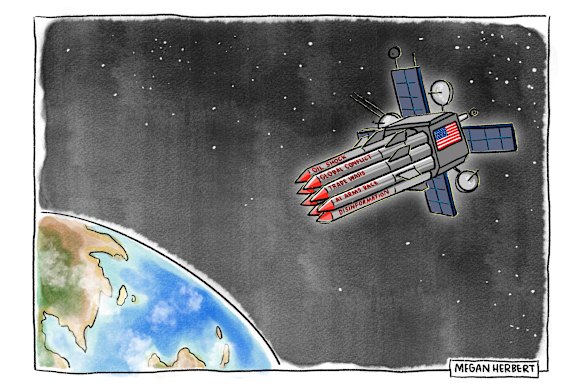
For once I agree with Trump – America’s future would be more secure if the president had a high IQ (“Donald Trump dismisses AI concerns”, September 15). The problem is that the US Constitution does not allow for Barack Obama to make a comeback. Drusi Megget, Birpai Country
Ban the plan
Once again, in the news we see continuing stories of home buyers having their money stolen by inept, incompetent and corrupt developers and builders (“Nassif tells ICAC it can’t handle the truth”, September 16). At the centre of this is the practice of buying off the plan. Once the NSW government allowed private certification, it did not take many years until it was obvious that buying off the plan was a bad idea. But people will continue to be tempted to do so. Perhaps the solution is simply ban selling from the plan. Then the developers and builders would be subjected to much more scrutiny of how and where they get their money, and how they manage it. Best: people can examine the quality of the building before they put down their money. It would help too if the regulators and governance bodies were a bit more active in their surveillance. Peter Thompson, Grenfell
My concern is for the people who have bought units in Jean Nassif’s buildings and now face huge debts to fix all the faults, which should have been picked up by the private certifiers before being signed off. Josephine Piper, Miranda
Preventable tragedy
A child dies after a day in Cowra and Orange hospitals after a wrong diagnosis. Her mother’s videos showed the coroner that an alternative diagnosis should have been considered (“Mother’s plea after toddler’s sepsis death”, September 16). NSW country hospital doctors can call the emergency department of a Sydney teaching hospital about a patient whenever they wish. In this particular case, all a doctor or nurse had to do was call Westmead Hospital’s emergency department and point their phone at the toddler to get a second opinion from a team of specialists. No one should be suffering or dying in our hospitals for want of an accurate diagnosis. While it will add a little bureaucracy, all public hospitals in Australia should have access to a teaching hospital to help diagnose patients, and help follow up on treatment and patient progress. Peter Egan, Adelaide (SA)
Hasty getaways
I was fascinated and intrigued to read in today’s Herald the advertisement from Sydney Airport Corporation about the 37 motor vehicles abandoned in its parking area, including high-end makes like Mercedes, Lexus and Toyota Prado. It set me to wondering how many, if any, of these vehicles had been abandoned in haste to leave the country by dodgy property developers and organised crime figures avoiding police, or members of political committees avoiding appearing before investigative bodies such as ICAC. John Payne, Kelso
By the book
Philip Drew was astounded at the long queue to buy books at Sydney University (Letters, September 16). The Lifeline Book Fair in Canberra attracts more than 20,000 people three times a year at its fundraising event. It keeps hundreds of volunteers busy six days a week receiving donations and processing the books for sale. Print is not dead. Phil Armour, Yass
Shanks’ Pony
Suzanne Saunders’ recollection of being wired into her mum and dad reminds me that we never owned a car, the mode of transport being Shanks’ Pony (Letters, September 16). Allan Gibson, Cherrybrook
- To submit a letter to the Sydney Morning Herald, email letters@smh.com.au. Click here for tips on how to submit letters.
- The Opinion newsletter is a weekly wrap of views that will challenge, champion and inform. Sign up here.
Read the full article here