




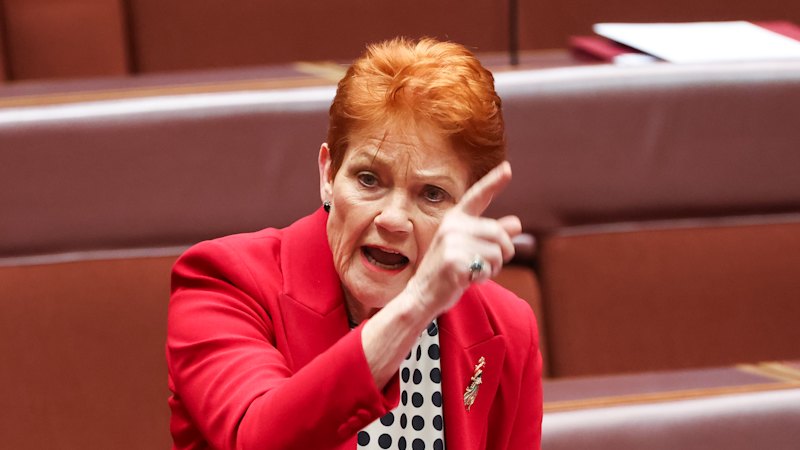
The claim by Pauline Hanson and One Nation supporters that immigration is altering Australia’s culture “too much” relies on a static, outdated view of identity (“Immigration motivates One Nation devotees”, August 25). Culture is not an artifact preserved in stone but something that naturally evolves as society grows. To conflate monoculture with social harmony is to misunderstand modern Australia. What binds us together is not a uniform ethnicity, religion or heritage but our commitment to shared democratic values like parliamentary democracy, the rule of law, gender equality and a fair go for all. Embracing our evolving cultural landscape does not weaken Australian identity, it reflects a mature, confident nation grounded in principles that unite us. John Bailey, Canterbury
With the conflicting migration numbers we’re being fed by One Nation and the Coalition, it’s time for the real stakeholders to stand up. Each of the alternative governing parties are trying to outbid each other to get to the lowest number and are confusing themselves and voters in the process. It’s time for business bodies to stand up and tell us how many new Australians they need to sustain or grow their businesses. They need to provide some real numbers to the argument so that this ridiculous bidding war ends and reality is forced on these politicians. Ian Ferrier, Long Jetty
Wow, tell us something we don’t know. Hanson’s message has always been one of exclusion and grievance: “We’re being swamped by Asians … Indigenous Australians get privileged treatment … there’s no such thing as a good Muslim”. So it’s no surprise her most devoted followers are focused not on the solution to problems like the cost of living but on finding someone to blame. Like the populist US president, Hanson makes a fine living off the system by fuelling discontent among those who feel they’ve been left behind. She has no answers, but that’s never been her goal. Phil Bradshaw, Naremburn
It’s not surprising that One Nation voters are anti-immigration, given the survey’s findings that Pauline Hanson’s voters represent a higher proportion of tradies and lower-income workers, sectors where many immigrants are deployed. However, we do need immigration as the country develops. The problem is how to find appropriate jobs and work locations for immigrants on arrival. We are notoriously slack in efficiently placing skilled people and others who come to Australia. By contrast, Canada and Germany have set up comprehensive systems to assess skills and find industries and locations for arriving workers. Certainly there may be a case for more or less immigration but the real issue is how do we ensure immigrants reach their full occupational and social potential in their new country? David Catchlove, Newport
The survey results are no surprise, given Pauline Hanson’s well-known antipathy to a range of migrants – Asians generally and Muslims particularly. However, it’s still far from clear which immigration policy One Nation fans favour. Is it the member for Farrer David Farley’s figure, which seems about the same as Labor’s target, or the much lower total nominated by the party’s director, James Ashby? There is an important difference between these two men: the former was recently elected by the people; the latter was simply appointed but is a dab hand at putting on stunts with a mop. Nick Franklin, Katoomba
Unwanted twist
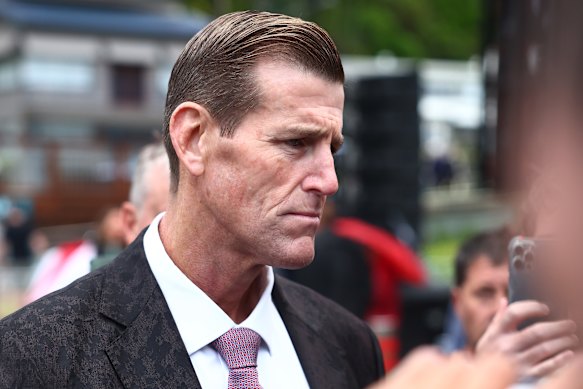
The poll of One Nation voters showing support for Ben Roberts-Smith tells us how shifts in opinion in Australia can fly under the radar (“Hanson isn’t only hero for those who want her to lead”, August 25). These voters are at the conventional end of a spectrum that extends all the way to the wacko sovereign citizen brigade. They sound a clear warning as that case wends its tortuous way through the courts – the danger that he could be claimed as some kind of martyr and galvanise attacks on Andrew Hastie in particular. BRS serving as a lightning rod for disaffection is a twist in the political landscape that Australia really doesn’t need. Margaret Johnston, Paddington

Win for the West
Shane Wright explores the $23 billion the GST deal favouring WA currently costs Australia, the $60 billion it is expected to blow out to, and the $6 billion it will cost to support other states if WA improves its iron ore royalty income (“PM backs GST deal, leaves future taxpayers on the hook for billions”, August 25). What he fails to mention is that Labor holds more than 70 per cent of WA’s federal seats and our PM intends to keep them all. It’s a pity he doesn’t realise how many eastern Australian seats he’s about to lose as a result. Brian Barrett, Padstow
Anthony Albanese has predictably assured West Australians there will be no change to the GST deal while he remains PM. He is no doubt demonstrating political nous in doing so; however, a stronger leader might have pointed out to them that their good fortune is at the expense of every other tax-paying Australian, and that we’re better off being united rather than divided. We’re also better off removing rather than adding pressure to the nation’s debt, to consider our future generations. Bruce McKinnon, Mosman
Mindless devotion
Peter Hartcher paints a grim picture of the trashing of American prestige under Donald Trump’s presidency (“How Trump is weakening America”, August 25). But as baffling as the ineptitude in his economic, military and diplomatic behaviours is the mindless devotion he continues to attract from devoted acolytes, media cheer squad and wider support base. No other political identity in American history has achieved the mass hypnosis Trump has managed, and it’s hard to see how the nightmare of such mindless adulation will end, if it ever does. I suspect that his influence on US politics and policy will far outlive him, perpetuated by the zealots already in his thrall. Adrian Connelly, Springwood
From the catastrophic failure of his war in Iran to his non-stop abuse of US allies while federal debt passes 120 per cent of GDP, Trump has damaged America’s reputation in ways no one could have imagined. But the greatest damage he has inflicted upon America is his deep lack of moral integrity. This is why Democratic presidential hopeful Jon Ossoff has directed his criticism of Trump as being self-seeking and corruptible. Ossoff appeals to the needs of black voters and poor working families while lambasting Trump’s military overreach in Iran as one of America’s greatest foreign policy failures. Perhaps Ossoff’s own presidential campaign could instead read MAMA: Make America Moral Again. Rev Vincent Zankin, Rivett (ACT)
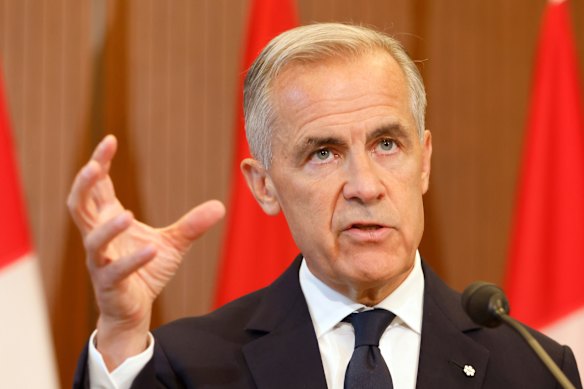
Correspondent Rob Phillips applauds Canadian Prime Minister Mark Carney for standing up to Donald Trump’s bullying, but is silent about Anthony Albanese’s comparative meekness (Letters, August 25). Carney is fast gaining a reputation as the leader of the West for calling out Trump’s betrayal of loyal allies and forging new trade relationships. Has Australia publicly supported Carney’s coalition of middle powers or is it still hanging onto the tattered coat-tails of the USA as that nation blithely trashes its friends and cosies up to dictators and war criminals? Salvatore Sorbello, Campsie

Closer than you think
Scott Poynting is right about the threat of a nuclear attack on Canada by the US (Letters, August 25). In the ’70s, singer Randy Newman wrote Political Science, a satirical song about American foreign policy during the Cold War in which he suggests America should drop “the big one” on its detractors. Among complaints about other countries, he says that “Canada’s too cold”. Thankfully, we need not worry about nuclear threats to Australia, as he sang: “We’ll save Australia. Don’t wanna hurt no kangaroos. We’ll build an all-American amusement park there. They got surfin too.” Phew! Jim Croke, Stanmore
Thanks to Scott Poynting for making me laugh out loud with his comment about US bombers being too far away to reach us. Does the RAAF base near Katherine NT not count? US fighter-bombers rotating through Katherine and Darwin could easily reach our major population centres if America decided we needed bringing to heel. Alan Stanley, Upper Corindi
I’m not sure whether Scott Poynting is being ironic, but of course we do have US bomber bases quite near us. On our soil, in fact. Given the capriciousness of the US government, indeed their anti-democratic, anti-trade actions, perhaps it’s time we asked them to take these military targets back to the USA. Colin Hesse, Nowra
I have bad news for Mr Poynting. At our invitation, the US regularly operates (nuclear armed?) B52s out of RAAF Base Darwin. Be afraid, be very afraid! Clive Dye, Broulee
All the US bombers would have to do is fill up in Darwin before bombing us. On the way back, they could refuel again. Oh dear, how very Milo Minderbinder. Stephen Turner, Seaforth
By George
I was elected to Georges River Council in 2021 by residents who wanted better consultation on planning matters (“The state wants 800 new homes in this Sydney suburb. The council is arguing for more”, August 25). Along with my fellow councillors I have worked constructively with staff, my colleagues and the community to achieve better outcomes. Since 2024, however, the state government has usurped council powers through non-consultative processes such as its Low and Mid-Rise Housing Policy and State Significant Development. That’s not local democracy, and it has pushed me to the brink of resignation. I doubt my supporters elected me simply to get footpaths and potholes fixed – they wanted me to represent their views on the decisions that shape their neighbourhoods. Peter Mahoney, Oatley
On the one hand is a scheme for multiple towers up to 22 storeys high to be dumped onto one side of a busy arterial road, serviced only by a narrow, one-way lane with difficult exit points. The proposal is half-baked to the extent that it leaves the other half of King Georges Road and the rest of the precinct to its own devices. On the other hand, there is a master plan from Georges River Council encompassing the entire Beverly Hills town centre and considering community interests. It should hardly be a contest if the government allows reason and good planning processes to prevail. Doug Walker, Baulkham Hills
Nature lucks out
Bravo to Cathy Wilcox for spotlighting the sickening spread of H5 bird flu in the broader context of escalating climate change (Letters, August 25). Are we letting nature die? The Albanese government allocated just $496 million to on-ground, nature-focused programs in this year’s budget. Last year BHP alone received more in diesel discounts than this entire national spend. Taxpayers actually pay $13 billion every year in diesel rebates that fuel the climate crisis and accelerate threats facing our wildlife. From a budgetary perspective, nature definitely lucks out. Our priceless, precious native species deserve better. Amy Hiller, Kew (Vic)
Bucolic musings
Thank you, Michael Thomas, for your reminiscences of the quiet life in leafy Cheltenham (“Leafy locale tailor-made for families”, August 25). Similarly, when young, I compared our little town, where there were few shops but many cows, with living in a retirement village. Now, sadly, as the last of the picturesque dairy farms have been sold off, the peace and quiet of much of our area has been replaced with traffic noise, and real estate agents outnumber the cows. Gardens with beautiful, tall old trees are seen as a hindrance to further development, and the sound of mooing at night has been replaced with the perpetual murmur of the motorway. I wish the powers that be realised the importance of maintaining the greenery and beauty of our localities – for everyone’s sakes. Therese Hume, Picton
Power struggles
While gas will play an essential role in providing reliable power and in a number of industrial processes for some time yet, in support of Ken Enderby’s plea to reduce the use of gas in people’s homes (Letters, August 25) I would add that reticulation of gas incurs the high risk, indeed the probability, of leakage. Natural gas, methane, has a very high global warming potential, and numerous studies in other countries confirm its reticulation is a major source of fugitive emissions. Peter Lane, Margaret River (WA)
Following the dollar
Sue Williams may call it “an unprecedented act of faith” for the Anglican Church to go into partnership with a developer to deliver housing on church property in Lane Cove (“The church adding an eight-storey unit block”, August 25). But given that, by the admission of Sydney Anglican Property CEO Ross Jones, “the numbers didn’t add up for social or affordable housing”, I’d say it’s more a “precedented act of avarice” and one the Anglican Church is more familiar with than any truly Christian organisation should be. And for the Anglican Bishop of North Sydney to dress it up as a community service is the hypocritical icing on the cake. Prue Nelson, Cremorne Point
Biased coverage
It’s an age-old problem that doesn’t need to be solved with a $4000 smart bed (“The bed looking to solve your relationship’s biggest sleep gripe”, August 22). Men and women seem to have different thermostats – men are often hotter and women are colder under the doona. My husband and I solved this dilemma 20 years ago by having separate doonas. Just go and buy single doonas of varying weights and a couple can sleep soundly. The added bonus is that the doona snatcher in the relationship just rolls off in their own doona, and any nocturnal malodours are contained. Maybe I should sell this idea to Elon. Maggie Brennan Gibson, Malua Bay
- To submit a letter to the Sydney Morning Herald, email letters@smh.com.au. Click here for tips on how to submit letters.
- The Opinion newsletter is a weekly wrap of views that will challenge, champion and inform. Sign up here.
Read the full article here