




Susie Dobson
Scion of the Packer media family, Francis Packer was indefatigable – a polymath, writer, intellect, gardener, visual artist, historian and Americophile – who moved through life with deep curiosity, creativity and grace.
Francis Clyde Packer, 63, the only child of Robert Clyde Packer and Angela Raymond, died suddenly of a heart attack on February 22 in Sydney.
He was born at King George V Hospital in Camperdown, affectionately nicknamed “Le Georges Cinq” by his father. He began his education aged six at Cranbrook School, where he made many lifelong friends.
His mother, Angela Raymond, said he was a “calm, funny (even then), loving baby and we adored him”.
“I taught him to read when he was three (thank you, Dr Seuss) and from then on, he was never without a book,” Raymond said.
In 1973, Packer went to All Saints College in Bathurst, where the headmaster, Peter Gebhardt (a contemporary of father Clyde’s at Geelong Grammar), guided him through his early boarding years.
From there, Packer travelled to the United States – where his Clyde had moved permanently after his public falling out with his own father, Sir Frank, and his resignation from the family business – to attend Milton Academy in Boston, where Gebhardt had taught in the 1960s.
Milton, famously attended by T. S. Eliot, Buckminster Fuller and members of the Kennedy family, was a formative experience. Packer thrived, particularly in languages (French and Japanese) and graduated in 1978.
At 16, he was accepted into the University of Chicago, where he earned his degree majoring in Biological Sciences summa cum laude and appeared on the Dean’s List in 1982.
After sitting his MCAT exams, Packer was accepted into five medical schools but chose the University of California, San Francisco, where his grandfather Dr Rex Money had trained in the early 1930s to become a pioneer of neurosurgery in Australia.
He soon realised medicine was not his calling and transferred to the Art Centre College of Design in Pasadena, graduating with a Bachelor of Fine Arts in 1989.
Packer’s years in California were rich and productive. He developed lifelong passions for architecture, design and horticulture. With degrees in science and art, he worked for a San Francisco graphic design firm.
The pull of home brought him back to Australia, where he worked at Sydney’s Powerhouse Museum during a pivotal cultural moment.
Professor Julia Horne, who worked alongside him there in the late 1980s, said they were part of a “generation that helped transform the Museum of Applied Arts and Sciences into the Powerhouse Museum”.
“Francis was intelligent, sociable, and brought a rigorous international perspective from his years in the United States,” she said. “He had a wonderfully perceptive and informed way of seeing the world: always curious, never pompous. His wide-ranging love of the arts, ideas and society shaped his professional vision, and he took his role and contribution to society seriously.”
Packer later served on the boards of major cultural organisations, including Musica Viva and the Melbourne Festival, where his insight and quiet commitment were deeply valued.
In the mid-1990s, he returned to the US, this time to New York, joining Hearst Corporation in the emerging field of new media. He lived on the Upper East Side and immersed himself in the city’s vibrant cultural life of operas, off-Broadway plays, recitals and enduring friendships.
His career later took him to Boston, San Francisco and Seattle. Always ahead of his time, Packer was fascinated by the convergence of design and technology.
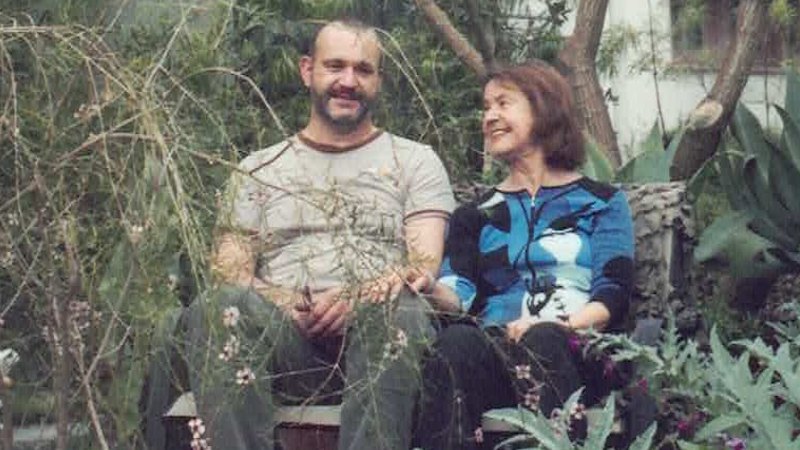
In 2002, he bought a 1930s Spanish Mission-style home in West Hollywood, where he created an extraordinary garden with the help of Elizabeth Taylor’s gardener, Nicholas Walker. That garden became his living laboratory, where a single dahlia inspired a series of photographic works exploring visual manipulation.
Raymond said her son was a voracious reader and a lifelong learner whose interests spanned art, science, history, religion and philosophy. He was known for his extraordinary kindness, impeccable manners and gentlemanly grace. He treated everyone, from colleagues to strangers, with generosity, curiosity and respect, she said.
“He came back to live here in 2014, and another part of his life started when Tim Olsen offered him an exhibition of his digital photographic art not long after that. The pleasure he gained from producing thousands of images, right up until he died, and from writing, gave him purpose, despite serious physical health problems,” Raymond said.
He relished travel, conversation and the quiet joy of a good library – especially in Thirroul, NSW where his mother lives. Packer was always working on new creative projects: treatments for operas, television, films and books. Those lucky enough to receive one of his excited phone calls about a new idea will forever remember his boundless curiosity and enthusiasm, friends said.
Composer and former Melbourne Festival director Sir Jonathan Mills said their friendship rested on shared interests in visual art, literature and music, and on Packer’s warmth, wit and quiet loyalty.
“Witty, insightful and endlessly curious. He had that rare ability to make the complex comprehensible and the ordinary extraordinary.”
Deborah Thomas
“Francis was never entirely at ease with the world into which he was born. At heart, he was a bohemian – drawn instead to more reflective, artistic and intellectually searching modes of life,” he said. “Conversations with him were genuinely beguiling. He had a gift for spinning speculative ideas – sometimes satirical, often operatic in scale – drawing on a wide range of cultural references and always animated by his distinctive wit.
“In one of his most recent communications, he outlined the beginnings of an operatic treatment of the Jonestown tragedy, an audacious conception centred on the rise and catastrophic unravelling of Jim Jones (1931-78) and the Peoples Temple in Guyana in 1978. It was, quite simply, an idea of real artistic consequence – unexpected, searching and entirely characteristic of him.
“He could be acutely perceptive – alive to nuance, to language, to the emotional tenor of a room – yet that same sensitivity could make the world a more complicated and, at times, a more taxing place for him to inhabit.”
Former editor of The Australian Women’s Weekly Deborah Thomas said Packer was one of the “most interesting and original minds I’ve ever known”.
“His aesthetic and visual sensibilities were of the highest standard and Francis’s large-scale photographs, particularly his close-ups of exotic flowers at night, are truly sublime,” she said.
“Witty, insightful and endlessly curious. He had that rare ability to make the complex comprehensible and the ordinary extraordinary.”
A private family celebration was held last week for Packer, who is survived by Angela Raymond. His father Clyde died in 2001.
The Morning Edition newsletter is our guide to the day’s most important and interesting stories, analysis and insights. Sign up here.
From our partners
Read the full article here