



Underused land including the space under the rail line at South Brisbane would be transformed with skate parks, climbing walls, public art and pickleball courts, under a Brisbane City Council vision for the Olympics legacy unveiled on Thursday.
Up to 50,000 additional homes around Games venues would also be delivered, as would river taxi services, a web of shaded pathways across the city, 24-hour precincts, improved ferries, a Metro expansion and upgraded parks.
The council document titled “Brisbane Beyond the Games” outlined how the city could secure the best long-term gain from hosting the world’s biggest sports event.
It listed more than a dozen significant infrastructure and transport projects the council hoped to deliver before athletes would arrive.
“It’s actually not about the opening ceremony,” Lord Mayor Adrian Schrinner told several hundred industry leaders during a lunch at The Star on Thursday.
“It’s about what people think … 10 years after the games.
“This community will all come together, and we will look back, and we will make a decision on that date whether this has been a good thing for Brisbane.”
Dr Tony Matthews, an urban planner at Griffith University, said the Olympic committee had to focus first and foremost on delivering the basics.
“I don’t want to be all down on the Olympics, but there’s an enormous task ahead of us, and I don’t think we’ve taken the advantage that we could have from the time we had,” he said.
“I’m just a little wary of trying to get so much done in a relatively narrow time window at this stage. We can promise a lot and aspire to a lot, but delivering a lot is a different situation.”
Queensland University of Technology urban planner Dr Mark Limb said the document was light on detail, but the single most important thing Brisbane City Council could focus on to benefit residents in the long term was expansion of rail and metro services.
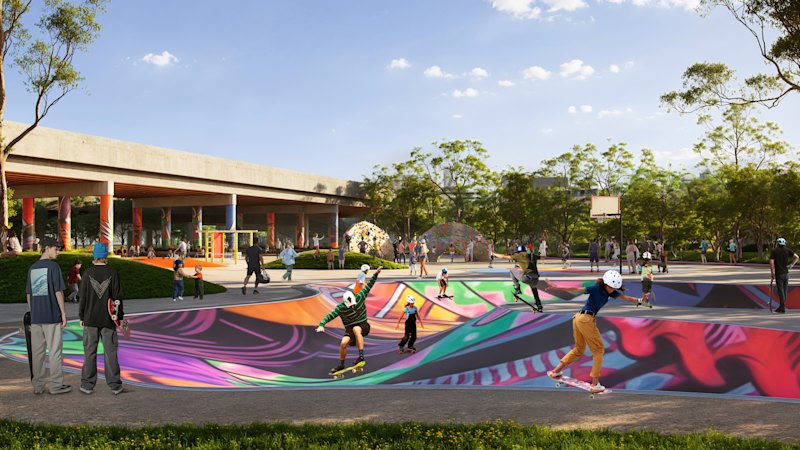
A proposal called the “Low Line” – a twist on New York’s High Line, which runs along the top of an abandoned railway bridge – was included in the document.
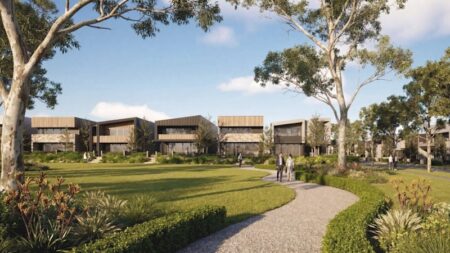
Artist impressions showed a revitalised space underneath South Brisbane’s raised rail line, with a skate park, playground, rock climbing wall, outdoor gym equipment, basketball court, and street murals.
Brisbane City Council said the proposal, which came from Aria Property Group and Urbis, could also feature pickleball courts, dog parks and public gardens.
“We will use the games as a catalyst to transform leftover land around major infrastructure into vibrant urban sports parks and community spaces,” the document said.
The ferry network would also be upgraded, according to the document, and pontoons across the river could be opened to private operators to allow introduction of water taxis.
Limb questioned how functional this would be in a city with a narrow, winding river.
“I think if there was a true market for a water taxi, you’d probably have them already … it’s not really a useful mass transit option.”
The document said infrastructure investment in areas such as Fortitude Valley, Kurilpa, Milton, Newstead and Woolloongabba could lead to about 50,000 new homes being built in those areas.
Limb added that private investment tended to lag well behind zoning changes, and extensive development may take longer than six years.
A web of shaded pathways, known as the Green and Gold Grid, is also planned across the city.
New connections between the CBD and Suncorp Stadium were planned before the start of the 2027 Rugby World Cup, while shade cloths for the Victoria Bridge could be installed within weeks. Multiple other routes are planned.
“This will lead to a lasting legacy of walkability, urban greening, thriving precincts and healthier, more connected communities,” the document says.
Schrinner told the lunch his absolute priority was expansion of the Metro into the suburbs. He has previously said this could not be done without funding from the federal government.
“I think if you’re looking for real long-lasting impact, it’s aspects related to mass transit that’s going to help us,” Limb said.
Matthews added one of the best legacies Brisbane City Council could achieve through the games would be expansion of green spaces.
“I would say placemaking and urban greenery … should be the key guiding principles of the legacy,” he said.
“We have a relatively low volume of green space available … and we’re going to be sacrificing a fair bit of it for the stadium.
“There’s just endless amounts of well-founded research out there showing that the higher volume of urban green space you have in a city … the better all sorts of things for the residents.”
The document also references plans to capitalise on Brisbane’s “dawn economy”, as well as the possibility of 24-hour precincts, a Global Food Hall, and Pride House for LGBTIQ+ athletes and fans.
The Labor opposition on Brisbane City Council highlighted the fact proposed new housing did not include affordability mandates.
“[Schrinner] reheated old announcements to pretend he’s achieving something new exactly six years out,” leader Jared Cassidy said.
“Basic services and infrastructure are falling to the wayside … more missed bins, shocking roads, crippling congestion and a homelessness crisis are what this Lord Mayor will be remembered for.
“Brisbane needs a champion for 2032. Adrian Schrinner is not it.”
Start the day with a summary of the day’s most important and interesting stories, analysis and insights. Sign up for our Morning Edition newsletter.
From our partners
Read the full article here