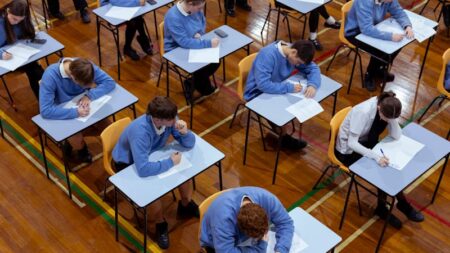







Religion, science and maths are the most common VCE subjects for students to drop as they move from year 11 to 12, new data shows, but fewer Victorian students are abandoning harder mathematics for an easier stream.
Students who did a unit 2 VCE subject, typically undertaken in year 11, did not continue through to unit 4 on 47,040 occasions from 2025 to 2026, according to figures from the Victorian Curriculum and Assessment Authority (VCAA).
While it is common for students to take six subjects in year 11 and five in year 12 – and drop a subject as they move between year levels – these choices reveal insights into their strengths, interests and career preferences.
Students dropped VCE religion and society at the highest rate. By unit 4, 9216 fewer students were enrolled, an 87 per cent decline compared with unit 2. Many religious schools require students to take religion.
A spokesperson for Melbourne Archdiocese Catholic Schools said that in year 12 students often did this through alternative pathways, including school-based programs that did not contribute to VCE.
“This reflects the choices students commonly make across a range of VCE studies as they focus their academic efforts on other subjects that may be more directly aligned to their future career or educational pathway, such as meeting prerequisites for university courses,” the spokesperson said.
Of greater concern to educators and industry groups is a stubborn trend of students not continuing to unit 4 in science and maths subjects, including biology (2888 fewer students), chemistry (2784 fewer) and maths methods (2762 fewer), despite a push to boost the national pipeline of graduates in STEM fields.
However, there are early signs of this trend turning around in maths methods, which includes more abstract problem-solving and is the fourth most commonly dropped subject in VCE.
In 2021, 18 per cent of students doing maths methods dropped the subject in year 12 for general maths, which is generally more accessible. Last year, this had reduced to 13.9 per cent. Overall methods enrolments in year 11 have grown over the same period.
“Victorian students are increasingly choosing to stick with higher-level maths, with the proportion moving from mathematical methods to general mathematics falling every year for the past five years,” a VCAA spokesperson said.
Sion Binoy, 17, was among the students who dropped maths methods to pursue general maths in year 12 this year at Viewbank College in Melbourne’s north-east.
He said methods had taken up so much time that it detracted from his other subjects.
“Most people do pretty well as long as they do the work in class,” he said of general maths. “It’s not quite as big of a time commitment as some of the other math subjects.”
Still, Binoy said he enjoyed maths – finding it was more objective than other subjects – and general maths felt more practical.
“If you didn’t get the mark, it’s not because of the teacher’s preference or anything like that, it’s just because you got it wrong,” he said.
“And there’s a simple path to getting better; it’s just doing more questions.”
Bernadette Foley, Engineers Australia professional standards group executive, said there was a worrying national trend of too many young people opting out of maths altogether.
“Around one in three students now complete senior secondary school without studying any maths. That closes doors before many students have had the chance to discover where those pathways could lead,” Foley said.
She said increasing prerequisite requirements for university courses was not necessarily the answer. A better solution, she suggests, is changing the perception of STEM being “hard subjects” to instead focus on the opportunities for real-world improvements they bring in fields such as healthcare, the environment and technology.
“Many students are far more capable than they realise. The challenge is building confidence, particularly among students who are creative, curious and want to make a difference, and helping them see that STEM is a pathway to achieving exactly that,” Foley said.
A Department of Education spokesperson said VCE was intended to be flexible for students to build the learning program that best suited them.
“The only compulsory component is a study from the field of English,” the spokesperson said.
Start the day with a summary of the day’s most important and interesting stories, analysis and insights. Sign up for our Morning Edition newsletter.


From our partners
Read the full article here