




A Sydney scientist has unearthed critical evidence about the oldest-known complex life forms in the universe, parsed from slabs of Australian mudstone which preserved the bodies of organisms that dwelled in a primordial sea.
The microscopic 1.7-billion-year-old creatures are among our oldest ancestors; pioneers which gave rise to all multicellular life from toadstools to velociraptors, humans, bugs, trees and toucans.
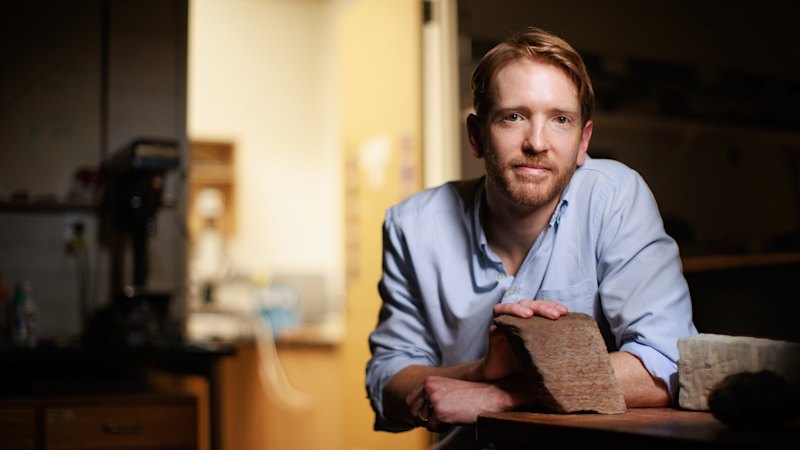
Geobiologist Dr Max Lechte has tried to pinpoint where and why cells became complex, leading to life as we know it. It’s an ancient mystery that could help alien-hunting astrobiologists decide which planets to train their telescopes on.
Life on Earth was dominated for almost four billion years by mats of primitive bacteria.
“Why didn’t life just stay simple?” Lechte said. “Why did we eventually evolve into more complex forms and eventually into animals and intelligent life, including us?”
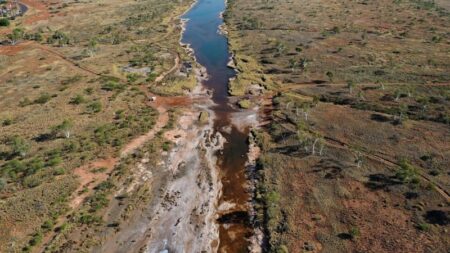
Lechte, from the University of Sydney, investigated ancient rocks from the McArthur and Birrindudu basins of the Northern Territory to answer those questions in a new Nature paper.
‘Why didn’t life just stay simple? Why did we eventually evolve into more complex forms and eventually into animals and intelligent life, including us?’
Geobiologist Dr Max Lechte
The landscape of rocky canyons and red soil was once an inland sea. Microscopic organisms lived in the waters, died, and were entombed within the muds of the seafloor, which hardened into rock.
By dissolving chunks of this rock in an acid that preserves organic material, Lechte’s co-author Leigh Anne Riedman from the University of California uncovered 12,000 fossil microbes.
Some were primitive spheres, but others were more elaborate, with jutting appendages and plates, or had creased surfaces like the whorl of fingerprints. These were the ancient “eukaryotes”, the earliest versions of a new and more complex type of life that would lead to all plants, animals and fungi.
“These are our oldest microbial ancestors that we can look at,” Lechte said.
Lechte analysed the rocks’ chemistry. He was looking for iron, which reacts readily with oxygen – think of an exposed nail rusting with air – and reveals details about ancient oxygen levels.
The team discovered eukaryotes only thrived in shallow, oxygenated coastal waters. In deeper waters, where oxygen hadn’t reached, they found only simple single-celled bacteria.
Back then, well before the rise of plants, cyanobacteria were the only lifeforms pumping out oxygen. Oxygen levels hovered at 1 per cent of current levels, and the gas dissolved only into the shallowest surfaces of the sea.
Lechte’s results show our early ancestors were restricted to those limited oxygenated pockets for about a billion years until higher levels of the gas liberated them into new habitats, resulting in the appearance of algae, fungi, sea sponges and jellyfish.
Oxygen supercharges the breakdown of organic carbon into energy, like a pair of bellows blasting coals into a roaring fire. But it can also be toxic, damaging cells through oxidation.
Harnessing oxygen was an evolutionary tradeoff between capitalising on a powerful new fuel and learning to repair from oxidative damage: a job for a complex organism.
Lechte argues the ancient creatures dwelling in oxygen-rich habitats must have gained mitochondria, the “powerhouse” structure which turns oxygen into energy in all eukaryotic cells, including ours.
“That’s important because that sets kind of a minimum date on when the mitochondria were acquired,” Lechte says. “We know that it must have been before 1.7 billion years ago.”
The finding supports the idea that the rise of mitochondria was the crucial turning point from a planet populated by slimy microbial mats to the extraordinary biodiversity we see today.
Recent research into the origin of mitochondria focused on the possible role of Asgard archaea – a microbe named for the gods’ heavenly fortress in Norse mythology – living alongside the ancient stromatolites of Western Australia.
The stromatolites are the most ancient form of bacterial life, 3.5-billion-year-old rocky structures built by cyanobacteria. Scientists revealed last month that an Asgard microbe from the Shark Bay stromatolites interacted with a bacterium through tube-like structures known as nanotubes.
A long-held biological theory holds that this kind of interaction may have led to the formation of mitochondria, if one microbe engulfed the other. The partnership between Asgard archaea and bacteria may mark a missing link between single-celled life and the type of mitochondria-hosting organisms found in the Northern Territory rocks.
Brendan Burns, an associate professor at the University of NSW and part of the stromatolite research team, said the new Nature paper was intriguing, but noted fossils offer limited information about an organism’s metabolic lifestyle.
“It can be difficult to say from this study whether early eukaryotes required oxygen, or just tolerated oxygen,” he said. The organisms may have just learned to withstand toxic oxygen rather than harness it.
Lechte said knowing how life formed in deep time, when the Earth was an extreme and alien place, aids the search for extraterrestrial life.
“It’s really important to first understand how life got here, on our planet, before we can speculate about what conditions are good for life on other planets.”
The Examine newsletter explains and analyses science with a rigorous focus on the evidence. Sign up to get it each week.
 Angus Dalton is the science reporter for The Sydney Morning Herald.Connect via X or email.
From our partners
Read the full article here