




It’s not just eyes on a fire — it’s now ears, too.
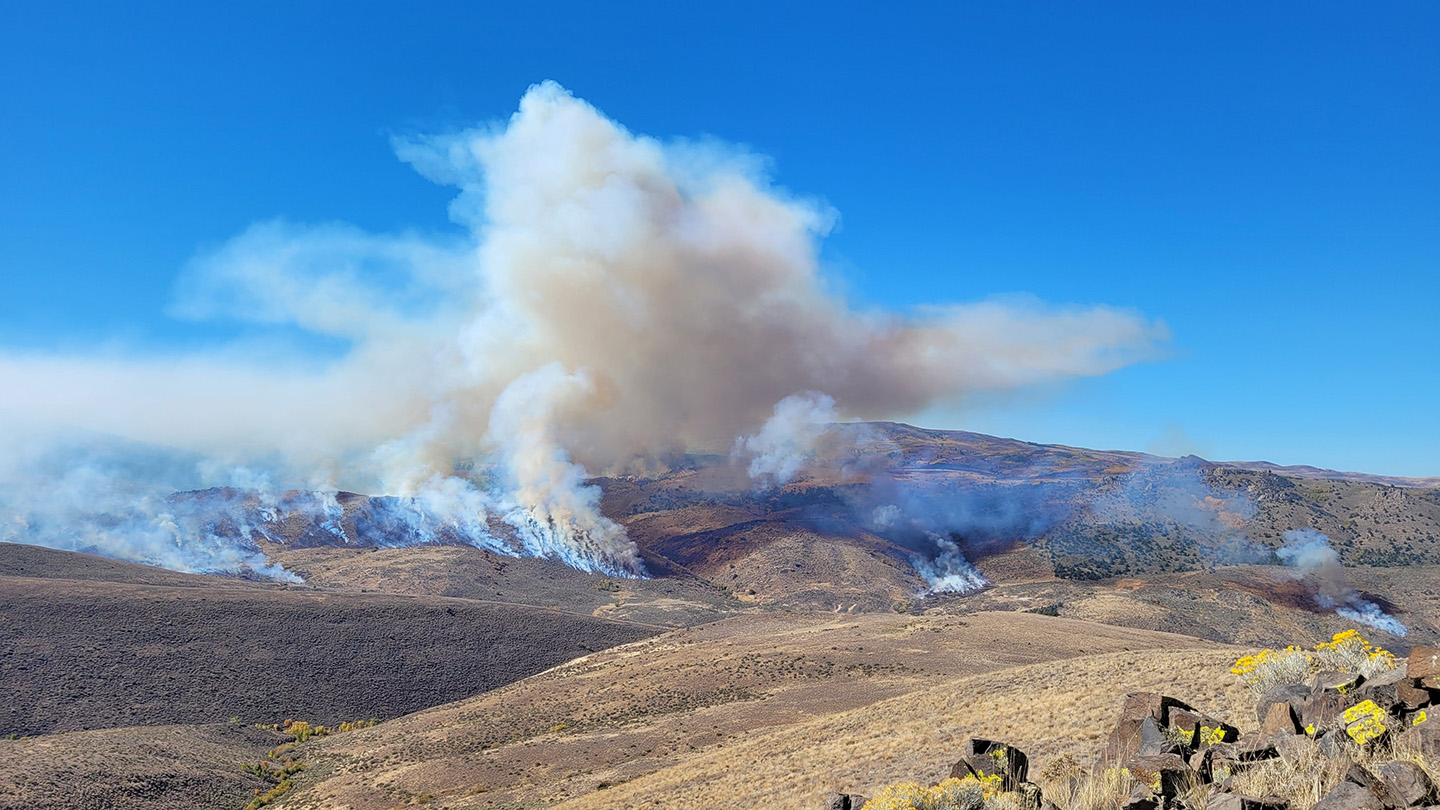
A low-intensity grassland fire “hums” loudly enough to be monitored by sound alone, researchers report in the July 16 Geophysical Research Letters. Acoustic sensors deployed near a prescribed Idaho burn picked up the low-frequency rumble it gave off and followed where it was burning — a sign the technique can detect relatively weak fires.
Similar acoustic monitoring has picked up a fire before — another team reported detecting a prescribed forest fire in 2025. But that fire burned hotter. The Idaho burn was in a damp landscape and therefore was low intensity. “That’s encouraging for the broader use” of the technique, says Jake Anderson, a geophysicist at Boise State University in Idaho.
In the past, wildfires tended to be spotted by people perched atop lookout stations. Today, satellites and airborne platforms track most fires. But even the newer technology comes with limitations: Smoke and flames — the traditional harbingers of a fire — can be obscured by clouds and trees. “A lot of those things require direct line of sight,” says Cody Evers, an environmental scientist at Portland State University in Oregon who was not involved in the research.
Turning to sound waves, specifically those at frequencies below the range of human hearing, is an alternative. Fires emit pressure waves with frequencies ranging from 1 to 20 hertz as they continuously release plumes of hot gas and draw in cold air in a process called puffing. (Human ears are sensitive to frequencies between roughly 20 and 20,000 hertz.) “Infrasound can give you very fast alerts about how a fire is changing,” Anderson says. “And it can do so in poor-visibility conditions.”
In 2023, Anderson and his colleagues placed more than 90 infrasound sensors across a swath of southwestern Idaho scheduled for a prescribed fire. The team designed and built the instruments, each less than a kilogram and roughly the size of a paperback book, and distributed them across eight arrays containing anywhere from three to 44 sensors.
With arrays of sensors, it’s possible to estimate where a sound is coming from, says Madeline Hunt, a geophysicist at Boise State University. The technique should be familiar, she says: “With two ears, you can get a better idea of the direction to something, more than if you were just listening with one ear.”
Anderson, Hunt and their colleagues found that the largest array, located nearly two kilometers from the fire, accurately tracked the fire’s spread over the course of several hours. The infrasound tended to arrive from the same direction as the helicopter responsible for igniting the fire. Crucially though, the infrasound signal persisted even when the helicopter left for refueling, evidence that the sound was due to the fire itself, the team concludes.
The next step will be to study a wildfire. But that’s more logistically difficult, Anderson says, since researchers may not be able to safely access affected terrain. “In the long run, an ideal solution would be to have a technology that’s installable by firefighters themselves.”
Evers says that wind might prove to be a limiting factor. Larger fires are often associated with high winds, and wind produces copious amounts of infrasound. “If there’s a lot of wind around,” he says, “it could create all sorts of problems.”
Infrasound might do more than track a fire — it may also help fight one. Sonic Fire Tech, a company based in Cleveland, is marketing fire-suppression systems based on infrasound. Earlier this year, Sonic Fire Tech demonstrated how a small indoor cooking fire could be extinguished using its technology. There’s no mess from overhead sprinklers, and the sound waves don’t pose a danger to humans or pets, the company notes.
However, it’s highly unlikely that such technology would translate to prescribed fires or wildfires in nature, Anderson says. That’s because sound waves spread spherically and dramatically lose power if they’re not confined. “I would be surprised if anytime soon we see a long-range, outdoor infrasound tool for extinguishing fires.”
Read the full article here