




There’s no such thing as Thing, the disembodied hand that loyally skitters around the fictional Addams Family in the popular television series Wednesday. But at least one species of sea cucumber appears to have evolved something surprisingly close.
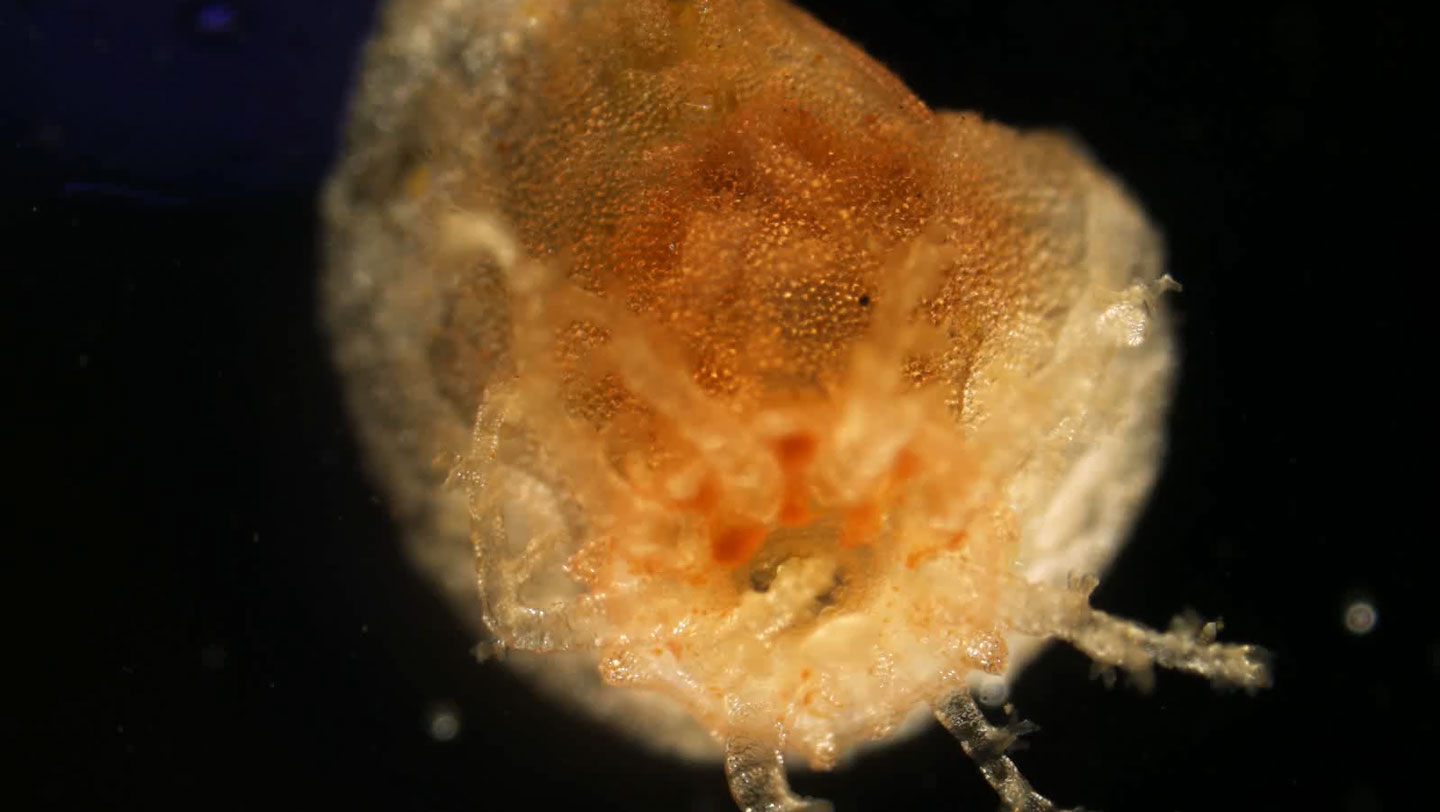
Detached tissues from appendages of a scarlet sea cucumber (Psolus fabricii) survived for more than three years in flowing seawater without special nutrients or antibiotics, researchers report May 29 in Science Advances. The discovery may force scientists to rethink what it means for tissue to be alive.
“It’s an amazing finding,” but not entirely surprising given the sea cucumber’s remarkable capabilities, says José García Arrarás, a regenerative biologist at the University of Puerto Rico in San Juan. Some species can be cut in half, with each half regenerating completely. “But [the work] raises fascinating questions,” says García Arrarás, who was not involved with the research. “What kind of cells are they? How do they feed? Can these tissues outlive the animal itself?”
Sausage-shaped sea cucumbers are marine invertebrates that typically range in length from a few centimeters to over 30 centimeters, depending on the species. They live on seafloors from shallow coastal waters to the deep ocean and are close relatives of sea stars.
Scientists who study sea cucumbers in the lab typically keep them in tanks filled with fresh seawater, says marine ecologist Annie Mercier. During one routine transfer of a scarlet sea cucumber between tanks, one of Mercier’s colleagues noticed that the animal had left behind a few podia, small tubelike appendages it uses for movement, on the bottom of the tank. That’s something that often happens in nature, too. “We would have expected those to decay and waste away quite rapidly, but several days later they were still there,” says Mercier, of Memorial University of Newfoundland in St. John’s, Canada.
Surprised, Mercier and colleagues investigated what would happen to other tissues they cut off using a scalpel, including tentacles and body wall. While the body wall tissues died within weeks, the tube feet and tentacles survived for more than three years.
Using a typical compound microscope, the researchers observed that the tissue went through cleaning of the wound where it was cut, clearing out old dead cells and division of living cells. When researchers added amino acids labeled with a trackable atomic tag to seawater, they could see that the tissue absorbed the nutrients. The tissue didn’t decay even after getting buried in a couple of centimeters of mud.
“We started calling it our ‘zombie project,’” Mercier says. “It’s a piece of tissue that isn’t decaying. It’s still acquiring nutrients, reshaping itself, evolving and doing all sorts of living things, yet it’s not necessarily a living organism in the traditional sense.”
The work can offer new ways to study changes that occur during aging, García Arrarás says. “They have tissues that are a week old and others three years old, coming from the same original tissue,” he says. However, a key next step should be detailing characteristics of the cells within the tissues. “You need to know exactly what you have” before you can understand what’s going on, he says.
Read the full article here