



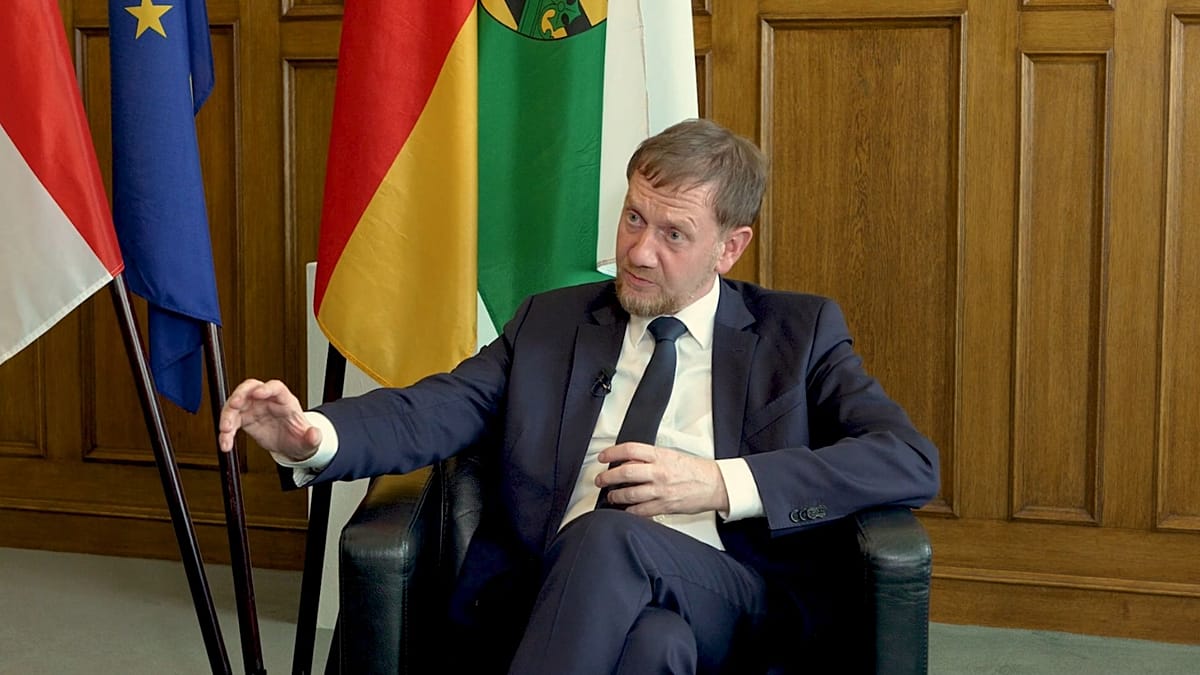
For the Minister-President of Saxony, Michael Kretschmer, resuming gas supplies from Russia is not fundamentally out of the question.
“Once there is peace, we can, should, and must talk about such matters,” Kretschmer told Euronews.
“One can only hope that this peace deal or this ceasefire (…), comes as quickly as possible, because every day an incredible number of people are dying there on both sides of the front,” he added.
The leading CDU politicians spoke to Euronews during an interview at the official state representation of the Free State of Saxony in Berlin. The conversation touched, among other things, on energy supplies from Russia, the economic sanctions against Moscow and the roughly one million Ukrainian refugees in Germany.
Kretschmer has repeatedly advocated for negotiations with Russia, arguing that the conflict cannot be resolved through military means alone, but only through diplomacy.
The CDU politician has previously expressed scepticism about supplying Ukraine with German-made Taurus long-range cruise missiles.
“In my view, Germany must not become a party to the war, and from my perspective it has already gone far too far,” he said.
Kretschmer criticised the way opponents of military support for Ukraine were often portrayed as having dubious motives, accusations which he called “morally completely over the top and, in my view, also unacceptable”.
“I very much believe that we need to forge alliances diplomatically,” the politician added. This cannot be done without China, India and other countries.
Kretschmer adopts a nuanced stance on economic sanctions as a political tool: “The attack on a sovereign state cannot be allowed to go unpunished. If that sets a precedent, we are finished,” he said.
Sanctions must not endanger Germany’s economy
“That is why I have always said, in terms of international law and also quite clearly as our own position, not a single square metre of Ukraine, not even Crimea, has become Russian. And in that respect, a response with a smart selection of sanctions is of course the right thing to do”.
But the emphasis, he said, is on the word “smart”. These measures must not be designed in such a way “that they primarily hit us, that they jeapordise our economic strength,” Kretschmer said.
Europe’s defence capabilities, including systems such as a missile defence shield, must remain financially obtainable, he argued, which requires a strong economy.
The Saxon state premier argued that the end does not justify the means. Instead, he said, the goal must be to act rationally in order to compel an aggressor to come to the negotiating table.
“For that, you first need a willingness to negotiate, and secondly you have to consider which measures hit us particularly hard and may, in case of doubt, also put our legitimate interests at risk, for example the country’s economic strength,” Kretschmer emphasised.
Kretschmer calls citizens’ allowance for Ukrainians ‘a big mistake’
Kretschmer has also repeatedly criticised the federal government’s decision to grant Ukrainian refugees access to Germany’s citizens’ allowance. Speaking to Euronews, he argued that this policy discouraged Ukrainian refugees from seeking employment.
“In France, Poland, the Czech Republic and the Netherlands, the employment rate quickly reached 70% or 80%, while we were still at 20% or 30%,” he said, adding that this disparity did not come down to Ukrainian refugees themselves but instead, should be attributed to welfare policy.
“That is the citizens’ allowance, that is a big mistake,” he added.
Kretschmer, however, sees the EU’s Temporary Protection Directive as far more important for providing swift and unbureaucratic assistance when large numbers of refugees arrive.
This provides temporary protection without lengthy asylum procedures and was activated in 2022 for refugees from Ukraine, giving them rights of residence, work and social benefits in the EU.
“In my perspective, the crucial point is that the EU’s Temporary Protection Directive is expiring next year, and will likely, as I am hearing, not be extended for another year,” Kretschmer told Euronews.
Kretschmer believes this instrument has to come to an end “because we can see that there are large parts of Ukraine where people can live well and safely,” and that Ukraine “needs support in order to be rebuilt”.
“We can see how our capacity to provide support here is limited. And that applies to Germany, but it also applies to many other countries”.
For that reason, the Saxon Minister-President—together with his counterparts from Bavaria, Mecklenburg-Western Pomerania and Saarland—pushed during coalition negotiations for municipalities to receive €100 billion from the so-called special fund.
“For us minister-presidents, it was clear at the time that we cannot provide funding for armaments or even equipment for Ukraine while hospitals, schools, nurseries, sports facilities, fire brigades and similar infrastructure in the municipalities are being left behind,” Kretschmer said.
“That is why we said we would agree to this on the condition that municipalities and states were supported on that scale. From my point of view, that was absolutely the right decision”.
It is the federal government’s responsibility to safeguard the ability of democracy to function at the local level. Many financial gaps result from federal legislation that is not sufficiently funded.
Read the full article here