





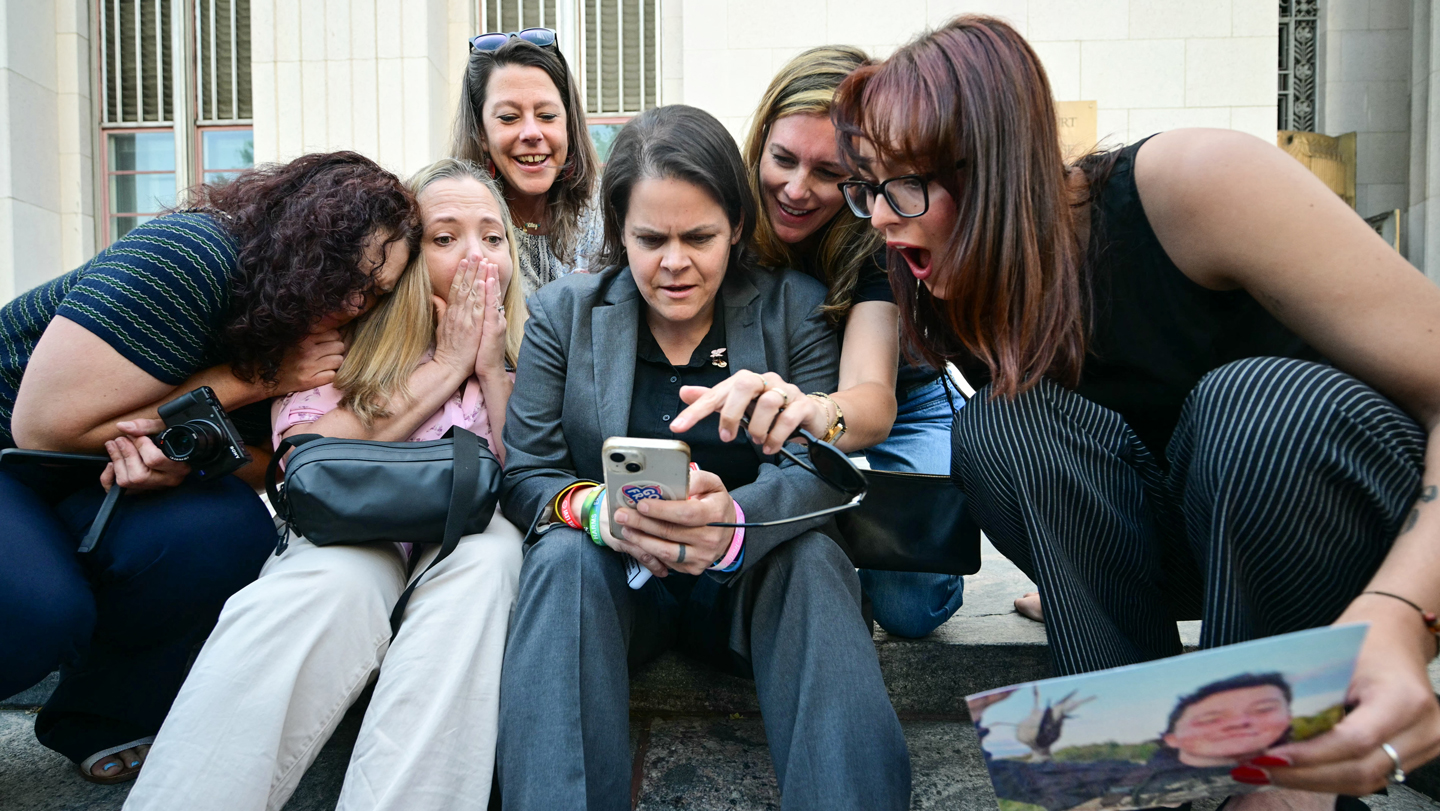
Social media is designed to be addictive, jurors in a landmark trial against two of the largest social media companies have found.
Research in recent years has increasingly suggested a causal link between teen social media use and psychological harm. But this is the first time that link has been upheld in court.
On March 25, jurors in a California state civil trial found Meta and Google liable for designing social media apps that can hook young users. The case centered around a 20-year-old woman identified as Kaley, or KGM. KGM’s lawyers argued that she began using social media platforms, including YouTube, owned by Google, and Instagram, owned by Meta, during elementary school, eventually spending up to 16 hours a day on Instagram alone. The lawsuit alleged that KGM’s self-worth became tied up with likes and follower counts. That social media addiction, in turn, caused numerous mental health problems, including depression, anxiety, body dysmorphia and suicidal thoughts.
The legal battle focused on the design of the social media platforms and not the content of posts. The plaintiff’s lawyers argued that tech companies knowingly engineered their products for addiction by building in features that keep people, particularly vulnerable children and teens, coming back for more. Those features include the ability to scroll endlessly, or infinite scroll, algorithms that deliver curated content, short video clips and push notifications.
The tech companies countered that scientists have not established a causal link between social media use and psychological harm and that KGM’s tumultuous childhood, not her social media use, caused her mental health problems. Lawyers for YouTube also argued that the online video sharing platform was not a social media company.
Both companies said they are exploring legal options, including appealing the decision. But this verdict is expected to set a precedent for other similar cases in the works.
We are in the midst of a youth mental health crisis, says pediatrician Jason Nagata of the University of California, San Francisco. And social media design, while not the sole cause of teens’ poor health, is a problem that can be fixed. “I think [the verdict] is a step in the right direction,” he says.
Science News spoke with Nagata to understand the societal implications of this verdict. His research with over 8,000 children ages 11 and 12 found that those preteens showing signs of social media addiction, including obsessively thinking about social media and difficulty logging off, struggled with more mental health problems a year later than children without those signs. The findings appear in the April 2026 American Journal of Preventive Medicine.
This interview has been edited for length and clarity.
SN: What makes these platforms’ design features so alluring to young users?
Nagata: We know that teenagers are going through lots of brain changes, body changes, puberty [and] growth. They are constantly comparing themselves to other teenagers. Social media exacerbates all of these comparisons in ways that are really unrealistic. Like some of the influencers on social media, their content is heavily edited and filtered such that teenagers are not comparing themselves to other teenagers. They’re comparing themselves to highly filtered, edited, curated versions of the best versions of other teenagers who maybe are also getting ad money.
There’s also evidence that even though teenagers may not be looking for, say, body image content, they [still] get it through their feeds, perhaps based on their age or powerful algorithms that keep feeding very similar content.
SN: Jurors had to decide if design features cause addiction. Why has this question of causation been so hard to answer?
Nagata: Our research, the Adolescent Brain Cognitive Development Study, also known as the ABCD study, is one of the largest long-term studies of adolescent health in the United States. It contains a six-item questionnaire called the Social Media Addiction Questionnaire. Each of the questions mirrors an element of addiction that one would see with substance use, so the questions are about conflict, relapse, tolerance or withdrawal.
In our study, we looked at 11- to 12-year-olds. The minimum age for these platforms is 13. In our national study, two-thirds of 11- to 12-year-olds had underage accounts. We found that underage users who had higher symptoms of social media addiction had higher depression, ADHD [attention-deficit/hyperactivity disorder], oppositional defiant and conduct problems one year later. They also had poorer sleep.
Even though the ABCD study is a very robust, large national study, we’re not able to definitively prove causality. The gold standard for proving causality is to design an intervention in which you have a control group and an intervention group. But I think designing a study like that in this case would be unethical and unfeasible. So we are limited to observational data.
SN: Does that mean the jury overreached in finding tech companies guilty?
Nagata: The jury was presented with evidence for specific individuals who may have been harmed by addictive features of social media platforms such as infinite scrolling, algorithms and constant notifications.
Our data reflects trends at the population level.
I do think that this is one of these situations where we may never have the perfect randomized controlled trial to really get to this [issue of causality]. But two-thirds of 11- and 12-year-olds and over 90 percent of teenagers are on [these platforms]. I think that from a public health perspective, it’s OK to start testing some of these policies and then rigorously evaluating them with science, but not waiting, not letting perfect be the enemy of the good.
At what point do we start having some of these policies or interventions even in the absence of perfect data?
SN: Meta and YouTube argued that KGM’s troubled childhood, not her social media use, caused her mental health problems. Can upbringing and addiction be disentangled?
Nagata: Addiction likely has genetic, biologic and environmental factors. You can’t really control your genetics. But I do think that social media and some of these environmental factors are modifiable. And to the extent that we can address those modifiable factors, either by making the algorithms less addictive or reducing exposure to addictive elements … it can reduce addiction for some users. With so many underage users and teenagers on [these platforms], those changes can have really widespread population impacts.
SN: What would help researchers identify the elements of social media that are so damaging to children?
Nagata: One thing that would be very helpful for the research community is to actually see the granular data from tech companies. Right now, the detail of data available to most scientists is pretty limited. To more robustly understand directionality and causality, having more access to real-time data, real-world content and real-world interactions for individual users would be incredibly helpful to better understand some of these potential causal relationships. For instance, we could know if a user is messaging friends with certain feelings or thoughts right after they’ve been exposed to certain content or certain types of platform design features.
Read the full article here