






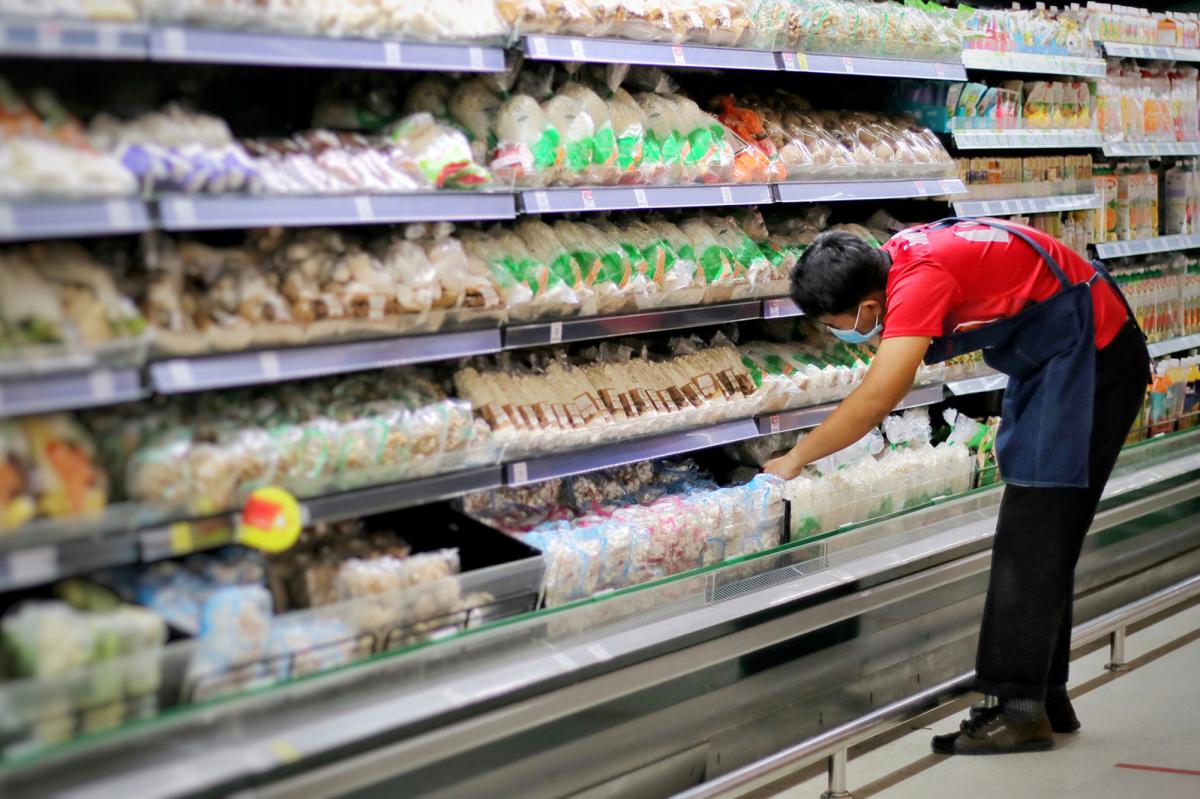
Since the post-war years and the exodus to the suburbs, the supermarket has become a beloved and necessary staple of American life, offering up fresh food, convenience and cheery customer service.
But all is not well amidst the fluorescent lights, produce misters and Muzak, Ann Larson writes in her new book, “Cleanup on Aisle Five, Essential Work, Poverty Wages and the View from Behind the Supermarket Register” (Atria/One Signal Publishers, June 9).
In October 2020, Larson went to work as a supervisor and cashier at a grocery store in Utah and witnessed fellow employees struggling to afford food because of their poor wages — some of the lowest in the retail industry — suffering from the pain of the job’s physicality and even wearing diapers because breaks were so limited.
“It was only as a grocery insider that I had been able to see what grocery work actually entailed and what it does to people,” Larson writes in her riveting, cash-register-eye view.
Her co-workers toiled so that customers could have fresh food, but they could barely afford to feed themselves. Clerks received no overtime pay or retirement benefits, and there was no union. Her colleagues had to choose between buying food and paying for health insurance, rent and gas. Several suffered from dental problems but couldn’t afford treatment.
“During the year that I was on the job, grocery staffers around the country earned under $15 an hour on the average,” writes Larson, whose hourly wage was $15.80 as a supervisor.
One of her co-workers, Stanley, had his credit card denied when he tried to buy a burrito for lunch.
Paula, Larson’s boss and a manager, bought three-day old meat with an expired sell-by date to sustain herself.
Cindy, 79 and a grocery-bagger for nearly a decade, could only afford a small cup of soup or a two-dollar children’s meal for lunch.
Willow, a cashier, had a severe case of eczema around her nose, her knuckles and fingers with skin flaking off onto the register as she rang up customers. She didn’t have enough money to treat the condition.
Working at the supermarket didn’t just pay poorly, it also took a toll on the body. Cashiers routinely suffered painful musculoskeletal injuries from the continual movement of passing items over the scanner.
One checker, Darth, turned his light off when there was a lull in customers. He’d worked behind the till six years and often had a severe stabbing pain in his arm, a musculoskeletal injury common to cashiers.
Larson believes that the federal Occupational Safety and Health Administration (OSHA) needs to step in and protect retail employees from injuries but thinks that the organization has become toothless in recent years.
Employees have little choice but to fall in line, quit or leave. Their every minute is tracked, and they’re always under surveillance — scanners, camera and time-keeping machines that won’t let employees sign in if more than 15 minutes late.
Bathroom breaks were only allowed on scheduled breaks. One co-worker, Travis, peed his pants when he didn’t make it until break time. Several colleagues resorted to wearing diapers in case they couldn’t hold it.
“I’ve been wearing a diaper since Paula said no more bathroom breaks,” Stanley confesses in the book. “I prefer not to have to pee in my pants. But sometimes it’s unavoidable.”
Working the store’s front end as a supervisor, Larson suffered from chronically aching arms and shoulders twenty-four hours a day and writes that “the supermarket was turning me into a judgy, ill-tempered person.”
Larson also notes that while supermarkets project an elaborate illusion to shoppers that they have multiple choices of brands and varieties, in reality it’s usually one of just a few parent companies that produce most of the products on the shelves — sometimes with dubious methods.
“While the supermarket may seem like capitalism’s greatest achievement employing more people than any other industry, so many products in stores are linked to low wages, injury, environmental destruction,” she writes.
Ultimately, she argues for a union-led federal commission directing an overhaul of supermarket architecture, reducing injuries along with providing quality health care and retirement benefits to workers, as well as mandated overtime pay.
Notably, a cost-cutting attempt by the owners of the grocery store Larson worked at to save money with self-checkout stations failed spectacularly. Customers couldn’t successfully work the technology, requiring a supervisor’s help or leaving frustrated shoppers to walk out without paying. Other markets have had similar experiences with self-checkout, demonstrating the need to value and fairly compensate grocery employees.
Larson quotes Martin Luther King Jr. writing, “All labor has dignity.”
Read the full article here