





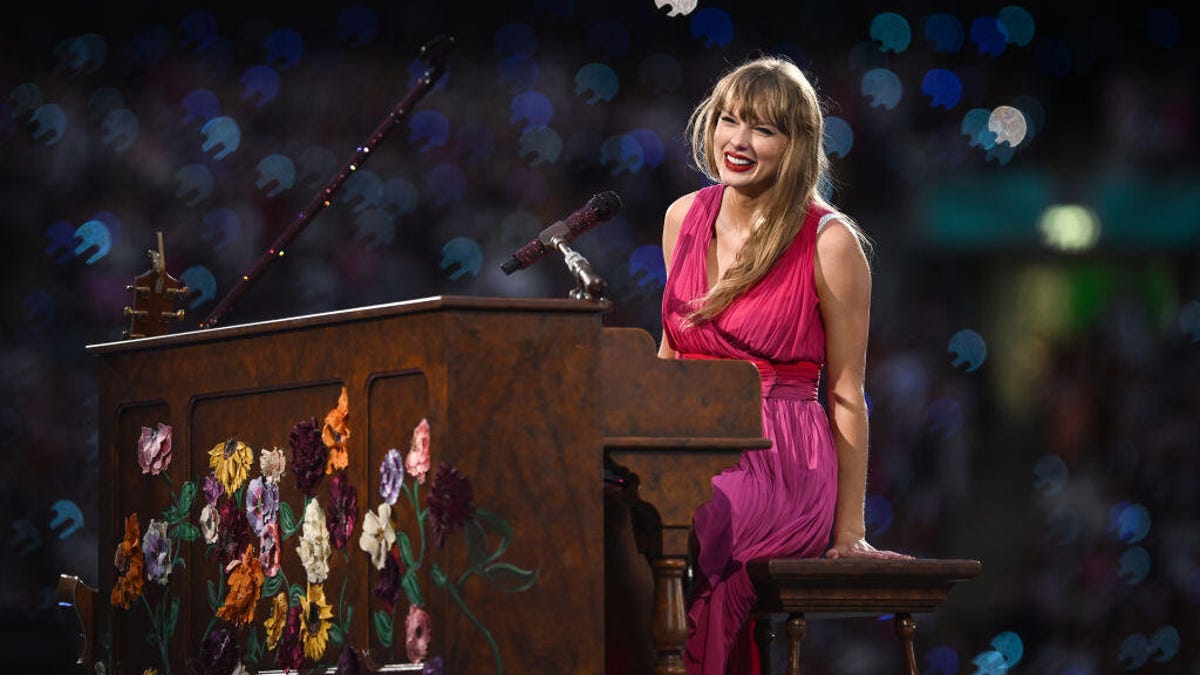
“I can’t believe we never get to go to the Eras Tour again.” We’re curled up, three of us, on my friend’s sofa to watch the new Taylor Swift docuseries on Disney Plus, Taylor Swift: The End of an Era. In a reverent tribute to the communal joy we experienced at The Eras Tour, screening these first two episodes doesn’t seem like something we should do alone, in our separate homes.
Just like my friend, I often despair that the Eras Tour was such an ephemeral phenomenon. It feels as though it should be like Disneyland or Glastonbury — the kind of thing you get to do once every year for your annual boost of escapism and serotonin.
Read more: The 29 Best Disney Plus Shows to Stream Right Now
But they’re not the same. In Disneyland, Mickey can be played by an interchangeable cast of people in a sweaty mouse costume. And part of the fun of Glastonbury is the ever-evolving list of headliners. The Eras Tour experience, however, relied on the perpetual presence of just one person: Taylor Swift.
Yes, it’s tempting to view Taylor Swift as a combined character-brand-cultural force. But she is — as Ed Sheeran points out in her Wembley Stadium dressing room as she begins her second London residency — a real human being. The Eras Tour is so much bigger than Swift, but it’s a show that can’t go on without her. It relies on Swift to set aside any fatigue or melancholia that might be plaguing her, pick herself up off the couch and pour herself into a sequined bodysuit.
Swift shared the stage with Ed Sheeran during her fourth London show.
Some days must have been harder than others, and this day — the day of the Ed Sheeran surprise cameo, and the day we see most prominently in this first episode — might have been the hardest of them all.
Swift is teary and anxious. She’s reeling after a one-two punch of violence and threatened violence have ruptured the safety of the space she’s meticulously crafted for her fans. First, an attack on a Taylor Swift-themed dance class, in which a man killed three little girls in Southport, England. This is followed by the cancellation of Swift’s Vienna shows when law enforcement uncovers a terrorist plot. It could, in Swift’s words, have resulted in a “massacre.”
We see Swift reckon with her own visceral grief, then set it aside in her bid to comfort the families of the victims of the Southport attack immediately before going on stage. “It’s my job to handle all these feelings, and then perk up immediately to perform,” she says. “That’s just the way it’s got to be.”
I’ve long admired Swift’s ability to offer support to the people she meets, willingly absorbing their heartaches and confessions, and responding with softness and empathy. This meeting, with her own heart breaking for the victims, is no exception.
While the rest of us have Taylor to cry to, Swift has her mother, Andrea — an unswerving source of support to the star, who consoles her now following her bravest performance yet. “I know it doesn’t seem like it, but you helped them,” she tells a sobbing Swift, who is already in full makeup and costume, moments away from facing a crowd of 90,000 people.
I was at that show. And, as I waited in the stadium, I was wondering whether Swift was feeling much trepidation about this first post-Vienna concert. I felt nervous for her in a way I never had before, as well as admiration for her getting back on the horse, but I needn’t have worried.
That night was my eighth Eras Tour show, and the atmosphere that night felt more charged than ever before. Swift seemed more emotional than usual, and the crowd seemed to meet her where she was. It felt like a symbiotic fervor, unlike anything else I’d experienced during the tour.
On the documentary, now we can see what was happening behind the scenes.
“We’re back!” Swift exclaims as she slides under the stage after her final bow, an ecstatic grin plastered across her face. “That was the most fun I’ve had, just knowing how happy they all were. They were losing their minds.” She throws her arms around her manager Robert Allen. “I’m so relieved,” she tells him, before asking if anything bad happened that she doesn’t know about. “Nothing,” he tells her. “And nothing’s going to happen.”
To see what Swift was experiencing through the lens of the documentary — on the other side of the door, as it were — confirmed that I wasn’t projecting. It helped me see that night in a new way: As much as Swift was dutifully fulfilling her obligation to us, her paying audience, she needed the escapism and release that the show provided just as much as we did.
The insight we glean here compensates for what otherwise feels like an off-kilter sense of narrative cohesion in Episode 1 of this docuseries. Some questionable decisions result in the odd jarring moment, courtesy of director Don Argott. He doesn’t have a meaty stable of titles to his name, but is also known for making — checks notes — a documentary called Kelce.
The second of these initial two episodes is perhaps the stronger, introducing us more substantially to the wider cast of characters involved in the Eras Tour machine, and providing the kind of juicy logistical insight fans like me eat up with a spoon.
My friends and I are already tried-and-true fans of backing dancer Kam Saunders. When he came to our city, Saunders delighted the whole of Edinburgh by being fitted for and then posing in a kilt. We coo, misty-eyed over the scenes of Saunders and his mother reflecting on his journey and her sacrifices together.
Conversely, we’re delighted to meet, for the first time, Eras Tour choreographers Mandy and Amanda. For people who operate largely in the shadows of the production, they give true star quality. Foregrounding their work (and personalities) is exactly what this docuseries should be about.
Swift’s singers, dancers and band were all star performers.
Hopefully, there’s more like this in the coming episodes, which will drop two by two over the next two weeks. Swifties love the minutiae as much as Swift herself, and no detail is too small.
Tell us about the infrastructure, the laundry schedule and the real reason Swift had a picture of Cardiff inside her cleaning cart. Show us the storyboards, the mathematical formula used to calculate the combination of costumes Swift wore at each show and the backstage take-out feasts. (The owner of the Kentish Town kebab shop where Swift filmed her End Game music video told me she placed a massive order one evening.)
More of Swift’s three cats wouldn’t go amiss either — especially as these days they’re largely absent from the internet.
As fun as it always is to see off-duty Swift goof about and live her life, the cultural behemoth she created in the Eras Tour deserves to be examined from all angles, including those that don’t feature her. This is something Swift herself recognizes. Not only does she not mind if her dancers pull focus, she says, but she hopes that they do.
As they practice their choreography for a surprise appearance with Florence and the Machine, she watches them with the same awe we reserve for her. For a moment, I wonder who the true audience is for these performances — could it perhaps be the person who had the best vantage point at every single Eras Tour show?
To us, Taylor Swift the performer might be the spectacle, but I have a sneaking suspicion Taylor Swift the real person gets her biggest kicks from being a spectator to the magic she conjures, too.
Read the full article here