





Even among the sea of first-timers, blue-bloods and downright oddball Democratic candidates hoping to rout the Republicans at this year’s US midterm congressional elections, the oyster farmer from Maine stands out. Despite having little political experience, Graham Platner, a gravelly voiced Marine Corps veteran, has emerged as a beacon of hope in the Democrats’ attempt to take the fight to Trump.
Running on a platform of Robin Hood-style aspiration – “I’m a working-class guy that lives a working-class life” – Platner, 41, is expected to be rubber-stamped as a Democratic candidate for the Senate at the primary election in the oceanside state of Maine on June 9. Having already seen off a much-loved stalwart from his own party, Governor Janet Mills, who has withdrawn from the race, he is a strong chance, if not a certainty, to beat the formidable Republican senator Susan Collins, who has served the state for nearly 30 years.
“He’s come out of nowhere,” says Bruce Wolpe, a senior fellow at the United States Studies Centre at the University of Sydney. “But people are listening to him, and they’re saying, ‘Oh, we respect what you’ve done and what you stand for. We’re going to vote for you.’ And I think he’s going to win that race.”
Platner represents a shift among Democrats towards more relatable, practical solutions, to lure swinging voters turned off by the party’s elitist image at the last general election; and he is emblematic of a change of focus playing out across the nation as its 50 states endure the often gruelling “primary” contests where parties select their candidates for November’s midterms. How are the primary contests playing out so far? What chances do the Democrats have of winning back Congress in the midterms? And who might emerge as the party’s best hopes for the 2028 presidential election?
How do the parties choose candidates for the midterms?
Midway through each presidential term, the United States holds “midterms”. In the US House of Representatives, each of the 435 seats represents a congressional district, each home to roughly 750,000 people. In the Senate, which has two seats for each of the states, terms run for six years, with a third of the 100 spots (33 or 34, depending on the cycle) coming up for contest every two years.
In the 2026 midterms, 33 regular seats are up for re-election, plus there are special elections for another two, those vacated by J.D. Vance and Marco Rubio, who resigned as senators to become Vice President and Secretary of State, respectively. So, this year a total of 35 Senate seats are in play.
Both the House and the Senate, together known as Congress, are currently controlled by the Republicans – by narrow margins.
In the House, Republicans claim a majority of 218 seats (which includes an independent who votes Republican) to the Democrats’ 212, with five seats vacant due to resignations or deaths.
In the Senate, Republicans have a majority of 53 seats to the Democrats’ 47 (which includes two independents who vote Democrat).
Many states tack on other elections to the midterms, too – such as those mandated for attorney general and lieutenant governor – so voters only have to turn out once for the whole shebang.
Parties choose their candidates for the midterms using “primaries”, a winnowing round of elections run by the states, who each have different rules for how people can vote and what makes a winner. (In Iowa, for example, you could win with, say, 40 per cent if the next closest had 34 per cent but in Texas, you need at least 50 per cent of the votes in the first round and, failing that, the top two vote-getters compete at a “runoff” election.)
The midterm primaries kicked off this year on March 3 in Texas, Arkansas and North Carolina and they’ll conclude with Delaware on September 15. The next batch is on June 2, when California, New Jersey, New Mexico, South Dakota, Montana and Iowa go to the polls. Twists such as runoff elections are just one complication that can stretch out the primary season by months and drain campaign funds, as is happening now in Texas (more on which below).
An estimated 46.2 per cent of eligible voters cast ballots at the last midterms, in 2022, slightly higher than average.
The midterms are always held on the first Tuesday that follows a Monday in November, which this year is November 3, as per a law passed in 1845. (Weekends were considered church time, Wednesdays were market days.) Today, of course, Tuesday – a regular workday – seems an odd day to ask voters to turn out, and many don’t, the US not having compulsory voting. An estimated 46.2 per cent of eligible voters cast ballots at the last midterms, in 2022, slightly higher than average (in 2014 it was just 36.7 per cent).
This year Democrats will be hoping that more of their supporters will make the effort – energised to cock a snook at Trump – while Republicans who are not necessarily Trump fans might choose to quietly stay home. Romping home in the House, as is expected, and flipping the Senate, which is possible, would give the Democrats control over the passage of legislation and frustrate the Trump administration’s agenda. It would also re-energise the party ahead of the 2028 presidential campaigns after the disappointment of Kamala Harris’s 2024 tilt, which was initially frustrated by doubt over whether Joe Biden would run again.
Who are some Democratic contenders in these midterm primaries?
For the Democrats, one spotlight falls on Graham Platner in Maine, who is up against Susan Collins, a “very, very wily campaigner” for a Senate spot, says Associate Professor David Smith from the United States Studies Centre. Platner, who served in Iraq and is now opposed to the United States fighting wars overseas, is campaigning against the “billionaire economy” with enough momentum (at least to date) to shrug off controversy over a tattoo that resembled a Nazi symbol, from his days in the military, which had led some to question his judgment. “He got this tattoo without knowing what it actually meant,” Smith recaps, “and he’s had to apologise a lot since then, and get it covered up.”
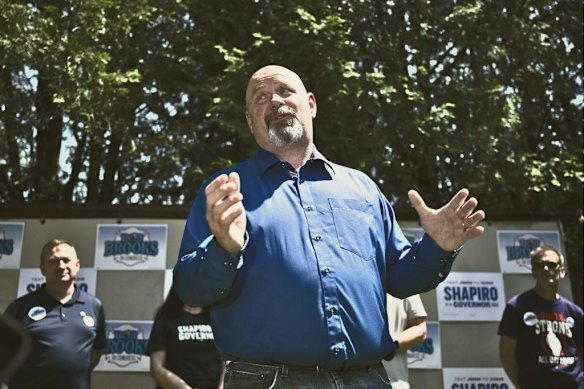
A few states south-east in rust-belt Pennsylvania, retired firefighter and union leader Bob Brooks recently clinched his nomination for the House in his primary, endorsed by the state’s governor, Josh Shapiro, and independent Bernie Sanders, who has long caucused with the Democrats. “I know what it’s like to live pay cheque to pay cheque,” Brooks told supporters after his win, reported The New York Times. “Only 4 per cent of Congress comes from the working class. You can say you stand with working people all you want, but if you’ve never lived that life, it’s like coaching a sport you’ve never played.”
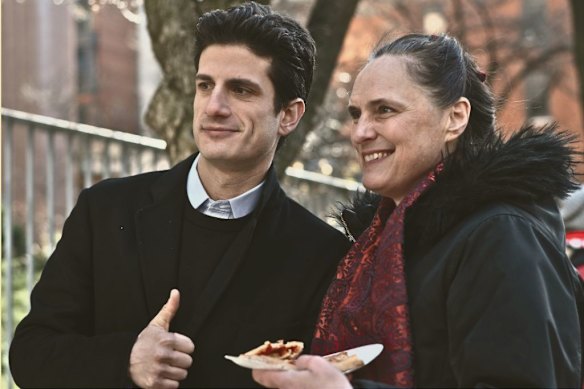
Nearby in New York, Jack Schlossberg, the 33-year-old grandson of president John F. Kennedy, and son of Caroline Kennedy, former US ambassador to Australia, is seeking a seat in the House, and is selling himself as “almost the saviour of the Democratic Party, the return of a Kennedy and the return of Camelot,” according to Emma Shortis, director of the Australia Institute’s international and security affairs programs. (The legend of the knightly court was invoked by Schlossberg’s late grandmother Jackie Kennedy after her husband’s assassination in 1963, to symbolise his brief, youthful time in power.)
‘I was born into a family whose legacy is not celebrity … but public service, and that’s something that I want to continue.’
Jack Schlossberg
Schlossberg’s campaign slogan is “Believe in something again” or #BISA – he’s famously prolific on social media. He told Vanity Fair earlier this month: “I think to whom much is given, much is required, and I embrace my responsibility as a citizen to do what I can for my country, and I think … in one of its darkest moments, I was born with a platform, and I was born into a family whose legacy is not celebrity as, as kind of understood now, but public service, and that’s something that I want to continue.”

Also in New York, Zohran Mamdani, whose successful mayoral campaign in 2025 focused on affordability, has endorsed young progressive (and renter) Claire Valdez in her quest for a House seat. Out west, San Francisco’s Connie Chan is running “for all the people who feel like they’re getting priced out of their own city”, hoping to step into the seat of retiring Democratic royalty Nancy Pelosi, who has endorsed her.
Down in Texas, would-be Democratic senator James Talarico, a 37-year-old presbyterian seminarian (David Smith describes him as “Christian left”) recently surprised patrons at a taco restaurant when he showed up with former president Barack Obama, who is supporting his run (and that of Democratic gubernatorial candidate for Texas, Gina Hinojosa).
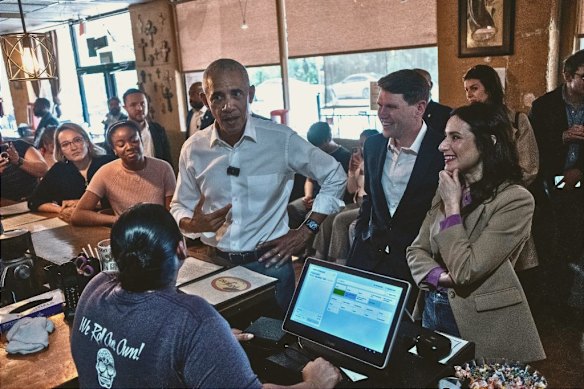
Talarico will face off in November against one of two Republicans, either incumbent Republican senator John Cornyn or State Attorney Ken Paxton, who was recently endorsed by Trump, to be decided in a runoff election on Tuesday. “The [Republicans] are currently spending tens of millions of dollars fighting between themselves,” says Cory Alpert, a PhD researcher at the University of Melbourne who worked for three years as an advance associate in the Biden-Harris administration. “A Democrat has a long way to go in Texas, but if there ever was a perfect storm of the ability for a Democrat to win Texas, it’s a very unpopular Republican president.”
Also in Texas, political newcomer Bobby Pulido, a singer-songwriter who last year received a Latin Grammy for his Tejano music, has already won his House primary contest. “As Latinos, what unites us all is that many of us come from humble beginnings,” he told CNN.

On the flip side, Democrats will have to fight to defend Senator Jon Ossoff in Georgia, a presidential hopeful in an unpredictable swing state. “He’s the Democratic incumbent who I think has the hardest road to travel, but he seems to be doing OK,” says Alpert, though Smith judges him “entrenched”.
“The big question,” says Alpert, “is, how is anyone going to define success in this election? Donald Trump is going to spin this however he wants, but what feels like a win to the American public on either side? It probably feels like a pretty significant victory for Democrats to pick up three Senate seats, and if they’re able to close the gap in the House or even win back the House, that again feels like a victory. I think the range could be the Democrats picking up a few seats but don’t win back a majority, or it could be an even bigger Democratic landslide than we might expect.”

What’s the likelihood of a ‘blue wave’ in the midterms?
Midterms are often thought to reflect the popularity or otherwise of an administration. “They’re really a referendum on the president,” says Bruce Wolpe. “The Democrats are amped up. They feel this is their last chance to stop Trump. What’s the future of the Trump presidency? That’s what’s really at stake here.”
Three of the past five midterm elections were considered “wave” years, in which the party that didn’t control the White House flipped 25 or more House seats. It can be even more dramatic: the Democrats went backwards by 54 seats in 1994 under Bill Clinton, and 47 under Lyndon Johnson in 1966 during the Vietnam War.
But in 2006, the party won a net 30 seats in a blow to President George W. Bush, then mired in the Iraq war; and in 2018 improved by 41 seats overall, at least in part due to some of President Donald Trump’s more controversial policies, such as his pledge to build a wall across the border with Mexico. (That was also the year that much-touted potential Democratic presidential candidate Alexandria Ocasio-Cortez won her House seat for the first time.)
To take control of the House, the Democrats need to improve by at least six seats to get to a majority of 218; in the Senate they need four to get to 51.
Polling suggests 2026 could produce a similar blue wave. Trump’s popularity has plummeted, including thanks to a cost-of-living crisis, stubborn inflation, high petrol prices and the uncertainty of the war in Iran. “Economic insecurity of Americans is absolutely a motivating factor,” says Emma Shortis. “Trump promised to address that, and he materially has not, he’s made those conditions worse, and I think Americans understand that, and for many of them, that will be a deciding factor in their votes.”
To take control of the House, the Democrats need to improve by at least six seats to get to a majority of 218; in the Senate they need four to get to 51. Both scenarios are possible. “As it stands right now it looks like the House is highly likely to flip Democratic and the Senate is within reach for them,” Wolpe says.
But it’s far from a given. “The Democratic Party is undergoing a robust discussion with itself about how to win again. That means a lot of viewpoints, a lot of energy, and a lot of candidates,” Democratic strategist Ian Russell told Politico last year.
Then there’s the redistricting controversy. Republicans have changed numerous district boundaries, a complex process that has been described by some as gerrymandering, or unfair manipulation.
And history shows that the Senate doesn’t necessarily follow a “blue wave” scenario in the House. In 2018, the Republican Party was wiped out in the House but actually gained two seats in the Senate, at least partly because Trump campaigned aggressively in the handful of states in which the Democrats were vulnerable.

When will Democratic presidential candidates show their hands?
Almost as soon as the 2026 midterms are over, all attention will turn to the next round of primaries, kicking off with Iowa in early 2028 – the ones that will decide the candidates for the next presidential election. It’s early days but some names are emerging as likely contenders. “I expect a big field, at least 10 candidates, and I think that’s good for the party, will be good for the country,” says Wolpe, who flags a likely Kamala Harris comeback. In April, she said she was “thinking about” running for president again in 2028 and would keep people posted.
Emma Shortis’ rule of thumb? “I think you can sometimes tell by who’s released a book,” she laughs. That crowded field includes Harris, New Jersey senator Cory Booker, Pennsylvania governor Josh Shapiro, Kentucky governor Andy Beshear and outgoing California governor Gavin Newsom.
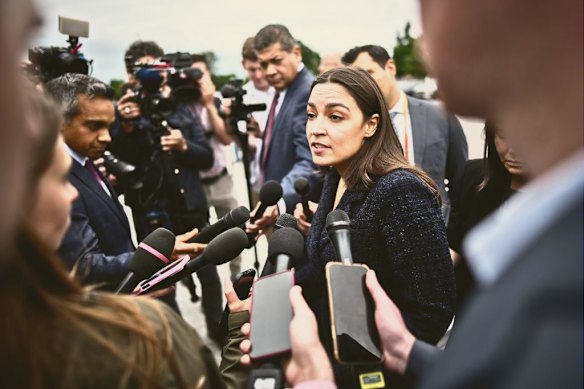
New Yorker Alexandria Ocasio-Cortez, 36, is “one of the most compelling figures to have emerged from the Democratic Party over the past few years”, says Smith. Another “young” achiever is Pete Buttigieg, 44, a former secretary of transportation who would be the first ever openly gay nominee for president. “His drawbacks would be if the Democratic Party is at a point in 2028 where they are looking for a real progressive; he is not that. He is very firmly associated with the moderate side of the party,” says Smith.
Beshear, the Democratic governor of conservative Kentucky, is an economic populist and committed Christian, says Smith. “His big pitch is he knows how to win in conservative America and he’s popping up in a lot of states that are very important to primaries. He has his messages that Democrats have failed to talk to ordinary Americans in a language they understand.”
Get fascinating insights and explanations on the world’s most perplexing topics. Sign up for our weekly Explainer newsletter.
Read the full article here