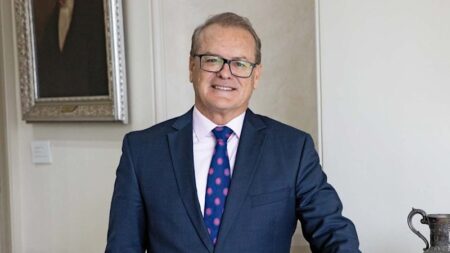






Back in 2001, Kerry and Lindsay Clare had a vision for Brisbane’s new Gallery of Modern Art, but it did not conform to the vision held by Queensland’s Peter Beattie government.
The Clares and their Sydney-based architectural firm, Architectus, were resolved to enter the global competition to design the gallery, planned to be the largest ever built in Australia. They were up against 173 other entries from 24 countries.
Submissions were judged blind, and the Clares, who both trained at QUT, made it through to the longlist of 12 with simple hand-drawn sketches. “We were told later by one of the jurors that they thought it was a veteran Japanese architect who had designed many galleries,” Lindsay recalls.
Of these 12, five entrants – two from the UK, one from Italy, and one from Melbourne, alongside Architectus – were invited to team up with Brisbane practices to produce sketches and presentations. Architectus was teamed with Davenport Campbell.
The Clares had known from the start they were taking a big roll of the dice, because their entry deliberately flouted one of the key design specs.
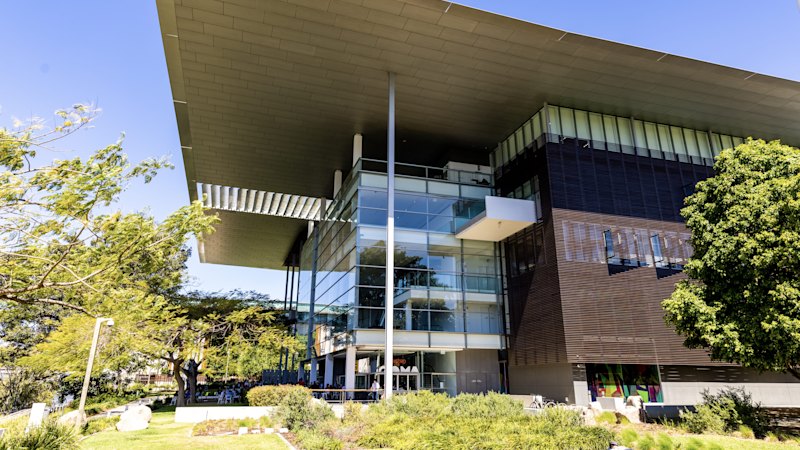
The Millennium Arts project for the Queensland Cultural Centre envisioned a building that, like Robin Gibson’s Queensland Art Gallery and State Library that opened in the 1980s, ran parallel to the river.
“But we turned the building around more or less 90 degrees, and stacked it up,” Lindsay says.
“We thought it might go straight in the bin – the ‘no’ pile,” Kerry laughs.
Their brazen approach did three things. It aligned the entry of GOMA with the new Stanley Place entrance that was being built to the rear of the Queensland Art Gallery. It created a covered outdoor space next to the river. It also meant Kurilpa Park would be retained.
In 2002, they got the call that advised them their entry with co-lead designer James Jones had been unanimously chosen by the five-person jury.
“It was just a surprise, a very pleasant one,” Lindsay says. “And from that point on it was an amazing journey over five years.”
A democratic building
Built in the budget range of a now thrifty-looking $100 million, the Gallery of Modern Art opened in December 2006.
To mark the 20th anniversary, the Clares, now based on the Gold Coast, are returning to the building.
The occasion is a free public Q&A with QAGOMA director Chris Saines and artist Tony Albert (whose artwork/playground designed with Nell, The Big Hose, is the gallery’s latest architectural addition).
The discussion is part of Brisbane Open House 2026, the annual weekend where visitors get access to notable houses, buildings and structures that are usually off-limits.
There has been much speculation over the decades about the shortcomings of the four unsuccessful shortlisted entries.
One of them imagined the building as a vast shimmering blob; another as a series of interlaced fingers with an emphasis on gardens and plazas.
The Clares’ entry balanced practical enclosed art spaces and outdoor areas. An understanding of Brisbane’s climate and culture did not hurt.
“We understood the quality of light, the weather conditions … we felt people might connect to the idea of the roof overhanging, creating shelter,” Lindsay says.
“We also understood the informality of Brisbane,” Kerry says. “The building is very democratic, there’s no barriers for you going into the gallery and connecting with the art and the programs.”
Lindsay concurs: “If you’re standing outside in your shorts and T-shirt, you think, ‘I can go in there.’”
Gallery fatigue
The central three-storey high corridor running along the ground floor with views straight out to the river and city was an important feature.
“Galleries, especially large ones, sometimes have a problem of what you call ‘gallery fatigue’. You might feel a little bamboozled, or you need to get out,” Kerry says.
“It’s almost like having a veranda in the middle, where you’re able to feel like you’re part of the world, you can see people going past, or boats or cars.”
The project had enormous logistical requirements: 15 exhibition spaces, two cinemas, eateries, offices, loading docks and storage, and the knowledge contemporary art can take large and strange forms.
“Hospitals have the ‘clean’ corridors and the ‘dirty’ corridors. Galleries have the art corridors and the people corridors. You want them to be able to get the artwork in and out of those spaces without interrupting the rest of the gallery or the people.”
Fifty-nine architectural staff members spent 50,000 hours on the project, had 708 meetings, and gave 71 design presentations.
The Clares speak positively of the gallery as a client for taking their side on requests from builders and government to economise. “It was suggested that we just cut off all the theatres at one stage, and reduce the size of the roof,” Kerry says. Neither occurred.
Their approach asserted that the building should not overshadow its contents.
“The architecture has to have a presence, it can have a strength, but not one that overpowers the capacity to produce outstanding art exhibitions,” Lindsay says.
“Over the 20 years that it’s been there, it’s had phenomenal exhibitions, and I’d have to say that some of those exhibitions could not be held in other galleries.”
The Queensland Art Gallery director who had originally petitioned for GOMA to be built, Doug Hall, would later write: “The building is elegant and grand without being pompous or threatening to visitors. Its physical and visual connections mark its relationship to a unique site. It is in every respect a public building.”
“People are surprised when we say, ‘GOMA’s 20 years old’, they can’t believe it,” Kerry says.
“We were there the other day, and we felt rather pleased with the way the gallery had stood up.”
20th Anniversary of GOMA discussion is at GOMA, Thursday, July 16, 6pm (no booking). Brisbane Open House takes place July 16-19.
Get alerts on significant breaking news as it happens. Sign up for our Breaking News Alert.


From our partners
Read the full article here