




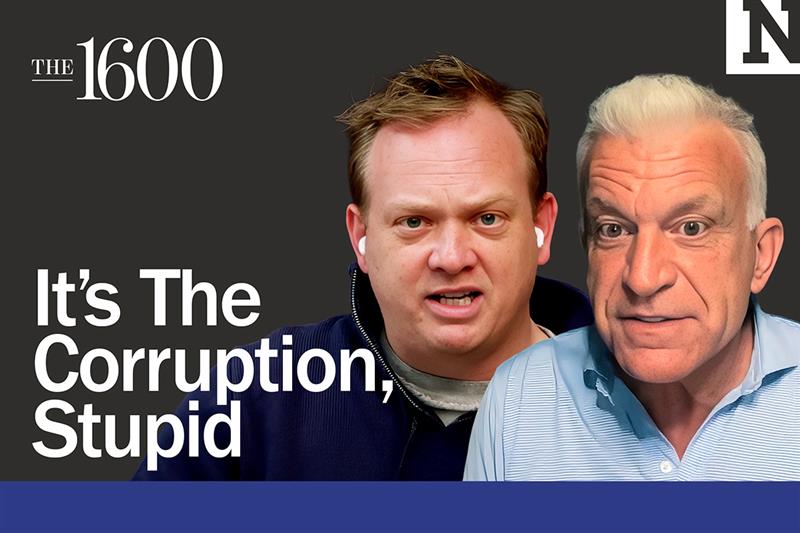
Dylan Ratigan, the financial journalist who left his perch hosting popular shows at CNBC and MSNBC at the height of their ratings success, is returning to the U.S. media landscape to argue that the anger he expressed on air 15 years ago has only intensified. The institutional corruption that has taken root in the U.S. political machine, which he warned about in one especially viral rant from 2011, has not been fixed; it has hardened. And he says both parties share responsibility.
“I felt like I was enriching myself by participating in a system that was perpetuating the very thing I claimed to oppose,” Ratigan told Carlo Versano on Newsweek’s The 1600 podcast, explaining why he left cable news entirely. The problem was never one man or one president, he said. It was a two-party system “structured to extract wealth from ordinary Americans while rewarding those who design it.”
From the aftermath of the Global Financial Crisis to today’s “golden age of corruption,” Ratigan sees a consistent pattern. His central argument is that Democrats and Republicans operate like competing media companies. They raise money by attacking each other while leaving most of the underlying budget and policy structure unchanged.
Watch Here: The 1600 Podcast Full Episode
Obama’s ‘Original Sin’
Ratigan’s 2011 MSNBC rant came toward the tail end of the first Obama term, when unemployment was stuck above 9 percent and Washington was deadlocked over the debt ceiling. It went viral because it captured a broader public frustration percolating in the wake of the Great Recession. The system itself felt rigged. Much of what he said then, he argues, still applies. The debt ceiling is higher, and wealth extraction has accelerated.
He points to Obama’s decision to recapitalize Wall Street after the crash as the hinge point. “You had to recapitalize it, but you didn’t have to do it without reform,” he said, describing what Carlo called Obama’s “original sin.” He argues that Wall Street was rescued without structural changes to prevent another crisis.
That failure, Ratigan says, fueled the resentment that later powered both Bernie Sanders and Donald Trump. “The frustration that existed in 2011, when I was part of the media ecosystem, is what both Sanders and Trump tapped into in their campaigns,” he said.
“I believe the primary reason Donald Trump is president today is because the Obama administration, along with a government apparatus jointly controlled by both parties, resisted meaningful reform.”
The result, he says, is a political trap. Voters are left choosing between institutional corruption and someone willing to exploit it. The system itself remains unchanged.
The Corruption That Binds Them
High-profile cases such as Jared Kushner’s business dealings while in government, the president’s own children being involved with companies receiving federal contracts, and suspicious trading activity tied to political events, have re-elevated these concerns for many Americans. However, Ratigan rejects the idea that this is unique to Trump. He points to earlier examples, including Hunter Biden, the Clinton era, and the revolving door between government and corporate boards. The difference now, he argues, is scale, openness and the collapse of American institutions
“I believe we are observing the most rampant looting and corruption in the history of any government,” Ratigan said. “The size of the resources available, combined with a highly sophisticated system around the current president, has created an unprecedented level of corruption.”
At the same time, he challenges the common “both sides are corrupt” framing. When asked whether that argument lets Trump off the hook, Ratigan shifted the focus. Americans, he said, should expect more than simply comparing themselves to worse systems elsewhere. “We should aim higher than just not being Donald Trump,” he said.
He argues that critiques of institutional corruption are themselves being used politically. When voters hear that the “system is rigged,” they often swing between disengagement and support for candidates who promise to dismantle it. Trump and Sanders, in different ways and to different degrees of success, both capitalized on that sentiment. Both favor stronger centralized power, though they differ on who should wield it and to what ends.
What Comes After the Collapse
On global dynamics, Ratigan pointed to Iran’s growing leverage over energy markets and the long-term risks to the U.S. dollar. He argued that recent conflict has increased Iran’s influence without direct military confrontation. The Strait of Hormuz was closed off not by force, but by global maritime insurers refusing to underwrite the new risk involved in transiting that chokepoint. He sees that as an example of asymmetric power.
He does not expect a sudden collapse of the dollar. Historical shifts, such as the decline of the British pound, took decades. But he argues that long-term pressures are clear. High debt levels, continued money creation, and the rise of alternatives such as gold and Bitcoin all point in the same direction. In that environment, he says, hard assets may offer protection, while cash loses value.
Ratigan, who now writes and hosts videos on Substack, ended on a broader reflection. Economic and political systems do break down. Empires fall. The question is not whether the United States can reform without disruption. History suggests that is unlikely. The question is what follows.
“Destruction clears a path for creation,” he said. “The hope is that what comes next is more constructive, more humane, and better for future generations.”
Watch the full conversation between Dylan Ratigan with Carlo Versano in the video player above or on YouTube.
Subscribe to The 1600 newsletter for more interviews and to receive Carlo’s popular daily column. Tap here to have it delivered straight to your inbox.
Read the full article here