



Deep below the surface of the Indian and Southern Oceans, a small team of Western Australian Museum scientists have dedicated years to documenting new species of marine life.
With more than 500 new species documented over the past 20 years, the scientists behind the discoveries are giving a peek into life on a deep sea expedition.
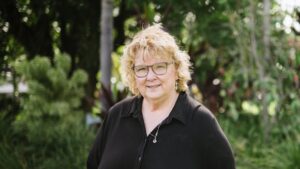
“Over the last decade, we’ve actually participated in or led seven deep-sea expeditions in Western Australia and the nearby regions,” Head of aquatic zoology Dr Lisa Kirkendale said.
The expeditions spread from Ashmore Reef to the Recherche Archipelago and out to Christmas Island.
Curator of aquatic zoology Dr Andrew Hoisie has been on the most trips of all the science team members.
“Days at sea are a lot more comfortable than they used to be. I have done some work with cray boats doing fishery observer type work and those can be horrible days at sea,” he said with a laugh.
Often partnering with other organisations such as CSIRO, Hoisie said the boats used for deep-sea work are big and “can handle decent seas.”
Stints at sea can go for up to 35 days and to depths of 5000 metres.
As for why they undertake the expeditions, the answer is black and white.
“From our perspective, it is simple: we want to find what we don’t know about,” Kirkendale said.
“New records or species that are not only new to science, but significant infill that we didn’t know lived there. We’re kind of infilling a map so that we know how to best protect what lives in our ocean property or ocean state.”
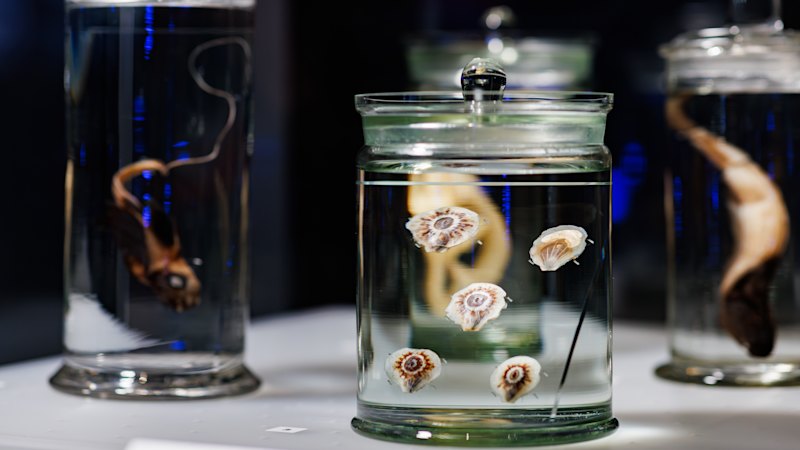
One of the discoveries brought back from an expedition are glass scallops also known as propeamussium alcocki.
Found in the abyss of Perth Canyon, located around 20 to 60 kilometres west of Rottnest Island, the scallops have what can be described as a marine-life backpack.
“It’s not just a glass scallop, which are stunning in and of themselves, but what we found was more often than not – so 90 per cent of the cases – an anemone has actually settled on the back of the scallop,” Kirkendale said.
“So in the abyss, there’s a lot of sand and not a lot of hard bottom. So it’s a premium space for them [to settle].”
The anemone has been named the Eye of Sauron for its resemblance to the Lord of the Rings character.
One key task the WA Museum science team undertakes is the taxonomy of species.
“Taxonomy is the description of new life essentially. It’s the naming process,” Kirkendale said.
“So if you have a new-species tingle, we call it, where you think it’s something new, you actually have to do a lot of comparative work to check it is absolutely new to science.
“You have to compare it with its most similar neighbour, which often resides at the Natural History Museum in London. It’s a long process taking something that you think is new – a discovery – and translating that into a description of a new species.”
Kirkendale said it can take up to 20 years from when scientists get the “first new-species tingle” to when it gets published with a new name into public scientific literature.
For WA Museum director of science Dr Jennifer McIlwain, taxonomy work separates them from other museums in Australia.
“Taxonomy sits at the heart of and underpins biodiversity. You can’t fully understand something unless you can put a name to it,” she said.
“That’s what sets the museum apart from other research organisations, particularly government research, is that we provide those authoritative names to animals. So disciplines like ecology and conservation biology all rely on us, the taxonomists, to provide those names.”
McIlwain said in the invertebrate space, approximately 75 per cent of the population remains unnamed.
“So we have a lot of work to do,” she said.
A new exhibition
Opening on April 4 at the WA Museum is OceanXperience, a new interactive exhibition that recreates life on the OceanXplorer ship.
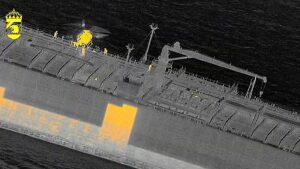
The ship which first launched in 2016 is an exploration, research and media vessel that unlocks the wonders in uncharted waters of the world.
Visitors to the exhibition get to immerse themselves inside the ship’s mission control, wet and dry labs, bridge and sub hangar to see how scientific research happens in real time.
The exhibition is also flanked by discoveries found by the WA Museum scientist team on previous research trips, not on the OceanXplorer ship.
“We’ve never been on an OceanX expedition. But maybe we’d like to go on one, now that we’ve crossed paths,” Kirkendale said.
WA Museum chief executive Alec Coles describes the exhibition as a “complete change of pace” to the previous Terracotta Warriors display.
“Western Australia has got 12,000 kilometres of coastline. We’ve got the whole of the Indian Ocean and indeed the south, going down towards the Southern Ocean and we have the most amazing marine biodiversity here,” Coles said.
“So to feature something like this is very appropriate to us and what’s really great is it absolutely reinforces what the museum’s about.
“I’d say of all our scientific work, the marine biodiversity studies are probably the ones that we invest the most in. So it’s amazing to be able to bring an international exhibition like this here and to be able to link it into what we’re about in our kind of DNA really.”
The OceanXperience will run from April 4 to October 11.
From our partners
Read the full article here