




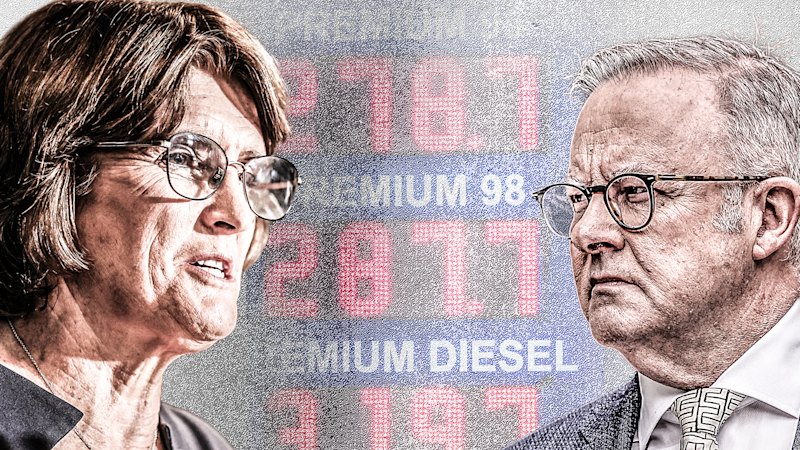
James Massola is right: the cut in the fuel excise is economically irresponsible, but entirely understandable (“This move is economically irresponsible – and absolutely the right thing to do”, March 31). That said, there is no guarantee the cut will be passed on fully by the petrol companies, and whatever savings are delivered will surely be eroded by interest rate increases that are most certainly coming. A bigger problem is that structural debt, deficit and taxation reform will be kicked down the road. There was some evidence it may have been addressed in the budget, but it’s hard to see that now happening. Next year’s budget will be within the dreaded 12-month election window, so again, it is unlikely that anything major will happen. The government has been living way beyond its means and the current crisis highlights the need for prudent spending and borrowing so the impact of future shocks is minimised. Mike Kenneally, Manly
James Massola correctly observes the cut in fuel excise and heavy vehicle charges was the right call, despite its inflationary effects and the potential impact on interest rates. The real test is whether fuel prices fall in response, and whether the ACCC is prepared or even legally able to hold fuel distributors to account for price gouging. If not, the government will reveal itself as incapable of holding a fuel hose, let alone using it. Brian Barrett, Padstow
I’m not sure that fuel prices will go down uniformly by 26c per litre across Australia on Wednesday. Actually, I’m not sure that they’ll go down at all. I think they’ll continue to go up, and the fuel companies and the federal government will make the unverifiable claim that: “Well, the prices are lower than they would have been.” The ACCC might try to monitor things, but any action it takes will be weeks and months behind the pace. However, I am sure the federal government will forgo millions of dollars in revenue, which it will recoup from consumers in some other way. Geoff Wilkes, Sherwood (Qld)
While many will welcome the reduction in fuel excise, it is not really a shortage of money facing Australia, but rather a shortage of fuel. To counter this, rational moves could involve a national reduction in speed limits because vehicles are generally most efficient around 85km/h; strictly enforcing the speed limits that we do have; imposing the luxury car tax on heavy ute and 4×4 imports; and creating high occupancy lanes for vehicles carrying two or more passengers. Maybe even make toll roads free for vehicles with two or more passengers. Taxing vehicle imports based on their likely fuel consumption, rather than emissions, would be a step in the right direction. Instead, the government is basically propping up the existing fuel-consuming economy with subsidies towards costs, rather than rational efforts to lower fuel consumption. Peter Woof, Mollymook
The 26c cut to the fuel excise, greatly appreciated by the average citizen, is “economically irresponsible”, according to James Massola, and “drongo economics”, according to Shane Wright (“Let’s not adopt drongo economics to deal with high-priced fuel”, March 27). This criticism comes despite media calls to the Albanese government to “don’t just sit there, do something”. The government’s attempt to calm the populace by a temporary reduction in the price of fuel should be applauded, not undermined. The suggestion that it will increase demand for petrol is tenuous – most people would prefer to spend less time in their cars rather than drive more. The $20 per tank saved may well be saved rather than spent. Tom Dolan, Narraweena
Cutting fuel excise will not discourage people from driving, and hence it will not make our fuel stocks last longer. Free public transport, working from home and cost relief for groups that need to drive make far more sense. Elaine Keane, Salamander Bay
Make EVs public
Your logic seems correct, Stephen Driscoll, that free public transport would most benefit wealthier, inner-city suburbs that have adequate services (Letters, March 31). However, many who can afford it will still eschew the egalitarianism of fare-free sardine cans. They will continue to thank the gods for Uber, notwithstanding that new surcharge (“New pricing sees Uber charge wealthy areas 40 per cent more”, March 31). C’mon Premier Minns, more EV public transport everywhere, please. Russ Couch, Woonona
Where I live, rampant fare evasion would indicate that for a significant proportion of travellers, public transport has been free for some time. For those who pay, free fares might just alleviate annoyance at the extent of this dishonesty. Wayne Duncombe, Lilyfield
Hordes hoarding
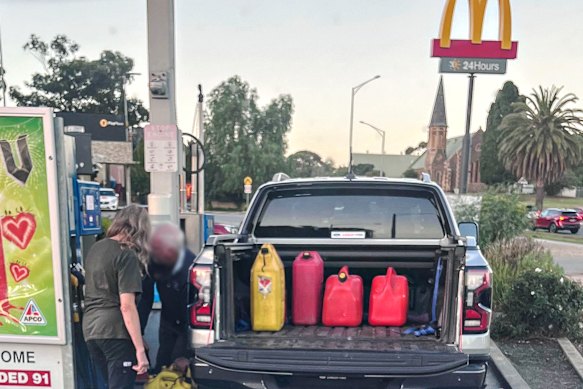
There is, of course, a lot more fuel hoarding going on than anyone will admit to. It is now a risky thing to be seen filling tins and jerry cans at a petrol station. It’s a good way to draw, at the very least, some savage remarks, get yourself videoed and maybe worse. But we can be assured that there’s a lot decanting taking place in the privacy of home garages and backyards. People are siphoning out their cars’ tank and going back the next day to innocently just take “what they need”. Petrol has a not particularly long shelf life, about three months before it starts to degrade and lose octane. Presumably, when this crisis abates, we will see a sudden crash in demand and the country will be awash with the stuff, as people stop buying altogether while they use up their home stocks. Then we’ll see if the fuel companies are as quick to drop prices when demand falls as they are to raise them when demand rises. Graeme Smith, Daceyville
Plastic plague
Another consequence of our continuing dependence on fossil fuels, apart from current fuel price shocks, supply shortages and political point-scoring, is plastic waste; plastic being manufactured from fossil fuels. Last weekend’s heavy swells have washed up millions of plastic fragments along the NSW coastline. My daughter and I spent hours picking up bits of plastic, including balloons and lollipop sticks, from a usually pristine beach in a Central Coast national park. It was depressing to see, not to mention the damage it causes to the marine ecosystem. Apart from cutting emissions, reducing the amount of plastic in the world would be another benefit of going fossil-fuel free. Kate Lumley, Hurlstone Park
Water off-limits
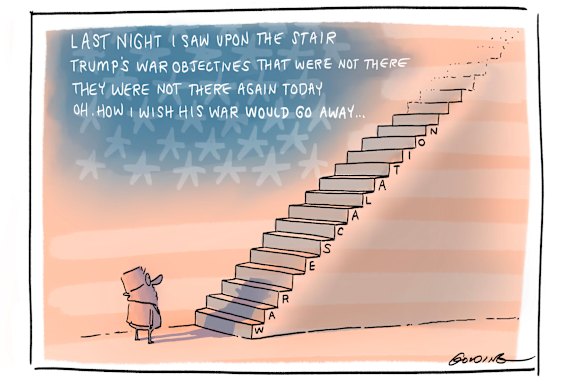
During World War II, the destruction of a dam by the revered “dam busters” was considered strategically acceptable. However, in the context of the world today, the threat by Donald Trump to destroy desalination facilities in Iran is totally unacceptable. Purposely depriving millions of people water should attract a war crime charge. Where are the decent Republicans in the US? Is the fear of losing their jobs so high that it has extinguished all their sense of morality? D’Arcy Hardy, Turramurra
Undemocratic party
Presumably, the No Kings protesters would have preferred Kamala Harris to have won the election in November 2024 – someone who was crowned as the Democrat candidate without a single vote cast after Joe Biden withdrew. Not very democratic. As for the shenanigans in 2016 in which the primary Democrat leader Bernie Sanders was manoeuvred aside for Hillary Clinton – well that was also pretty monarchical in both its ruthlessness and its disregard for what the Democrat members wanted. Cognitive dissonance anyone? Chris Mangan, Bracken Ridge (Qld)
Trickle-up economy
Elizabeth Knight writes about companies seeking refunds from the US (“The conga line of Australian companies suing to claw back Trump tariffs”, March 31). No doubt all of these companies passed on the tariffs to their customers, but will they be forthcoming and offer to refund any tariffs that they may claw back from the US to the customers who ultimately paid for them? I doubt it. Geoff Lindsay, Thurgoona
Lessons for life
I am writing in response to the article and editorial about Lindfield Learning Village (“Sydney’s alternative school goes mainstream”, “End of an educational experiment”, March 31). As both pieces make clear, this innovative school was not failing in its educational outcomes. Its HSC results were the fifth-best in the state last year for a public comprehensive school. The school’s only failure was its inability to overcome the prejudices of the Education Department and local conservative opinion. Together with a disregarded for the concerns of the current school community in favour of attracting new parents, these forces are punishing the school for daring to be different. What lesson are they teaching our kids? That bullying works. Luke Escombe, Chatswood

When institutions stop experimenting they stagnate, and our rapidly changing world requires educational institutions to evolve. Our daughter recently graduated from Lindfield Learning Village’s “experimental era” with Band 6 HSC results. The “stage not age” approach served her well; it allowed her to progress at her own pace and complete the Mathematics Extension 2 HSC exam in Year 9. Beyond the academics, the school empowered her to take an idea she had – creating a school yearbook – and project-manage it to completion. This is exactly the kind of real-world agency students need. I hope the new leadership acknowledges the visionary and experimental work already done at the school, and doesn’t throw the baby out with the bathwater. Michelle Lowbeer, East Lindfield
AUKUS sub-standard
Jennifer Parker sings another verse in her extended song of praise for AUKUS (“AUKUS is not on the rocks despite UK’s sub troubles”, January 15). It is easy to champion something whose delivery is still decades away because no one can prove you’re wrong until it’s too late. It would be more instructive for Parker to look in the rearview mirror at our appalling record on defence procurement, stretching back to the F-111 fighter/bomber in the 1960s. The only safe prediction we can make about the AUKUS submarines is that they will be the largest single item of government expenditure in the nation’s history, and provide dubious (if any) benefit to the people whose taxes paid for them. David Salter, Hunters Hill
Take it as read
Evan Parsons says anti-Trump correspondents don’t care about Iranian women getting the opportunity to embrace education and a career (Letters, March 30). The truth is, they already do. UN records indicate that the respective literacy rates for Iranian women and men now exceed 96 per cent. Plus, in 2025, half of Iran’s university students were reportedly female, as were 70 per cent of STEM (science, technology, engineering, maths) graduates. Conversely, Australia’s situation raises serious concerns. Here, 44 per cent of adults are rated as low or very low on literacy (ABS), and around 30 per cent of children can’t read well (Grattan Institute). Socially, high reading rates are reported to be characteristic of healthy, democratic societies. Fostering a stronger reading culture in Australia, especially among young people, is in everyone’s interests. Barbara Chapman, South Yarra (Vic)
The war in Iran is a reminder of the philosopher Hegel’s advice that what we learn from history is that we learn nothing from history. Greg Phillipson, Aranda (ACT)
Democracy manifest
Correspondent Chris Rivers’ thesis about compulsory preferential voting has some merit, but unlike him, I believe we must preserve mandatory universal voting (Letters, March 31). Citizens can withdraw from public life, but they cannot divorce from society, even though the recent notion of “sovereign citizenship” misleads people into thinking they can. Attending a polling station every few years is a small imposition to ensure high voting rates, which generates greater respect for the outcome. That contributes mightily to our generally stable democracy. You can also enjoy a democracy sausage on polling day. Australia’s electoral system and administration is excellent. Compulsory voting is a fundamental element of that excellence. Tim Coen, Ashfield
Your correspondent doesn’t have to vote for anyone he doesn’t like. Just vote for your favourite, which will be recorded in the first preference counts, and then leave the rest of the ballot blank. You have expressed your preference but chosen to abdicate your right to select the best from the rest, and that is your right. It is only compulsory to turn up and have your name marked off the electoral role, though I am not sure you are entitled to a democracy sausage on the way out. Perhaps just a bit of raw onion to sweeten your mood. Peter Kamenyitzky, Copacabana
Unfair attacks
Melissa Hoyer writes about the negative public reaction to Meghan Markle (“There is something about Meghan, and it still polarises us”, March 31). Barely another person in public life has been pilloried as much as she has. I don’t find her polarising, but I recognise that she is an easy target because she is living her best life with her prince by her side. Margaret Jones, Bathurst

Capital gain
Richard Glover’s article about finding lost cash rang a bell for many readers (Letters, March 30). As a 10-year-old, on Saturday mornings I’d get the train from home in Penshurst into Pitt Street. From there I’d wander over to the Australian Museum via Hyde Park and take advantage of the free admission to spend hours captivated by the exhibitions. On the way I’d stop outside Museum and St James stations, where I’d lift the steel grilles off the drains near the newspaper stands to scavenge the coins dropped by commuters during the week. Sometimes blokes would cheerily stop to help me lift the heavy grille, and nobody ever chastised me. Off I’d go to the museum, whistling as I walked, coins rattling in my pocket. Kent Mayo, Uralla
Finding money on the street can be an exciting experience – but not when it’s a one dollar coin superglued to the footpath. Charlie Dodd-Somerton, Ultimo
Timeless truth
How apt is this quote today, first made nearly a hundred years ago? “Everything is changing. People are taking their comedians seriously and the politicians as a joke.” Edward Loong, Milsons Point
- To submit a letter to the Sydney Morning Herald, email [email protected]. Click here for tips on how to submit letters.
- The Opinion newsletter is a weekly wrap of views that will challenge, champion and inform. Sign up here.
Read the full article here