






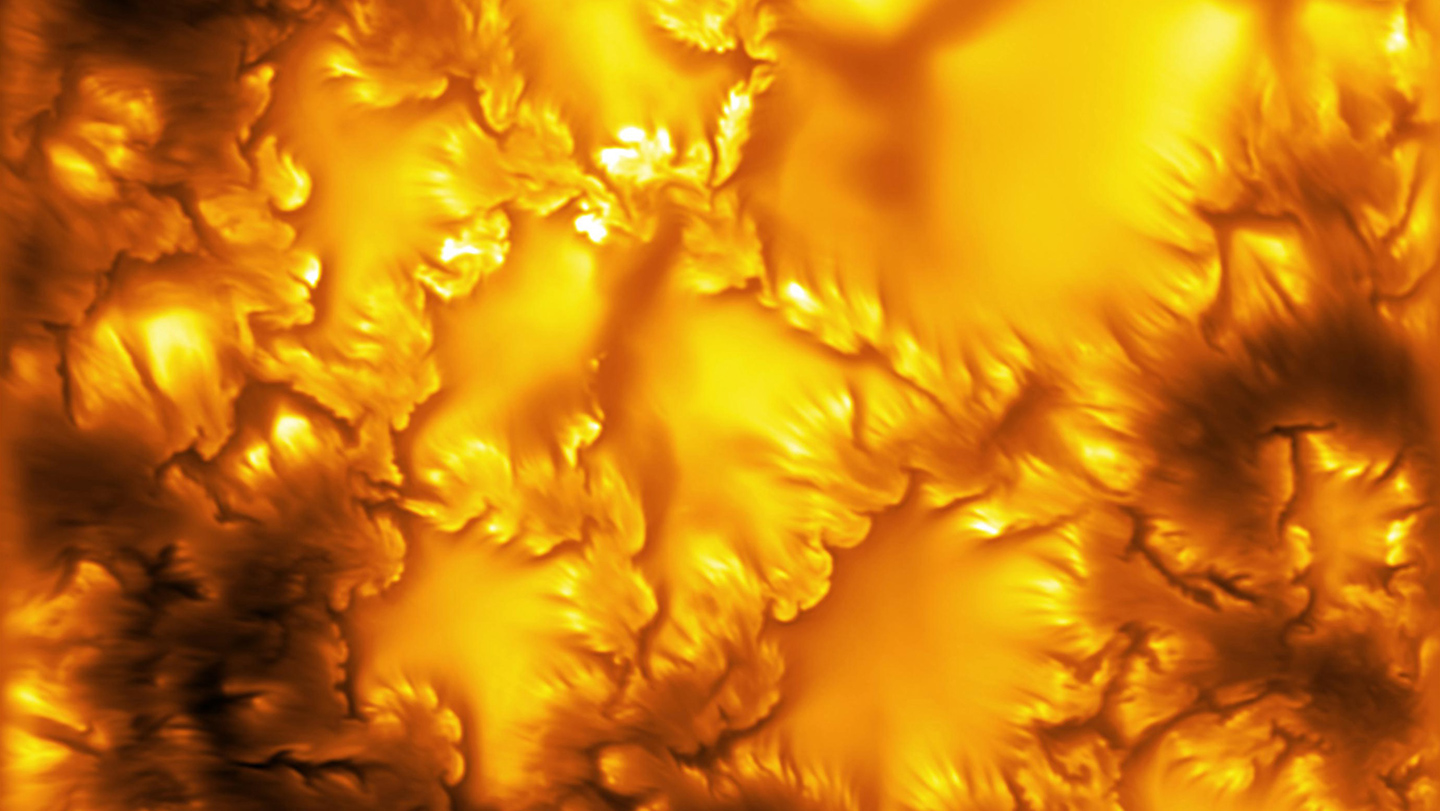
High-energy whirlpools speckle the sun’s surface.
New telescope images show characteristic swirls of magnetized plasma across a 19-kilometer-wide patch of the sun’s surface. The observations, reported August 5 in Nature, are the most detailed taken of the sun to date. The images also provide evidence for a type of fluid instability that might explain the sun’s outbursts, such as solar flares and eruptions.
“This instability occurs everywhere at the boundaries of solar magnetic elements,” says astrophysicist David Kuridze of the National Solar Observatory headquartered in Boulder, Colo.
Solar magnetic elements are regions of highly magnetized plasma on the sun’s surface. There are millions of them, and energy from their magnetized plasma can be transferred, stabilized and transformed by swirling motions — a phenomenon called the Kelvin-Helmholtz instability.
Kelvin-Helmholtz instability, or KHI, occurs when two fluid layers move next to each other at different speeds. A small disruption in the balance of these two forces can cause curling motions that roll up into waves. The instability has been observed in some ocean waves, clouds, Jupiter’s atmosphere and even the sun’s atmosphere.
But it has never been directly observed on the sun’s surface — until now.

The Daniel K. Inouye Solar Telescope captured the new images. The telescope, located near the summit of the Haleakalā volcano in Maui, Hawaii, is the largest solar observatory in the world and sports a mirror measuring 4 meters in diameter. It can take images of the sun’s surface at a higher resolution than was previously possible.
The new images show that on the sun’s magnetized surface, the Kelvin-Helmholtz instability can convert swirling plasma, which acts as a fluid, into tension that twists the magnetic field. That creates energy that can cause a solar explosion.
“Detecting these KHI structures requires resolving [structures] down to the 20-kilometer scale, a level of detail that was simply invisible until now,” Kuridze says.
To get such a crisp view, engineers also incorporated an adaptive system that corrects blurring caused by Earth’s turbulent atmosphere. This was crucial for fixing distortions that would have otherwise destroyed such fine resolution images, says Leon Ofman, an astrophysicist at the Catholic University of America in Washington, D.C., who was not involved in the study.
Understanding how magnetic structures on the sun’s surface transfer energy in fluidlike motion could provide insights into how solar activity develops.
“We are now beginning to understand that we need to study this process in order to understand all the stages of the transfer of energy from the interior [of the sun], going to the surface … and then affecting us on Earth and beyond,” Ofman says.
Read the full article here