





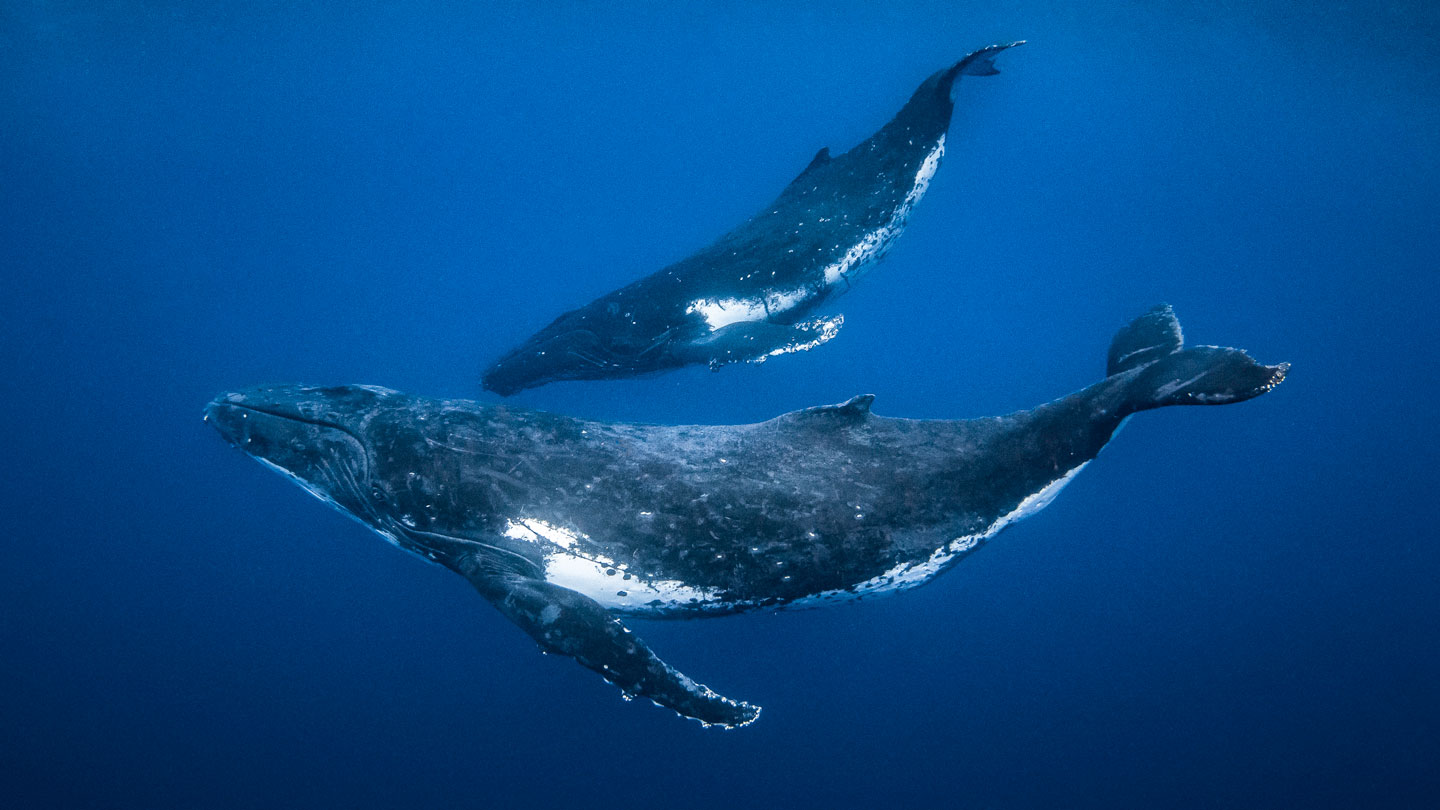
Humpback whales are known for their ingenious hunting tactics. One of the most sophisticated strategies involves as many as 20 whales working together to create a “net” of bubbles underwater that rise to trap fish and krill near the ocean surface.
Now, a recent study provides the first documentation of humpback whales (Megaptera novaeangliae) teaming up to feed at the seafloor too.
The hunting party consists of two to four whales that arrive simultaneously at the bottom of the ocean and roll to their sides while moving closer to one another. They orient head-to-head and open their mouths nearly synchronously to capture sand lances — small, eel-like fish that typically burrow or school along the sandy seafloor at night. Researchers report this coordinated hunting technique July 2 in Behavioral Ecology and Sociobiology.
“It’s a really exciting study,” says Luke Rendell, a marine biologist at the University of St Andrews in Scotland who was not involved in the work. The new findings suggest that there’s a lot more complexity to how humpback whales make their living “than we’ve maybe previously appreciated,” he says.
Researchers have long observed humpback whales devouring sand lances off the coast of Massachusetts in the Stellwagen Bank National Marine Sanctuary. A 2014 study documented these whales producing a unique “double pulse” call to communicate exclusively while bottom-feeding, mainly at night. Suspecting that the animals may be calling to coordinate hunting at the seafloor, the researchers used movement data, audio and video recordings from whales tagged in 2018 to study their behavior.
“When we first deployed these tags and got some of the footage back, it was crazy,” says Jeremy Goldbogen, a marine biologist at Stanford University.
In 87 out of 110 benthic-hunting events involving seven Stellwagen Bank humpback whales, Goldbogen and his colleagues observed the animals working in groups. They formed alliances with one to three other whales, all pointing their heads at each other and moving closer until their snouts almost touched. In near unison, the majestic creatures opened their mouths to scarf down sand lances shooting from the sediment.
While most of these observations came from tags on three individuals — Wonderland, Bolide and Bombay — the researchers noted a consistency in the groups’ behavior. The tagged animals and their cohunters arrived at about the same time to the seafloor; they often assumed the same position during hunting events; and they opened their mouths nearly simultaneously to feed.
“I’m convinced that this is cooperative behavior,” Goldbogen says, as opposed to whales merely aggregating to feed. He and his colleagues speculate that this benthic hunting strategy evolved so that whales could take advantage of sand lances’ burrowing and dense schooling behavior.
Diving for dinner
In the Stellwagen Bank National Marine Sanctuary, humpback whales team up at the seafloor to corral and capture sand lances. Two to four whales arrive concurrently, as seen in this animation. They then position themselves head-to-head, and open their mouths nearly simultaneously to feed on these schooling fish.

In Stellwagen Bank, the research team has seen individual humpback whales switching between surface bubble-net feeding and benthic hunting. It’s like they’re “playing two sports that have completely different skill sets to be successful,” says Ari Friedlaender, a marine biologist at the University of California, Santa Cruz. But the research team does not know — and hopes to find out — whether the same whale groups that feed together near the ocean surface also work in tandem at the seafloor.
Rendell also wonders if and how individuals are related to each other in these benthic hunting parties and whether the crew remains consistent over the years. Still, he says what amazes him is that even in one of the best-studied humpback whale populations in the world, there are still surprises and complexities to unravel.
Read the full article here