






On Sunday 6 September, the EU’s Entry/Exit System (EES) emergency flexibility measures will come to an end.
Over the summer, member states were granted authority to temporarily suspend the collection of travellers’ biometric data through fingerprints and facial scans to ease congestion in exceptional circumstances.
Industry bodies are now pushing for these flexibilities to be extended beyond September amid concerns of renewed border delays.
Less flexibility at airports and borders
The biometric system became fully operational across participating European borders on 10 April 2026, following a progressive rollout that began in October 2025.
However, European authorities have had a vital safety valve available during the transition.
Under EU rules, countries have been permitted to temporarily suspend the collection of biometric information at individual border crossings when passenger volumes become so high that waiting times become excessive.
From 6 September, that temporary period is expected to expire, meaning airports and border authorities will have less flexibility to ease biometric requirements simply because passport control areas have become overwhelmed.
At a press briefing on 1 September, a European Commission (EC) spokesperson said the EES had “broadly worked well” over the summer while underlining that “the advantages of the new system for the EU are evident”.
Referring to the end of flexibility measures on 6 September, the EC spokesperson said: “When it comes to the time after the summer, we are in close and constructive contact with those few member states where some adjustments are needed at certain border crossing points.
“Overall, we can see that there is a strong joint will to make the system work everywhere.”
After 6 September, Jurgen Himmelmann, co-founder and CEO of Global Work & Travel, says travellers should build significantly more time into journeys involving European border controls.
“Getting to the airport early is sensible, but there is a limit to how much control that gives you,” he says. “Bag-drop desks may not be open four hours before departure, and once you’re in a passport-control queue, you can’t simply skip ahead because your flight is boarding.
“I’d avoid planning a journey around the minimum connection time over the next few weeks. A connection that looks perfectly reasonable on paper can become uncomfortable very quickly if you lose an hour or more at the border.”
Fears of renewed border delays in September
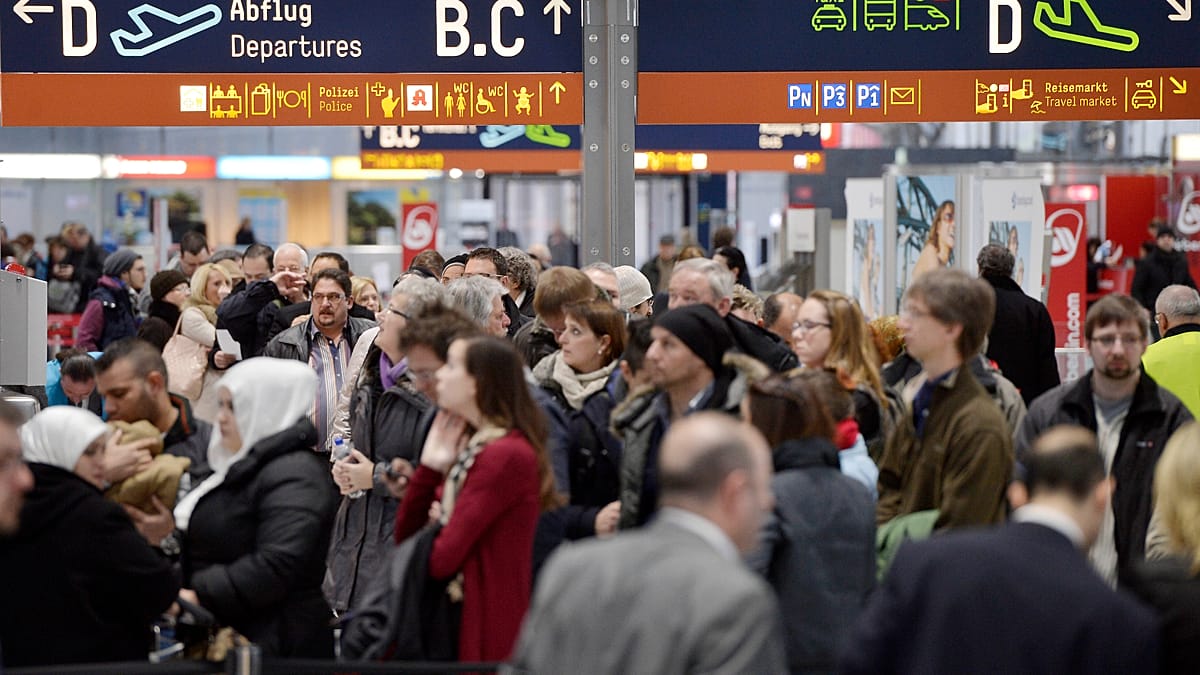
Industry experts are concerned the removal of EES temporary flexibilities will see border chaos return.
“We continue to push the European Commission to allow these measures to be used beyond September, recognising that there is still some way to go until EES is fully and consistently operational across all participating countries,” said Luke Petherbridge, Director of Public Affairs at ABTA, a UK trade association for tour operators and travel agents.
According to the International Air Transport Association (IATA), standard passport checks that previously took around 20 to 25 seconds now require about 90 seconds under the EES.
Data shows wait times have doubled at major hubs as the scheme struggles to cope with the sheer number of non-EU passengers passing through.
The study by UK-based newspaper the Financial Times and travel analytics group Qsensor shows that in Frankfurt, the average wait time reached 120 minutes in July, up from 60 minutes the same month last year.
At Munich airport, waits are up to 60 minutes from 31 last year and, in Amsterdam, maximum waiting times have rocketed from 80 to 120 minutes in the same period.
IATA has also urged the European Union to grant an extension of the “safety valve”.
“Extending the possibility of partial suspension beyond 6 September is absolutely necessary until the end of the winter season,” Thomas Reynaert, Senior Vice President, External Affairs at IATA, said at a media briefing this week.
Reynaert stressed that the association is “fully supportive of EES” but that certain conditions should be met before flexibilities are removed.
Writing in a LinkedIn post, he added: “Reliable systems, fully deployed self-service kiosks and automated border controls, together with adequate staffing, remain essential if EES is to operate effectively during peak periods without creating unnecessary disruption for passengers, border authorities and transport operators.”
Read the full article here