





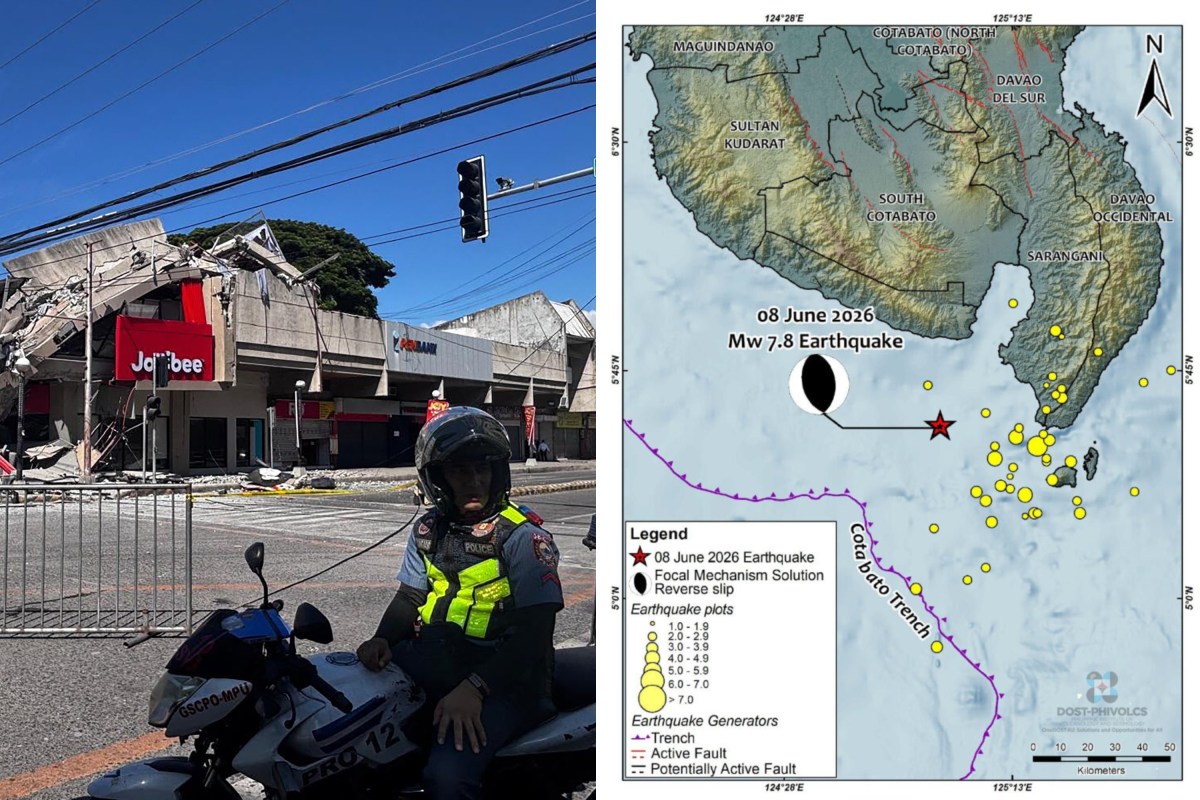
A tsunami alert has been triggered following a 7.8 magnitude earthquake off the coast of Sarangani in the southern Philippines early on Monday.
Tsunami waves “with a height of approximately 1 meter” were recorded along the coasts of Kiamba and Maasim, Sarangani, and Kalamansig, Sultan Kudarat, according to the Philippine Institute of Volcanology and Seismology (PHIVOLICS). Smaller waves were recorded in Mati City and Zamboanga City, it added.
The first tsunami waves were forecast to arrive between 7:37 a.m. and 9:37 a.m. local time, and could continue for hours, PHIVOLCS, said.
Authorities issued a tsunami warning for several coastal areas across southern Mindanao and the Sulu Archipelago.
Residents in this area are advised to “evacuate immediately to higher grounds or move farther inland,” according to advice from the U.S. embassy in the Philippines.
At least 15 people have died and at least 129 were injured after the earthquake, according to Philippine authorities.
There is no threat to Hawai, the Pacific Tsunami Warning Center assessed.
Earthquake Rocks Philippines
Philippine President Ferdinand Marcos Jr. said that “the national government is moving and we will not leave Mindanao behind.”
He urged people in the affected provinces to “please heed the tsunami warning.”
“Move to higher ground now. Do not wait. Your life is more important than anything left behind,” he said.
The earthquake, which had a depth of 10km, or 6.2 miles, per PHIVOLCS, was felt primarily in General Santos City in the island of Mindanao.
Photos from after the quake show damaged buildings in the port city, which has a population of about 720,000 people.
At least 138 aftershocks were recorded by the DOST-PHIVOLCS Philippine Seismic Network. Authorities noted that aftershocks can continue for several days to weeks.
Tsunami Warnings
The Pacific Tsunami Warning Center initially warned of possible waves of up to 3 meters, or about 10 feet. It later said that the tsunami threat had largely passed about five hours after the earthquake, according to the Associated Press.
Several countries in the region, including the Philippines, Malaysia, Indonesia and Japan, issued tsunami warnings, but most of the warnings have since been lifted.
The Philippines is among the world’s most earthquake-prone countries, as it sits on the Pacific Ring of Fire, a zone of intense seismic and volcanic activity.
US Embassy Advice
The U.S. Embassy to the Philippines has said the American Citizens Services unit in Manila and Consular Agency in Cebu are “fully operational.” Theembassy issued the following advice:
- Residents in the tsunami warning areas are strongly advised to evacuate immediately to higher grounds or move farther inland. Refrain from activities like swimming, surfing, fishing, and boating.
- Follow instructions from local officials, which may include closing beaches, evacuating low-lying areas, harbors and marinas, or moving ships to deeper water if safe to do so.
- Exercise extreme caution if you live within the affected areas.
- Stay calm and alert. During periods of seismic activity, watch out for falling objects and stay away from glass windows, shelves, cabinets, and other heavy objects that may cause injury.
- Maintain awareness of conditions and avoid steep slopes.
- Monitor local media and the PHILVOLCS website for updates.
- Monitor updates from local disaster and risk reduction management offices.
This is a developing story; updates to follow.
Read the full article here