




My father loved fishing, fried rice and footy – specifically the Hawthorn Football Club. But there was something he loved even more – being proved right.
And so if there is an afterlife, he will be sitting there with a cold bottle of VB saying to Moses, “I told you so”, before advising him on the best way to part the Red Sea.
They would be talking about the infiltration of the giant CFMEU by organised crime and would roll their eyes that Victoria’s corruption-busting commission has not been allowed to ask one question, let alone launch a full-blown inquiry.
When my father Fred was a senior policeman, he was the first law enforcement officer to call for a permanent independent commission against corruption in Victoria.
In the early 1960s he went to Hong Kong to extradite a crook to Victoria and developed a close friendship with Norman Whiteley, a gun-barrel straight local cop.
Ten years later, it was revealed the Hong Kong police force was as rotten as a month-old sweet and sour chop.
I met Whiteley in Hong Kong where he explained, “Here, honest police are like lighthouses, they stand out in the dark.”
In 1974, the governor of Hong Kong established ICAC with three roles: to expose corruption, advise government departments and businesses how to build corruption-resistant systems, and educate the public on the cost of corruption.
Its brief was broad: “To receive and consider all complaints of bribery, whether against Crown servants, public servants, or other persons.”
Whiteley was appointed deputy director (operations). ICAC was so successful that the local police rioted and stormed the anti-corruption building.
Fred kept in touch with Whiteley and in 1980 completed an ICAC senior management course. He came back convinced the model would work here. He later said: “Organised crime cannot thrive without corruption. It is already more entrenched than people are prepared to admit.”
He wanted a three-pronged attack: an Australian bureau of criminal intelligence, the introduction of US-style Racketeer Influenced and Corrupt Organisations (RICO) laws, and an ICAC.
The result was lip service. The criminal intelligence bureau was established with insufficient resources; plans to introduce RICO were shelved (the opposition is claiming it will introduce it 45 years after Fred’s recommendation), and Victoria’s version of ICAC was a limp alternative to the Hong Kong model.
The relationship between Victoria Police and ICAC became so close that Hong Kong undercover officers were used to infiltrate Melbourne’s Chinatown looking at police corruption.
In 1977, career cop Tom McGrath was planning to resign from Victoria Police when his wife was appointed to a position in Hong Kong. Instead, assistant commissioner Mick Miller arranged a three-year secondment to the ICAC.
“The legislation was amazing for the time and the resourcing incredible. We were there to investigate government departments, but it wouldn’t stop us looking at private companies that were offering bribes,” says McGrath, who became a senior corruption investigator in Victoria and NSW.
He says an anti-corruption body needs strong legislation, proper resourcing, access to top investigators and the capacity to find the money hidden in investments, often held by third parties.
In 2012, the government set up the grandly named and poorly resourced Independent Broad-based Anti-Corruption Commission.
Even the name is ridiculous, for it isn’t broad-based at all – hence its inability to investigate corruption claims involving the CFMEU.
There has always been a whiff of arrogance in Victoria where off-the-shelf-solutions are never good enough. We have a police chief commissioner, while everybody else has a commissioner. NSW and South Australia have an ICAC so we have an IBAC.
Everybody else has a workable public transport tap on system, so we invent myki – that involves strapping cash to a carrier pigeon that flies to a railway station where the station master fills out a ticket request with quill and ink to be collected when the purchaser provides an earwax DNA sample, along with photo ID and an original birth certificate.
If Victorian planners were asked to re-invent the wheel they would come up with a triangle.
The state government’s defence over its response to the corruption allegations is indefensible. Premier Jacinta Allan says she referred the matter to IBAC without saying they didn’t have the power to investigate.
Former IBAC commissioner Robert Redlich said: “It should have been well-known to the premier and her officers assisting her that IBAC’s jurisdiction is limited to investigating misconduct by public officials.”
In other words sending IBAC, with its limited powers, after the CFMEU is about as useful as sending a seal after a shark. The unanswered question is: Why didn’t the government give IBAC the powers to investigate the CFMEU?
A report by corruption investigator Graham Watson, SC, estimated the loss to Victorian taxpayers at $15 billion. The Premier rejected Watson’s figures. “This is a claim that the administrator has said is not well tested or properly founded.”
Watson was attacked as being fast and loose with the facts. If only the government had confronted corruption with the ferocity it attacked the corruption investigator, we may not be in this mess.
The government quibbling over the $15 billion figure is akin to arguing over how many stab wounds there are in a corpse.
Such figures are difficult to comprehend. If you had $15 billion in 1.5 billion $10 notes and laid them end to end they would cover 137,000 kilometres or three times around the world plus Melbourne to London and enough left over for a taxi from Heathrow.
The Reserve Bank produces $10 notes in sheets of 45. It can print 8000 sheets an hour. If they turned the machine on now and ran it for 24 hours a day it would take 173.6 days to make $15 billion.
A secret commission is exactly that – secret. Bribery is difficult to uncover because the bribee and briber want to keep it quiet.
The way to uncover it is to follow the money, as it is pointless taking a bribe if you can’t spend it.
Yet IBAC does not have that power.
The off-the-shelf solution – the Hong Kong ICAC – was given the power to seize suspects’ passports, freeze all assets and require statutory declarations on how the person under investigation had achieved apparently unexplained wealth.
It could charge civil servants for living beyond their means.
In 1985, I visited the Royal Hong Kong Police and ICAC as part of a journalism scholarship. The two bodies hated each other.
The ICAC staff had a replica of a London pub bar in the office known as the Rabbit Hutch, and they had the capacity to drink like thirsty robots.
In August 1985, I wrote: “Australia could well do with an independent body to investigate corruption in the building industry, trade unions, big business, as well as police, judicial and political circles.
“The ICAC experience shows that an elite body set up to investigate all corruption can succeed if there is the political will to support it.”
Where is the political will? Why are these bodies told to dig deep and then equipped only with a plastic spoon?
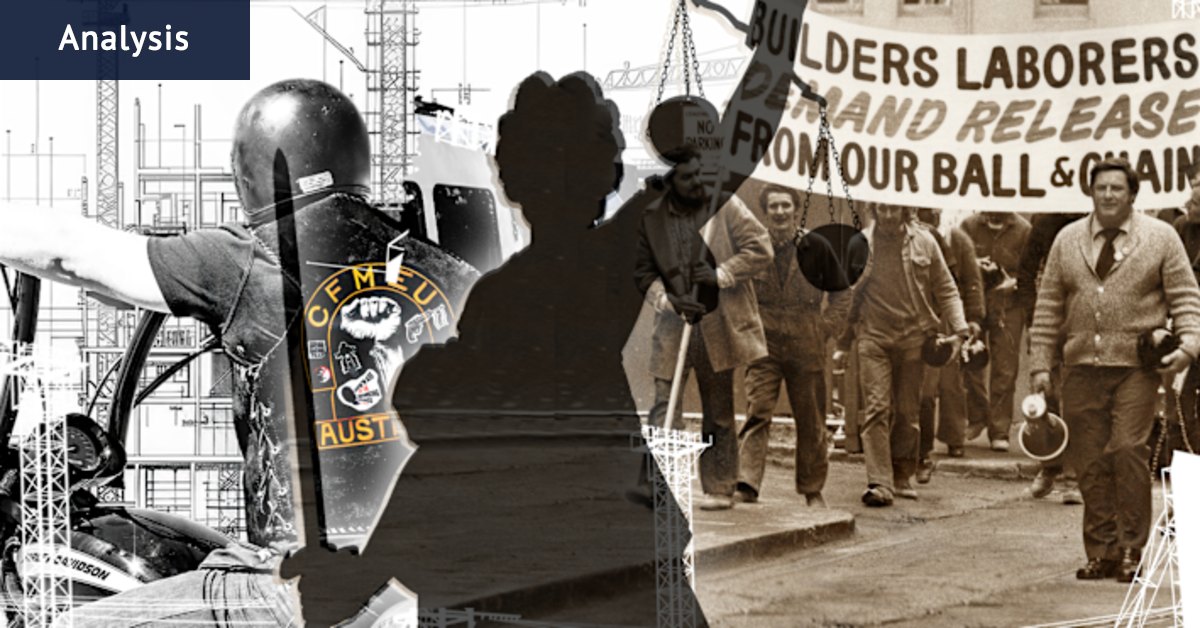
In 1981, police inspector Rick Murphy wrote a secret report into the Builders Labourers Federation, the father of the CFMEU.
And guess what Rick did? Followed the money.
He wrote: “The investigation has revealed there is collusion between various builders/developers and officials of the union under investigation.”
Turns out union secretary Norm Gallagher and other family members had their holiday houses at McLoughlins Beach, Gippsland, built and fitted out for free.
An accountant from one of Victoria’s biggest developers said that when Gallagher visited the office he was told, “Norm’s a bit short” and instructed to make out a $20,000 cheque for cash.
The Murphy inquiry was generated by intelligence gathered by police, resulted in a taskforce, a judicial inquiry, Gallagher jailed and the BLF deregistered. Because there was a will to seek the truth.
In contrast, the call for a royal commission into today’s CFMEU is convenient and lazy. It is expensive to set up, and can take years to deliver – if at all.
The inquiry into barrister/informer Nicola Gobbo cost $200 million and didn’t issue as much as a parking ticket.
A properly designed ICAC is both a law enforcement body using orthodox powers and a royal commission that can use coercive hearings.
Want to reform IBAC?
Rename it ICAC, give it powers to investigate all corruption in the public and private sector and to follow, freeze and seize the assets of corruption.
Considering the scope of the problem it would become self-funding.
Move allegations of serious police corruption from the police Professional Standards Command to ICAC. This will free 150 police to return to crime-fighting duties and remove perceived conflicts of interest.
Recruit recently retired police detectives to become ICAC investigators. Rotate serving detectives through ICAC, giving them a break from shift work and assisting in long-term retention.
Remove or reduce inefficient government authorities that oversee individual industries and professions.
Appoint an ICAC board of a retired senior police officer, retired supreme court judge and a civilian to oversee operations.
The ICAC commissioner would have to apply to the board to use royal commission powers for special investigations that would include compulsory hearings and the capacity to seize financial records.
From our partners
Read the full article here