





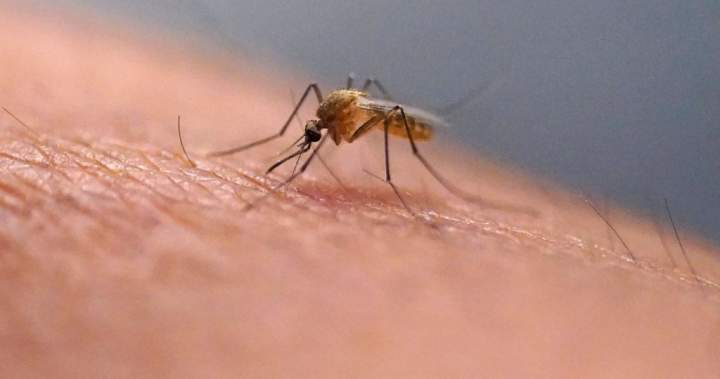
Positive mosquito pools carrying West Nile virus have been detected in several Ontario communities and across Canada over the past week, prompting renewed reminders for residents to protect themselves from mosquito bites.
Toronto, Windsor-Essex, Belleville, York Region and Halton Region have all reported positive mosquito pools this season, with public health officials saying the detections are an early sign the virus is circulating locally.
No human cases have been reported in those regions so far, but one person has tested positive while travelling outside of Canada.
Toronto Public Health has confirmed one batch of mosquitoes tested positive for West Nile virus this season, while Windsor-Essex and the Belleville area have each identified one positive mosquito pool.
York Region has reported two positive mosquito traps and two positive mosquito pools, both in Markham, while Halton Region has reported two positive mosquito pools during the week of July 13 to 19.
A total of 14 dead wild birds have tested positive for the virus in Canada, including 13 in Ontario and one in Manitoba.


Get weekly health news
Receive the latest medical news and health information delivered to you every Sunday.
Public health officials say residents who encounter a dead bird or other animal on their property should not handle it with bare hands because it could carry West Nile virus or another pathogen.
The organization recommends that dead birds or animals be buried using a shovel and gloves, at a depth of at least 50 cm (about one and a half feet), in an area that will not be disturbed.
However, health officials say West Nile virus detections are typical at this time of year, although residents should still take steps to protect themselves from mosquitoes.
“What we see during this time of the year… if mosquito pools are showing a few positive cases, that is in line for this time of the year and this season,” said Dr. Isaac Bogoch, an infectious diseases specialist and professor at the University of Toronto.
What is West Nile virus?
West Nile virus is spread to people through the bite of an infected mosquito. Mosquitoes become infected after feeding on birds, which are the virus’s natural hosts. The virus is not spread from person to person through casual contact.
Most people infected with West Nile virus do not develop symptoms.
“Usually people will feel sick with a headache, fever and chills for a few days and then recover,” Bogoch said.
However, he said a small number of infections can become much more serious. “In some cases, it can cause neuromuscular manifestations and other nerve-related problems,” Bogoch added.
Older adults and people with weakened immune systems are at greater risk of developing severe illness, according to the federal government.
However, Bogoch said the detections shouldn’t discourage people from spending time outdoors.
“It’s beautiful outside, so we should all definitely get outside and enjoy the sunshine,” he said.
“But there are some ways you can stay protected. Wear long clothing, use DEET or icaridin.”
Public health units also recommend removing standing water around homes, where mosquitoes can breed, and taking extra precautions at dawn and dusk, when mosquitoes are most active.
Read the full article here