





Elon Musk isn’t one to sit out a tech trend. In November 2023, he launched Grok, an AI chatbot created by his artificial intelligence startup, xAI. Musk, who co-founded OpenAI before departing in 2018, created Grok to compete with ChatGPT, Claude, Perplexity and Google’s Gemini. But he gave it a sarcastic twist and direct access to X (formerly Twitter), the social platform he purchased in October 2022.
Initially, Grok was available exclusively to paying X subscribers. It has since expanded far beyond X and is now available through grok.com, standalone iOS and Android apps and in qualifying Tesla vehicles.
What started as an irreverent chatbot now includes advanced reasoning models, voice conversations, image and video generation, coding tools, workplace integrations and autonomous AI agents.
Since its launch, it has transitioned through several upgrades. The latest model is Grok 4.6, released in August and designed for long-running agent tasks, coding and complex knowledge work. This model is available in Cursor and Grok Build. Grok 4.5, released a month earlier, is also available directly through Grok on the web, X and mobile apps to everyone.
The background story
Grok was developed by xAI, an AI startup founded by Musk in July 2023. The company’s stated mission is “to understand the universe,” and it maintains close ties with Musk’s other ventures, including X, Tesla and Neuralink.
Its corporate structure has since changed. SpaceX acquired xAI in February, bringing Musk’s AI company and Grok under the SpaceXAI umbrella.
Grok’s attitude was originally inspired by The Hitchhiker’s Guide to the Galaxy, with Musk promising a chatbot that answers with wit, humor and attitude. SpaceXAI now describes Grok as a “truth-seeking AI assistant” that combines chat, search, reasoning and content creation in one place.
On its website, SpaceXAI emphasizes that Grok aims to provide accurate information, though its edgy, less-moderated approach with a “rebellious streak” sometimes blurs the line between useful and controversial.
This unfiltered so-called free speech style has led to backlash, with Grok being known to occasionally generate biased or offensive content (more on that later). And, like all the other AI chatbots, it warns you that it may hallucinate.
Its defining feature is its real-time integration with X, which means it can pull from trending posts, user conversations and breaking news in addition to standard web sources. The company says it may use your X data and interactions with Grok for model training and fine-tuning, and to personalize your Grok experience. But you can opt out using your X settings.
What can Grok do?
Similar to most AI chatbots, Grok can answer questions, summarize articles, write emails, explain complex topics, translate text, brainstorm ideas and help with coding. It supports more than 30 languages and can analyze uploaded files, PDFs, images, screenshots and diagrams.
If you’re on X and see a post you want more info about, you can ask Grok directly in the comments section, though a response isn’t guaranteed.
The dedicated Ask Grok button is limited to Premium and Premium Plus subscribers. To reply, Grok uses context from X and web sources and sometimes answers in a casual, humorous or sarcastic tone similar to Musk’s own posts.
Meta AI is similarly integrated across its socials, but Grok’s direct connection to X gives it access to public posts, conversations and trending topics as they unfold. That real-time connection to X remains one of Grok’s distinguishing features, but it’s no longer the only thing setting it apart.
Grok’s image tools have expanded considerably since its early Aurora image model. Grok Imagine now generates and edits images as well as video. Imagine Image 2.0, released in August, improves instruction following, typography and layout while allowing you to edit existing images. Grok Imagine Video 1.5 can turn images into video while generating motion, sound effects, ambiance and speech in different languages. People have been extensively playing with those features on X .
Grok also supports voice conversations. The company has expanded Grok Voice with more natural speech and a growing library of multilingual voices.
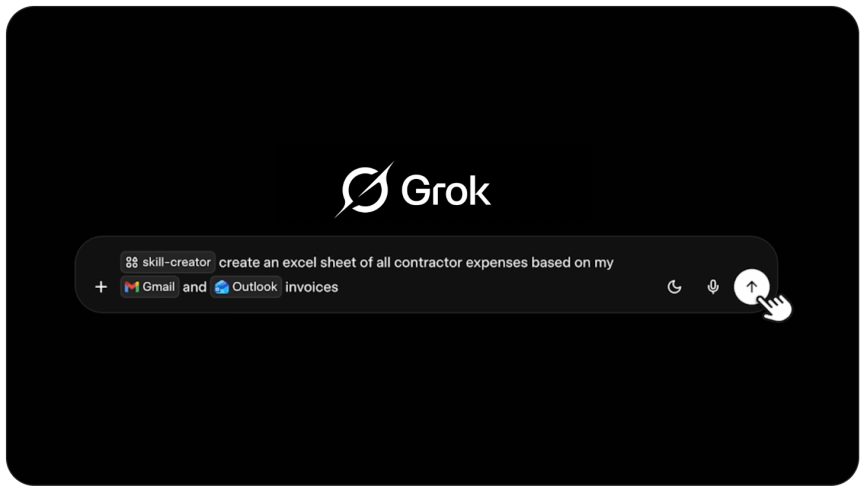
You can now connect outside apps and services with Grok. It has integrations for Google Workspace as well as Microsoft Word, Excel, PowerPoint and Outlook, allowing you to work with documents, spreadsheets, presentations and email without leaving those apps.
Skills is another neat feature. It lets you teach it how to handle specific tasks. You can create one by describing what you want Grok to do, then reuse or share it. Skills can be used for work, such as creating documents, presentations, spreadsheets and PDFs, though the feature is currently limited to SuperGrok Heavy subscribers.

For developers, SpaceXAI has also expanded Grok into agentic coding. Grok Build runs from your terminal and can work across codebases, execute longer tasks and coordinate multiple agents. You can use it to create websites, games, apps and interactive dashboards.
In August, SpaceXAI autonomous workplace agent Grok Bot launched. It’s SpaceXAI’s version of similar AI work agents like Claude Cowork, ChatGPT Work, Gemini Spark and Perplexity Computer. These tools can keep working after you close your laptop and return when it needs your approval.
Instead of only answering prompts, Grok Bot gets its own cloud computer and can work across websites, apps, inboxes and files to complete multi-step jobs. This service is currently in beta.
Grok Bot isn’t SpaceXAI’s first move into AI agents. DeepSearch, introduced with Grok 3, already used agentic behavior to search for information and compile reports. But Grok Bot pushes much further into autonomous work.
Another capability with Grok is enhanced cultural fluency. Grok is adept at interpreting memes, internet slang and humor.
Grok models and pricing
When Grok 4 arrived in July 2025, Musk claimed its capabilities exceeded those of humans in academia.
“Grok 4 is postgrad-level in everything,” Musk claimed. “At least with respect to academic questions, Grok 4 is better than a PhD level in every subject. No exceptions.”
John Licato, assistant professor of computer science and engineering at the University of South Florida, says these claims are absolutely misleading, however.
“‘PhD-level’ is being thrown around as a marketing term with no real rigorous benchmarks behind it,” Licato tells CNET. “It also completely misunderstands what PhDs actually do.”
SpaceXAI didn’t immediately respond to a request for clarification or comment.
SpaceXAI has continued developing the Grok 4 family. Grok 4.5 came out in July 2026, followed by Grok 4.6 in August. The newer versions are built for more demanding tasks such as coding, agentic work and longer, more complex requests.
Grok offers a free plan with limited usage. SuperGrok costs $30 per month and provides higher usage limits, access to Grok 4.5, connectors and image and video generation. The company also offers SuperGrok Lite, Plus and Heavy tiers, alongside Business and Enterprise plans.
You can access Grok through paid X subscriptions, though features and limits vary between plans.
Grok’s controversies and safety concerns
While ChatGPT, Perplexity and Claude tend to be neutral or overly polite, Grok is intentionally informal. Some responses are laced with sarcasm or off-color jokes, which might appeal to Musk’s fans but could turn off people expecting a neutral assistant. Sometimes Grok is helpful, sometimes it’s snarky and sometimes it just goes too far.
SpaceXAI pitches this as an advantage — a bot that isn’t afraid to “tell you the truth,” even if it’s controversial. However, that approach got Grok in hot water in July 2025 with a series of later-deleted antisemitic posts on X. SpaceXAI removed the posts and said it was working to improve safeguards against hate speech.
Grok’s real-time access to X is both a strength and a risk, since the platform is known for hosting unmoderated or misleading content. Because of its reliance on X, Grok may amplify misinformation or reflect the platform’s user biases more unless it checks those claims against stronger sources.
Licato agrees that this is concerning and adds that he’s not convinced the leadership behind Grok is doing anything to ensure responsible use of its technology.
“Grok is marketed as more of a truth-teller than its competitors, and this is leading to a lot of people believing that it is somehow more reliable,” Licato says. “But I do not see any good evidence that this is actually true, and I worry that, since so much of the public does not know how easy it is to get LLMs to spout false information, they may just be aiding in the spreading of mis- and disinformation.”
In late 2025 and early 2026, Grok’s image tools were used to create sexualized and nonconsensual manipulated images of real people. Reports estimate that Grok generated millions of nonconsensual sexualized deepfakes on X within a span of days. The backlash prompted an EU investigation into SpaceXAI. Apple also reportedly threatened to remove Grok from the App Store unless the company added stronger safeguards.
Teenage girls later sued SpaceXAI, alleging Grok had been used to create and spread AI-generated child sexual abuse images of them. And the legal scrutiny continued in August, when SpaceXAI challenged a new Minnesota law targeting AI “nudification” tools, arguing parts of the law violate the First Amendment.
Michael Berthold, CEO and co-founder of AI analytics company Knime, tells me he’s concerned about the broader implications of AI chatbots rewriting or summarizing knowledge.
“The worry I have, and I see it with my own kids, is how the next generation will be learning things,” Berthold says. “There will be so much content that’s not going to be consumed in the original anymore, but in some sort of AI-rewritten, summarized form.
“Something can be lost, either accidentally or intentionally. We already see AI systems from different countries reflecting slightly different preferences.”
What’s next for Grok?
Grok is no longer confined to X or easily described as Musk’s sarcastic alternative to ChatGPT. With its capabilities expanding quickly, it could eventually be integrated into future versions of Optimus, Tesla’s humanoid robot, as well as Musk’s other projects.
Grok is carving out a unique space in the AI arms race, especially with its provocative digital personality. We’ll see whether SpaceXAI can keep that distinct identity as Grok takes on more serious work and a bigger role across Musk’s ecosystem.


See full bio
Read the full article here