


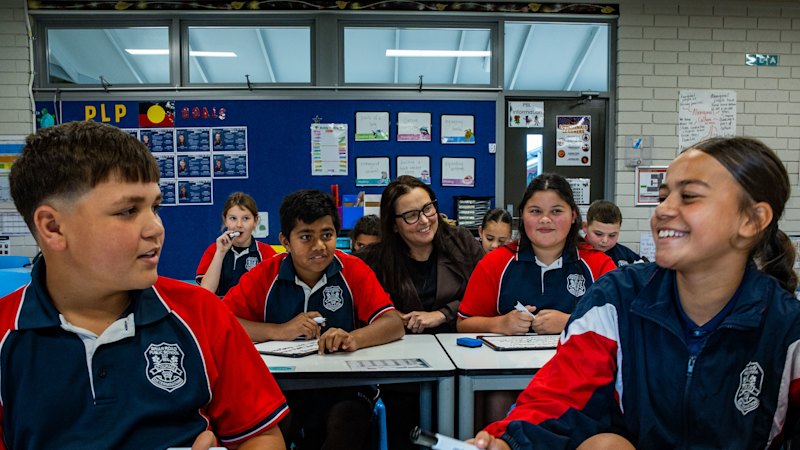
Every term, Briar Road Public in Sydney’s south-west invites parents for dinner at the school to discuss what teachers have been doing. But this year, principal Tammy Anderson went a step further: teachers put parents in the classroom for a demonstration. “We actually opened the classrooms and had teachers running the lessons,” Anderson said.
Briar Road in Airds, near Campbelltown, might be a little different to other schools in Australia. For the past five years, Anderson and her staff have overhauled how they approach learning by employing explicit teaching practices. It means new concepts are explained as small digestible chunks. Teachers model how to perform a task with step-by-step instructions, constantly checking for understanding before releasing students to work independently.
Underpinned by the cognitive science of how students learn best, the school day starts with a daily review of previous content. It also involves the teacher “cold calling” on students to ensure they’re paying attention. At Briar Road, where about half of the students are Indigenous, it is known as “boomeranging”.
“We had such great feedback in our exit slips from parents saying, ‘Oh my goodness, I actually wish I was taught like that’,” Anderson told the Herald.
The predictable, structured routines are the same in almost every classroom. Behaviour has improved. NAPLAN results are impressive. “I have tried lots of different things, and we had pockets of things that worked,” Anderson said. “But this has been something that has shown sustained outcomes for our kids. It’s evidence. It’s not feelings. It’s not emotions.”
But in the education world, the evidence can sometimes trigger strong emotions and emotions might feel like evidence. Those tensions were brought to the fore this week with the release of the latest global report card on schooling.
Program for International Student Assessment results show Australia’s reading and mathematics scores have continued their 20-year decline Students are now at least two years behind peers who sat the test at the turn of the century. Science results are stagnant. While the equity gap has narrowed, it is not because poor pupils recorded better results, but because the performance of rich students declined. If the Australian education system was a consumer product, customers this week might think they were entitled to a refund.
Globally, academic results are in freefall. Analysts point to factors external to school: increased digitalisation, longer screen time and falling rates of reading for enjoyment. Teachers say AI chatbots, which allow students to outsource their thinking for even basic homework tasks, have ripped like a bushfire through classrooms since 2022 and are robbing students of the need to think. Almost everyone agrees we have a problem, but a fight is under way between sections of the nation’s universities and education bureaucrats about the best way to go about fixing it.


One potential solution lies in England, which broke into the global top 10 for the first time since the PISA tests began in 2000. It now has one of the best education systems in Europe after rolling out a suite of reforms, including teaching students to read with phonics – the practice of decoding the sounds that letter combinations make. England has overhauled university teacher training programs with a focus on explicit teaching.
While other school systems were talking about problem-solving capabilities, England was making students rote learn times tables. When educationalists in countries like Australia were arguing facts were no longer important because they could be easily Googled, England developed a “knowledge rich” curriculum. Its policymakers reasoned a student could critically think about an issue if they knew the requisite set of facts about it. Championing the results this week, former education secretary Nick Gibb said England learnt “the accumulation of knowledge in long-term memory leads to an increased ability to think and perform higher-order intellectual tasks”. (Wales and Scotland did not emulate England’s approach and their results in the latest PISA tests lag England’s.)
This week, Education Minister Jason Clare singled out those reforms, enacted by a former conservative government, as a beacon of what may be possible for Australia. The English results were “impressive”, he said. “It’s also hard-earned.” Similar reforms were under way in Australia, he said, including mandated numeracy and phonics checks, an overhaul of teacher education degrees at university to ensure students were taught core content – including explicit instruction and what cognitive science revealed about the most effective ways all students learn. Explicit teaching is official policy in NSW (though some schools are applying it more enthusiastically than others). Victoria is also on board.
While the science-based approach to education has gained momentum, it has also gained enemies. At the centre of the attacks is criticism of the Australian Education Research Organisation, established in 2020 as Australia’s answer to Britain’s Educational Endowment Foundation (which has had a big impact on England’s approach) to bridge the gap between evidence-based research and classroom practice. AERO champions explicit instruction.
In a LinkedIn post earlier this year, the head of the South Australian Education Department, Professor Martin Westwell, critiqued material released by the organisation, which used the example of a square having four sides in a lesson about geometric shapes using explicit instruction.

Westwell acknowledged AERO’s intent was to provide a clear learning path: an explicit explanation first, followed by teacher modelling, then student rehearsal and finally students being guided to independent practice. But he also said it was “throwing out thinking in the service of reducing cognitive load to almost nothing”. “Students repeat after her: ‘A square has four equal sides’.” The post was accompanied by a disappointed emoji.
In response to questions from this masthead, Westwell said direct instruction was an important and evidence-informed part of effective teaching that had a clear role in South Australian classrooms, particularly for early reading. But he said teachers needed a “toolkit” of evidence-informed practices.
“No single teaching approach should be viewed in isolation as the answer in every circumstance,” he said. “High-quality teaching builds strong knowledge and skills, while also developing the dispositions students need to apply that knowledge – to think critically, solve problems, collaborate and adapt.”
He said even Britain’s Education Endowment Foundation identified a range of effective approaches available to teachers, rather than promoting one single teaching method.

Dr Greg Ashman, deputy principal at Ballarat Clarendon College in Victoria, said AERO was doing a job that education academics should have been performing for the nation’s teachers by supplying them with clear evidence-based practices.
“Instead, education academics tend to waffle at length about French philosophers and critical theory, loftily dismissing the use of evidence as something rather vulgar,” he said. “Having spent their careers doing anything other than providing practical solutions, they are embarrassed by an organisation that does provide solutions and with a clarity that cuts through to teachers.”

He also dismissed the argument that teachers need a toolbox of strategies. “The claim that explicit teaching is ‘just one strategy’ is an attempt to neutralise the argument without addressing the evidence,” he said. “But it is flawed. If you have children who do not yet know the mathematics you wish to teach them, it really is best to explain it, model it and break it down into small steps. It is nonsensical to do this some of the time while leaving them to flounder some of the time.”
Almost a year ago, Clare unveiled plans to create a new teaching and learning commission to enable greater co-ordination between curriculum development, teaching, assessment, research and reporting of results. It would combine the Australian Curriculum, Assessment and Reporting Authority, which runs NAPLAN tests, the Australian Institute for Teaching and School Leadership, the Australian Education Research Organisation and Education Services Australia.
In the overhaul, some fear the independent research function of AERO might be lost or sidelined, diminishing the momentum towards explicit instruction. At a political level, some in education circles fear the influence of South Australia on the formation of the new commission, noting its resistance to the explicit teaching push.
Asked if there was pushback against the methods from her state, South Australian Education Minister Lucy Hood said she attended her first education ministers meeting in July and had highlighted her government’s “efforts in phonics and numeracy checks and our $76 million commitment to get kids off screens”.
“We led the nation by introducing a year 1 numeracy check this year, and other states and territories are now following our evidence-based reform,” she said.
The most vociferous attacks on AERO have flowed from university academics who have questioned its true independence and its charitable status. They have criticised how it positioned teachers as “incapable of understanding and interpreting research”.
In one episode last year, an education lecturer at the University of Melbourne noted “persistent trust issues” with the recommendations AERO made while discussing how the government refused to release a “secret” KPMG five-year review of the organisation.
Academic Emeritus Professor Robert Hattam posted to LinkedIn that AERO “operates within a closed circuit of authority, co-producing a truth regime with the Centre for Independent Studies”.
The CIS, a right-leaning think tank, has long promoted explicit instruction. For some critics, the association between the evidence-driven model and the right is cause for suspicion. However, the model has supporters across the political spectrum.
Acknowledging the numerous missives aimed at her organisation, AERO chief executive Dr Jenny Donovan said the concept that schools would be evidence-driven was a foreign one until quite recently.
“All of this is new in our teacher training, which is shocking, and has not been universally welcomed,” she said. “It’s been resisted by many of the academics who’ve been working in education for a long time – it’s different to what they’ve been doing. It’s a challenge to what they’ve been doing. Nobody finds change easy.”
For Australia, she said explicit teaching could turn around results quickly. “You’re going to see change and improvement straight away,” she said.
But, she said, improvement in PISA results for 15-year-olds would take time. “Because that represents adoption of good practice at scale, and we don’t have that at the moment.
“The site for the change is the classroom. The agent of the change is the teacher.”

University of Sydney vice chancellor Mark Scott, previously secretary of the NSW Department of Education, chaired the government’s Teacher Education Expert Panel’s review into teacher education degrees, and said he supported the work of AERO.
“There is a real challenge for the teaching profession. When you spend time in other professions like medicine, there is a desperate clamour for evidence showing sustained and improved outcomes for patients,” he said.
While education ministers were alarmed at PISA results and rightfully sought to respond with policy, he said, what principals and teachers did in schools was just as important.
“I think the PISA results are sobering again but every year when NAPLAN results are released, the same story gets written.” That story, he said, was about schools where the socioeconomic background of the parents suggested students would struggle, but instead they achieved “outstanding results”.
“The characteristics are the same – there’s a clear focus on reading skills early, attention to phonics, a clear commitment by the principal and a collective efficacy of staff working together to achieve results.”
Ashman and others said there were major structural differences between the English and Australian education systems that meant replicating the English achievements might not be simple. England had school inspectors, government schools were organised into small groups and they were overseen by a local council while in Australia there tended to be a “spongy” layer of bureaucracy.
“Coupled with the lack of anyone checking what is actually happening in classrooms, this leads to potential problems in implementation,” he said.
“The best hope in Australia is a pincer movement in which the politicians provide enabling structures that encourage and enable innovation, coupled [with] a grassroots movement that owns the knowledge-rich, explicit-teaching agenda.”
Start the day with a summary of the day’s most important and interesting stories, analysis and insights. Sign up for our Morning Edition newsletter.
Read the full article here