





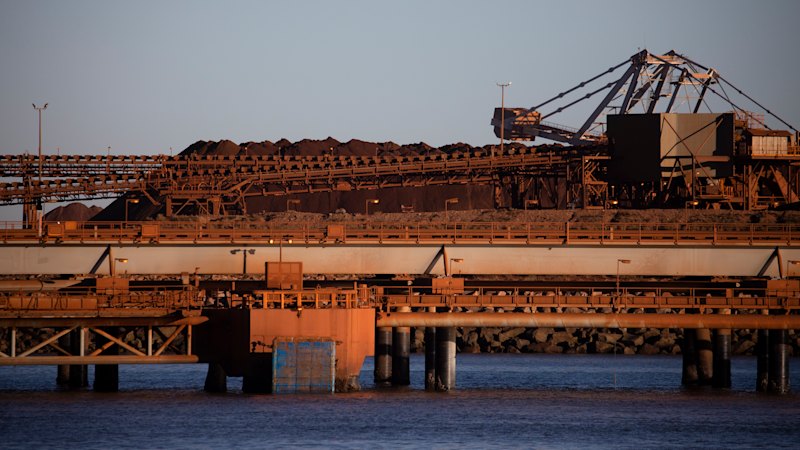
Workers at other Pilbara mining projects will be “taking note” of the strike action set to halt BHP’s operations at Port Hedland on Thursday, one expert warns, as a coalition of union members prepare to down tools at a cost of up to $50 million for the mining giant.
Meanwhile, WA Opposition Leader Basil Zempilas said the historic strike at the nation’s biggest bulk export port – the first in the Pilbara this decade – marked an “emboldening” of the union movement under Premier Roger Cook’s watch.
The move by the Combined Ports Unions, made up of members from the Electrical Trade Union, the Australian Manufacturing Workers Union and the Western Mine Workers Alliance, will see members stop work for an eight-hour period at BHP’s Port Hedland port operations.
The action has gained support from unions on the opposite side of the country, with members of the Electrical Trades Union QLD and NT announcing they would also rally from 10.30am on Thursday outside BHP Coal Brisbane headquarters.
In a statement, a spokesperson from the NT and Queensland ETU branches said the action stood in solidarity with workers at BHP’s Port Hedland export terminal.
The spokesperson said Pilbara union workers are asking BHP for equal pay for equal work, a transparent classification structure that lets workers progress on skills and qualifications, and working conditions set out properly in the enterprise agreement.
“These are standard terms in enterprise agreements negotiated by unions right across the country,” the spokesperson said.
“If workers at Port Hedland win these conditions, it breaks a model BHP has spent decades building in the Pilbara, which is setting wages and conditions on non-union terms.”
Port Hedland ships about $150 million of iron ore a day, with academics estimating BHP accounts for about $120 million of that.
Union supporters have previously cited pay rates at a Perth desalination plant of up to $240,000 a year as a benchmark for what staff in Port Hedland, about 1600 kilometres north, should receive.
ETU WA secretary Adam Woodage previously said he expected the action to cost the mining giant between $40 and $50 million, depending on the productivity levels at the port during the strike.
But Dr Alexis Vassiley, a work and employment relations lecturer at Edith Cowan University, said the strike action could provide the leverage for unions to successfully negotiate an enterprise agreement with BHP.
“We’ve got to remember this was a region where, in the 70s and 80s, strikes were very frequent, and it was those strikes and the tight union organisation that improved conditions for the workforce, as my research has shown,” he said.
“Yet since 1999, all of the iron ore companies have removed significant union influence, so it’s in a way a non-union region.”
Vassiley said currently only train drivers at BHP and Rio Tinto had a union-negotiated enterprise agreement in the Pilbara.
“The significance lies in the fact that if this happens in one company here, BHP, and at one site, the port, you would imagine that workers at other companies and at other sites would be taking note and thinking of doing the same thing,” he said.
“At a core level, what the unions are seeking here is very standard across Australia and even at BHP mines, such as coal mines in Queensland and New South Wales, because what they’re seeking is an enterprise agreement with conditions that last for the life of the agreement.”
Zempilas said he was concerned the union movement had been emboldened under the leadership of Premier Roger Cook.
“Right now, it appears the union movement has taken over the running of the WA Labor government,” he said.
“They appoint all of their pre-selected candidates. They put them in their ministry portfolios. They pick the premier. They fund their campaigns, and now they can tell the Cook Labor government when to talk and when not to talk.”
At a media conference on Monday, newly minted WA Mines Minister Daniel Pastorelli said the government wanted to ensure the workers were rightly rewarded for the hard work that they do.
“And we want to make sure that the industry can continue to thrive,” he said.
“So we just urge everyone to come together to find an outcome. I think the workers do an incredible job. You know, especially the workers on those FIFO swings.
“It’s a hard slog, and so they should be rewarded properly. So we ask and we hope that they can come together and find a practical solution.”
Zempilas agreed that every worker should have the opportunity to argue lawfully for the right wages and conditions.
“But I believe that the wages and conditions of these particular workers is adequate,” he said.
“I think fair-minded West Australians would consider that their wages and conditions are not only adequate. In many cases, they are world-leading, and I don’t believe that fair-minded West Australians think this particular industrial action is warranted.
“One day alone will cost BHP $120 million, but that represents $7 million to the people of Western Australia in mining royalties.
“Seven million dollars is the equivalent of the annual salary of 50 senior nurses in the Western Australian public health system, and it’s so important that Western Australians have the opportunity to digest those numbers.”
Vassiley was confident in the possibility of more industrial action.
“The reason for that is that workers withdrawing their labour is really the only leverage they have when bargaining is not going well,” he said.
“For BHP, they’ve been forced to negotiate with the combined ports unions because they have shown majority support in the workforce.
“I think it’s entirely possible that there will be more industrial action if there aren’t changes in the bargaining process after Thursday’s industrial action and protests.”
From our partners
Read the full article here