





In Britain, JMW Turner’s Picturesque Views in England and Wales romanticised the country’s coasts and castles. For Japan, Katsushika Hokusai’s Thirty-six Views of Mount Fuji helped make the stratovolcano a must-visit among international tourists.
And in China, it is the shanshui paintings depicting the nation’s mountains and rivers that have captured the imagination of travellers for centuries.
Far from the glittering skyscrapers of Shanghai (but not so far – in actuality it’s less than a three-hour flight) you’ll be able to find lofty cloud-shrouded peaks and flowing waterways that feel like something out of an ink wash painting in Guilin.
No stranger to tourism, the city in Guangxi, South China, has been famed for its karst scenery for centuries – more than 800 years ago, Wang Zhenggong declared the landscape as “the best under heaven”.
Tourists both domestic and international have been agreeing with him ever since.
While it was among the first areas in China to open to foreign visitors in the 1980s, in recent years it has fallen off the radar – perhaps as Zhangjiajie, which also has limestone karsts, has soared in popularity thanks to the Avatar movies.
While a visit to China will typically revolve around major cities like Beijing, Shanghai or Xi’an, my trip to Guilin and its unrivalled scenery has convinced me that it more than deserves its place on your itinerary, whether it’s your first trip or your 50th.
Scenery out of a painting
Limestone karsts can be found all over the globe, from Slovenia and Georgia to Thailand and Vietnam, yet the landscape surrounding Guilin is among the world’s most spectacular.
Having sprung up around the karsts, the city has limits on building heights which mean that the topography can be enjoyed no matter where you are.
Aside from the Elephant Trunk Hill (very much what it says on the tin – it’s a hill that looks like an elephant drinking water), Guilin’s most iconic sight might just be the Solitary Beauty Peak.
Part of the Jingjiang Princes’ Palace, the city-within-a-city was built around the peak during the Ming Dynasty in the late 14th century. Standing alone, the clusters of karsts nearby are said to be bowing down to it.
A wander through the complex reveals its history: It served as the residence for the Jingjiang princes, then during the Qing Dynasty it became the imperial examination compound for Guangxi province. Today, it is both a tourist site and campus for Guangxi Normal University.
Solitary Beauty Peak is climbable, and after 15 minutes of very steep steps you’ll be able to appreciate both the layout of the complex and the wider city sprawl weaving between karsts.
The most dramatic scenery – which is also UNESCO World Heritage-listed as part of the South China Karst site – is outside Guilin itself.
A Li River cruise offers the opportunity to see the best of it as you wind your way from Guilin to Yangshuo.
Along the way, our tour guide pointed out natural “paintings” in the rock, like the Nine Horse Mural Hill, but my imagination is clearly lacking (or perhaps I wasn’t squinting hard enough) as I could never quite work out what I was looking at.
Even without agreeing with the creative names for some of the peaks, the views are incredible – so much so that the vista near Xingping features on the back of the 20 RMB note.
There’s never a bad view in Guilin
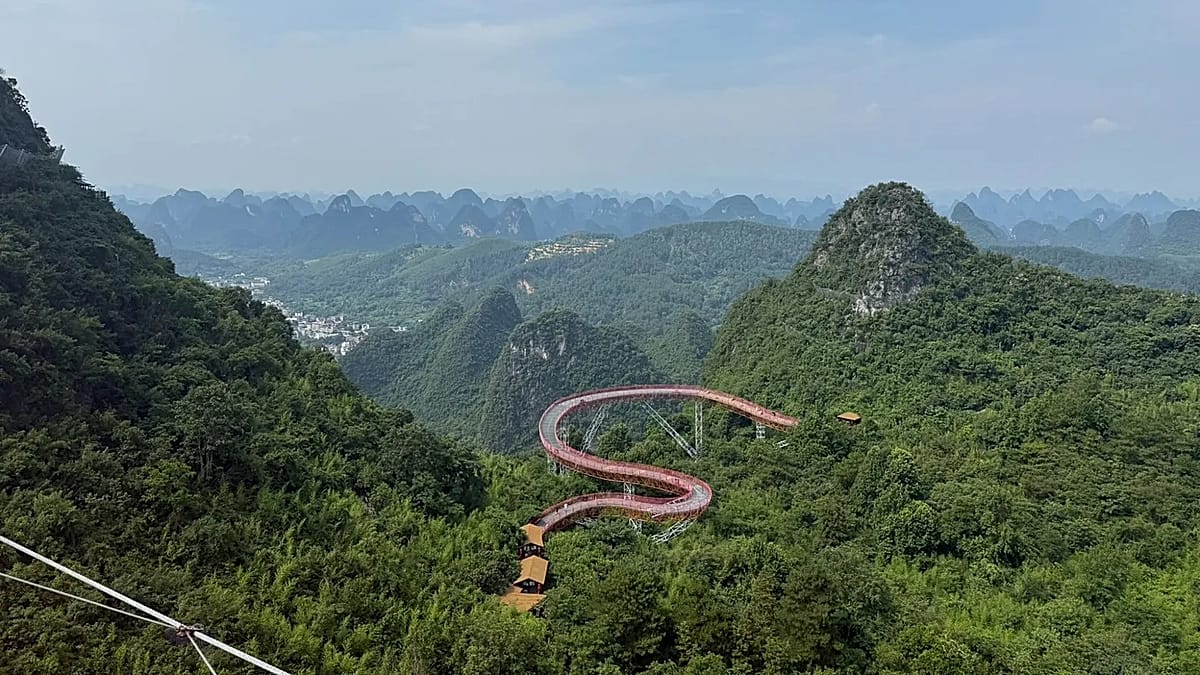
While the Li River is impressive, it was the view from Ruyi Peak that really blew me away.
After a slightly terrifying ride on a cable car, a heart-pumping walk across a suspension bridge, and a climb up even more steps, the karst landscape unfolding in front of you from the viewing platform seems to be never ending.
I can only compare it to the karsts of Phang Nga Bay in Thailand, which also feel slightly out of this world – fitting, given that both were used as filming locations for the planet Kashyyyk in Star Wars: Episode III – Revenge of the Sith.
Another of Guilin’s top tourist sights are the Longji Rice Terraces. Located around an hour’s drive outside of the city, the terraces form layers up the mountain slope which is said to look like the scales of the dragon.
The view will differ depending on the time of year you come – our visit fell at the start of June when the workers were preparing for the next season, so the terraces were waterlogged.
If this trip taught me anything, it’s that there’s never a bad view in Guilin, even if it’s overcast…
The nature of karsts also means that the terrain is filled with caves, with more than 3,000 believed to be located around Guilin.
Reed Flute Cave is the most famous of these, and has been a tourist site for literally centuries – one of the inscriptions on the walls dates back to 792 AD in the Tang dynasty (rather than being the Chinese equivalent of “Chris woz here”, they are travelogues and poems).
Having been rediscovered in the 1940s, the cave is now lit up in colourful lights and has signs explaining what the various stalactites and stalagmites resemble, such as a lion, mushrooms or a stage curtain (and this time, I definitely got the vision).
Culture and cuisine
Home to the largest ethnic minority population in China, Guangxi’s full title is the Guangxi Zhuang Autonomous Region.
Most of the workers at the Longji Rice Terraces belong to the Zhuang minority, and you can see their traditional architecture at the nearby Ping’an Village.
Impression Liu Sanjie is also a way to learn about the local culture. Featuring more than 600 performers wearing traditional Zhuang dress, the show was inspired by the life of the folk singer Liu Sanjie.
While it is performed in both the Zhuang dialect and Mandarin, you thankfully won’t need to brush up on your language skills. The show is more about giving an “impression” of what life is like for the Zhuang people, with local farmers and fishermen also taking part in the performance.
The show takes place at night among the limestone karsts in Yangshuo, and having been choreographed by Zhang Yimou, who was also in charge of the 2008 Olympics opening ceremony, it’s a real spectacle on water.
Huangluo Village, also near the Longji Rice Terraces, is home to the Red Yao people who are known for their long hair and colourful traditional costumes.
The women cut their hair only once, at the age of 16 in a special ceremony, and these locks are saved and weaved back into their hair when being styled.
You can see this ceremony performed at the Huangluo Yao Village theatre, although as the show is in Mandarin, you’ll need to go with a guide to get the full picture.
The China Long Hair Science and Technology Museum around the corner also explains the different hairstyles which show whether or not a woman is married and has kids, as well as how these women keep their hair so healthy and long.
You can even buy hair products making use of fermented rice water, which is said to be their secret.
The Yao and Dong Minorities are known for their oil tea, which was added to UNESCO’s Representative List of the Intangible Cultural Heritage of Humanity in 2022 as part of the Traditional Tea Processing Techniques and Associated Social Practices in China submission.
Made by frying tea leaves with garlic, salt, ginger and chilli in peanut oil before being boiled, it is commonly served with puffed rice and eaten with a spoon.
Guilin is also known for its rice noodles, which are said to have been created to appeal to immigrants from north China, where wheat – and therefore noodles – are more common.
Head to the night market on Zhengyang Pedestrian Street to grab a bowl and to try other Chinese classics like stinky tofu.
Next time I’ll visit Guilin for…
I wish I’d spent a few days based out of Yangshuo as there are some really spectacular hotels which have the limestone karsts for a backdrop.
I’d also like to experience bamboo rafting on the Li River as a slower way to see the karsts.
How to get to Guilin
You can fly to Guilin Liangjiang International Airport from Shanghai Pudong International in just over two and a half hours.
There are also domestic flights available from major hubs including Beijing (three hours), Xi’An (two hours and 10 minutes) and Chengdu (one hour and 50 minutes).
From Hong Kong, you can reach Guilin by high-speed train in just over three hours.
Top tips
The Great Firewall means that many foreign websites and social platforms, like Instagram, WhatsApp and Facebook, won’t work in China if you are connected to the internet via wifi.
I could access these apps just fine when using data from an eSim – after running into some issues with Airalo on a visit to Kosovo, I consulted the wise folks of Reddit and settled on a Nomad eSim, which worked perfectly.
Install and set up the Chinese version of apps before you arrive. You can use WeChat or AliPay for payments (most places won’t accept cash any more) and Amap for navigation.
Within AliPay, you can also hail a taxi using Didi Travel, or pay for public transport.
Dianne Apen-Sadler was hosted by Trip.com, the online travel agency.
All of the experiences mentioned above are bookable through Trip – you can find all of the Guilin options on the Trip.com website here.
Read the full article here