




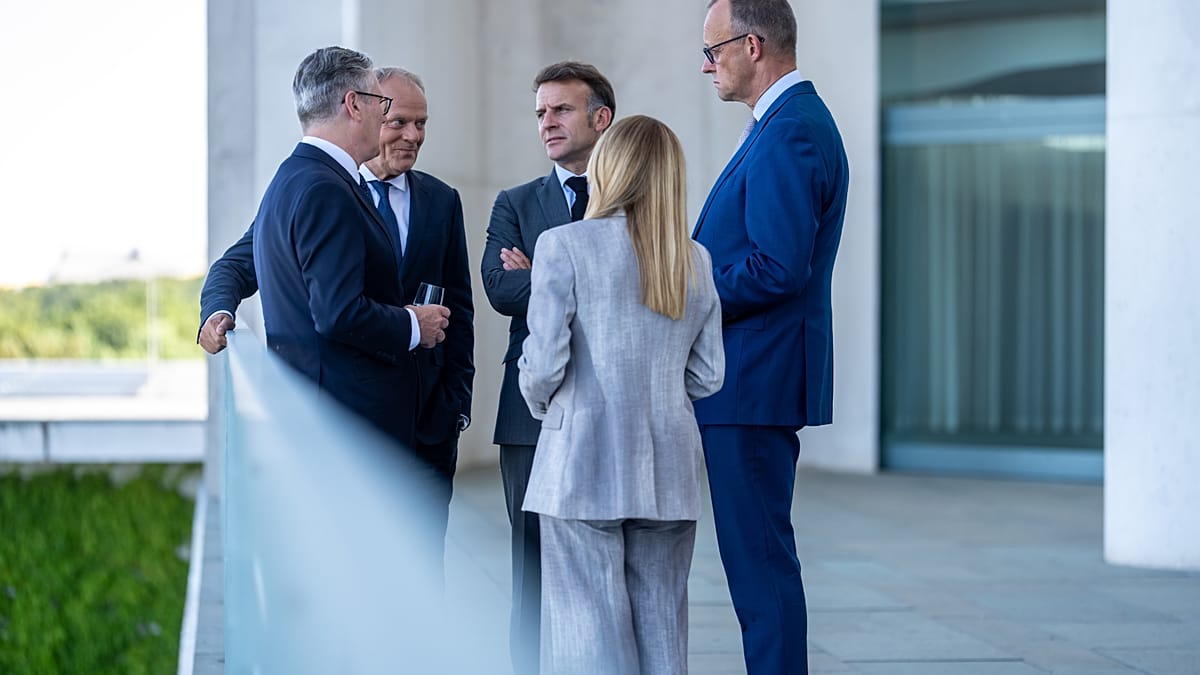
France’s President Emmanuel Macron, the UK’s Prime Minister Keir Starmer, Italian Premier Giorgia Meloni and Polish PM Donald Tusk met in Berlin on Wednesday for an E5 summit hosted by German Chancellor Friedrich Merz.
The E5 format was launched in 2024 to bring together the defence ministers of Europe’s largest military powers and biggest defence spenders, coordinating support for Ukraine, addressing the US’s gradual withdrawal from Europe, and setting up joint defence projects.
The gathering of NATO’s most influential European members comes ahead of a key summit of the alliance on 7-8 July in Ankara.
The E5 meeting also aimed to build on the so-called “Évian moment,” as Macron put it — when G7 leaders, including US President Donald Trump, displayed unity on backing Ukraine’s war effort and ramping up pressure on Russia to engage seriously in peace talks.
“The process that began at the G7 summit in Évian continued at last week’s European Council, and is set to continue with the NATO summit in Ankara, followed by the ‘Coalition of Willing’ in support of Ukraine and the security guarantees,” Macron said at the press conference after the E5 summit.
Coalition of the Willing
Berlin pressed ahead with the high-stakes E5 summit despite the political turmoil that engulfed London on Monday, after Starmer resigned as prime minister under pressure from his own Labour Party following a disastrous set of local election results.
Starmer has played a central role in European security discussions, co-leading with Macron the so-called “coalition of the willing,” which aims to provide security guarantees and military commitments as part of a future peace deal with Ukraine.
How committed his likely successor in Downing Street, Andy Burnham, will be to defence spending pledges and Ukraine’s peace process remains an open question.
Merz has positioned Germany as co-chair of the coalition — a role that could grow further if the UK’s political crisis deepens or its policy direction shifts.
Earlier this month, Macron, Starmer and Merz met Ukraine’s President Volodymyr Zelenskyy in the E3 format to discuss security guarantees and military support, particularly around anti-ballistic missile and deep-strike capabilities.
That meeting drew criticism from Italy and Poland, who were excluded from the talks — prompting the move to widen the format to E5 and bring in Europe’s two other major defence powers.
Supporters of the E5 argue the E3 is too narrow a base for decision-making, particularly given Poland’s role as a crucial logistical hub for Ukraine’s war effort; any peace deal, they say, would require Warsaw’s close involvement. Yet a serious diplomatic rift is currently driving a wedge between Poland and Ukraine.
Others see the E3 as the natural format for talks with Russia, since the group holds unmatched military weight in nuclear deterrence, intelligence-gathering and deep-strike capability.
NATO’s European pillar
The Ankara summit comes at a critical moment for NATO, with Trump irritated at European allies over their lack of support for his war in Iran. NATO Secretary General Mark Rutte met the US president on Wednesday in a charm offensive. Rutte joined the European leaders’ discussion via video conference.
The backdrop of the upcoming NATO summit is Washington’s gradual scaling-back of its presence in Europe — not just conventional military assets, but also so-called strategic enablers: the logistics, command structures and infrastructure that underpin the ability to project and sustain combat power.
“We are here together today, in the E5 format, to confirm that our countries will safeguard European unity and transatlantic unity,” Poland’s Tusk said at the press conference.
Last week, US Defence Secretary Pete Hegseth sharply criticised NATO allies at a meeting of defence ministers in Brussels, urging Europeans to take greater responsibility for their own security as he announced a six-month review of American force levels on the continent.
During the press conference, Chancellor Merz pointed out that all the countries involved committed to significantly boost their defence spending, which he sees as “laying the foundation for a more balanced transatlantic partnership.”
How to strengthen NATO’s European pillar and gradually replace US military capabilities in the region — with the E5 as the leading players — was the central question facing Europe’s largest military powers on Wednesday.
Merz said that the E5 powers agreed to coordinate closely to tackle major defence challenges, such as long-range weapons, air defence, and artificial intelligence.
“We are all clearly in agreement that Europe must shoulder its responsibilities in terms of defence and security, resolutely pursuing the path it has set out on towards a stronger European component of the Atlantic Alliance,” Meloni said.
Read the full article here