





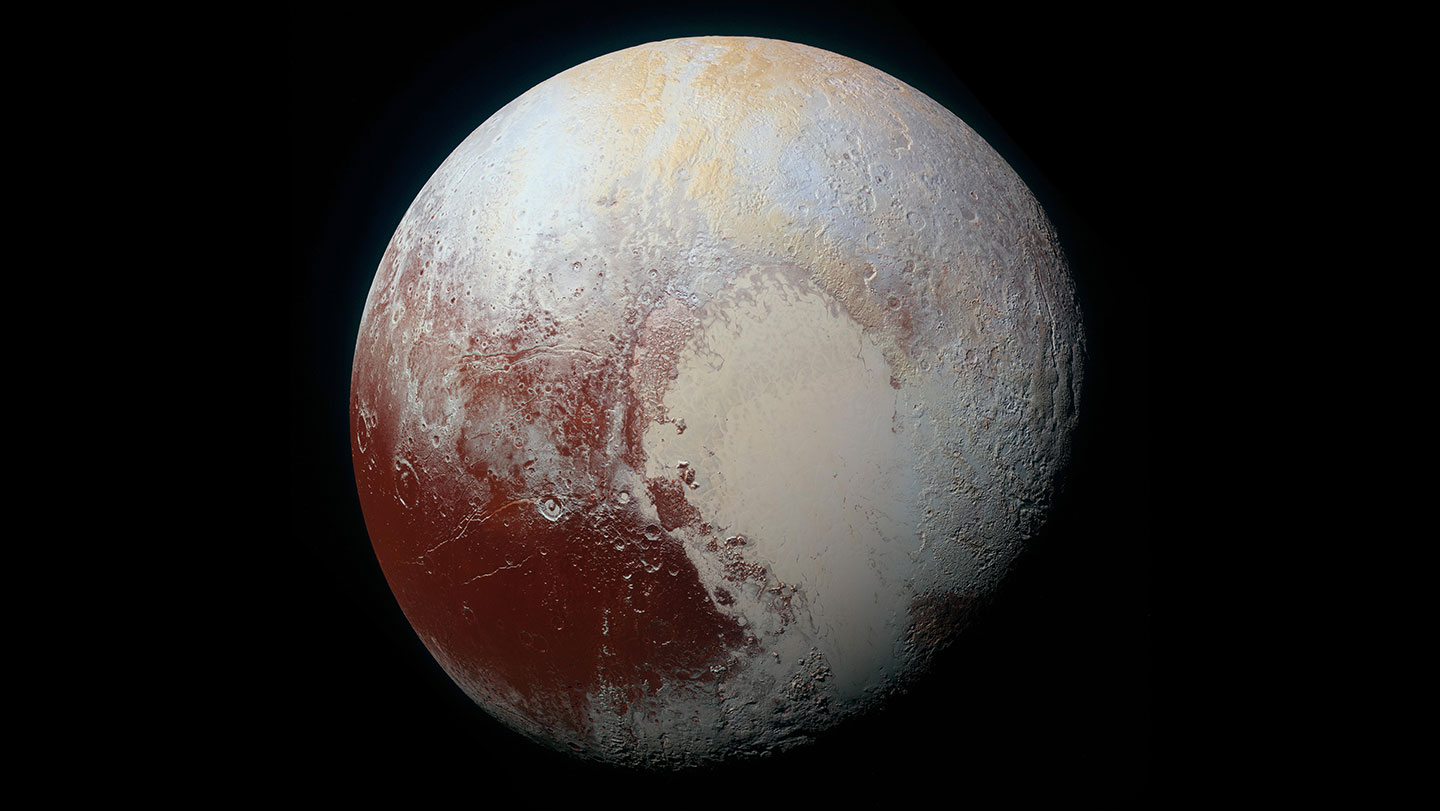
Terrestrial planets experience landslides in spades, and so do some moons, asteroids and comets. But — until now — they’ve never been definitively spotted on Pluto, even though the icy world has all the ingredients necessary for their formation. Images taken by the New Horizons spacecraft reveal six large landslides on the dwarf planet, researchers report June 13 in Icarus.
Combine a mountainous, rocky landscape with a bit of gravity, and landslides are apt to occur. These mass movements can sculpt an environment, delivering solid material and nutrients to new places, says Maria Teresa Brunetti, a physicist who studies landslides at the National Research Council in Perugia, Italy. “Landslides play an important role in shaping landforms.”
Rocky bodies ranging from Earth to Phobos (a moon of Mars) to the asteroid Vesta all exhibit evidence of landslides. But Pluto has lagged in the landslide game. Even after the New Horizons spacecraft zoomed by Pluto and its moons in 2015 and captured high-resolution imagery, researchers hadn’t pinpointed any. (Pluto’s largest moon, Charon, shows evidence of them.)
A reanalysis of New Horizons data changes that. Researchers, including Brunetti, looked for characteristic signs of landslides, such as steep cliffs and portions of the landscape that differed in tone and texture from their surroundings. Six features fit the profile, all of them near a wide, flat plain known as Sputnik Planitia.
Each of the landslides is located along the inner rim of an impact crater, where the terrain is steep. The largest is roughly 130 square kilometers in area, or about twice the size of Manhattan. That’s near the upper size range of landslides that typically occur on Earth, Brunetti says.
The landslides range in height from 1,500 to 2,200 meters. That’s somewhat puny compared with landslides elsewhere in the solar system, but these features have a trick up their proverbial sleeves: Compared with landslides of similar heights, those on Pluto tend to run out over longer distances. That’s a sign that material tumbling down a slope on Pluto experiences less friction, on average, the team concluded. That conclusion can help constrain the material properties of Pluto, Brunetti and her colleagues suggest.
Pluto is probably home to many more landslides, the team says. Finding them, Brunetti says, will require more analysis of New Horizons data — and, hopefully, more missions to Pluto.
Read the full article here