




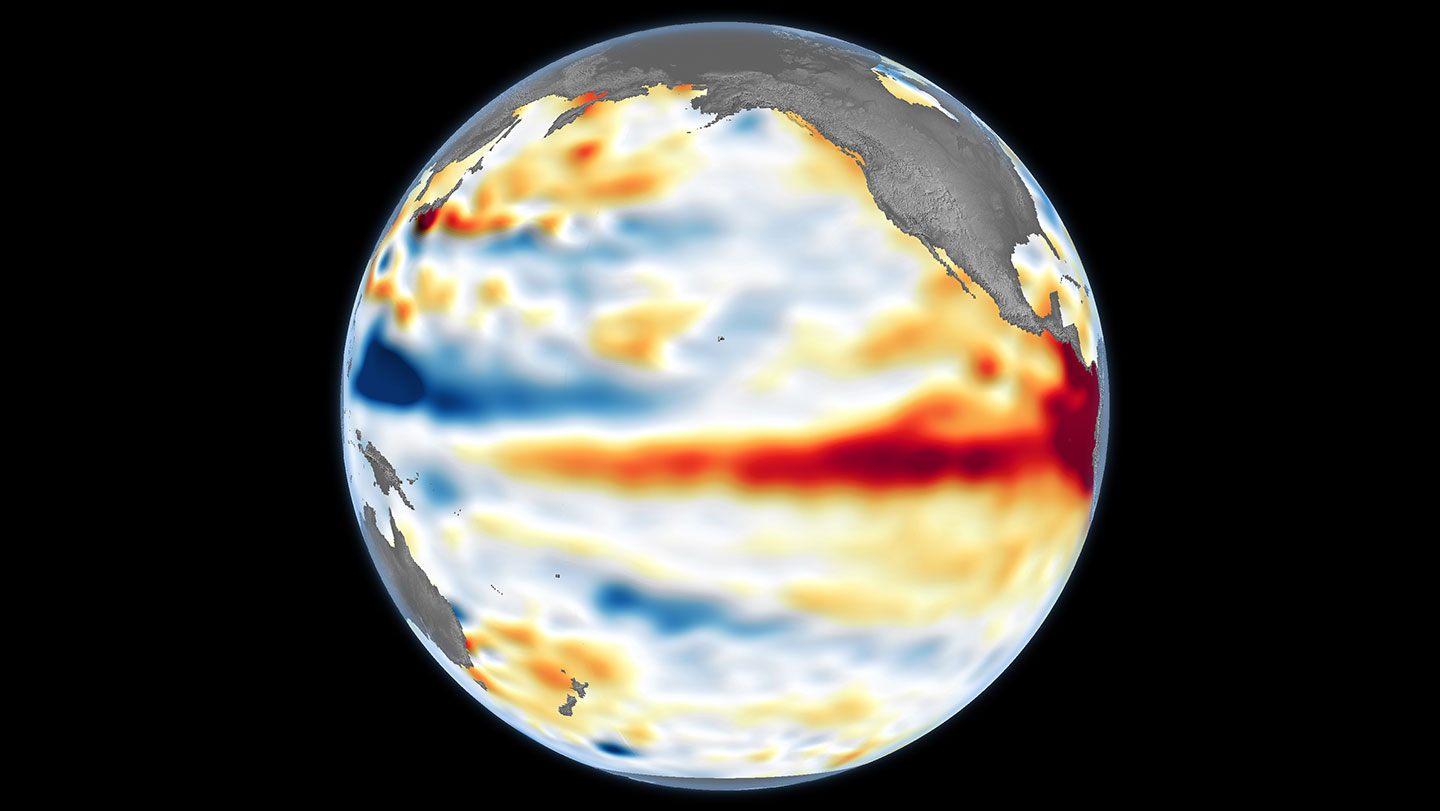
There might be a way to geoengineer El Niño so that it wreaks less havoc, scientists say.
Adding aerosols to the atmosphere over a particular patch of the Pacific Ocean can increase and brighten clouds in the region, creating a cooling effect. New computer simulations show this can trigger atmospheric changes that might reduce the strength of an El Niño event — and the weather extremes that come along with it, researchers report July 8 in Science Advances.
The idea was sparked by fires, says Jessica Wan, a climate scientist now at the University of Chicago. In the aftermath of the 2019–2020 Australian wildfires, huge billows of particles rose into the atmosphere and then wafted over the southeastern subtropical Pacific Ocean. The fires brightened the clouds over the ocean there, and that brightening helped trigger a multiyear La Niña event, the flip side to an El Niño.
This “opportunistic experiment” demonstrated how cloud modification in a particular region can alter large climate patterns, says Wan, who did the research while at the Scripps Institution of Oceanography in La Jolla, Calif.
The team wondered whether it would be possible to geoengineer a similar effect to mitigate the impacts of El Niño, the “warm” phase of a yearslong climate pattern known as the El Niño–Southern Oscillation. El Niño events are brief, typically lasting less than a year, but can be deadly and costly. Past strong El Niños have brought heat waves on land and in the ocean and drenched some parts of the world with torrential rains and floods while baking others with severe drought.
Adding aerosols specifically to beef up the eastern subtropical Pacific’s clouds would be a targeted version of a kind of climate geoengineering called marine cloud brightening, or MCB. MCB proposes that certain aerosols — particularly sea salts — injected into the atmosphere could brighten the ocean’s cloudiest regions, making them whiter and more reflective, which would send more of the sun’s radiation back into space to help cool the planet.
To simulate how MCB might mitigate El Niño, the researchers focused on two strong El Niño events: 1997–1998 and 2015–2016. The team then identified where the fire particles had been densest over the southeastern Pacific Ocean and targeted those regions in their computer simulations for aerosol injections.
“We wanted to try to go full hammer to see what happens,” Wan says. The team simulated a massive injection concentration of about 500 particles per cubic centimeter. It also varied the timing of this cloud boost, seeing what happens if the injections occur at the very start of an El Niño, or when it’s nearing its peak, as well as how the length of injections.
Turning down El Niño’s heat
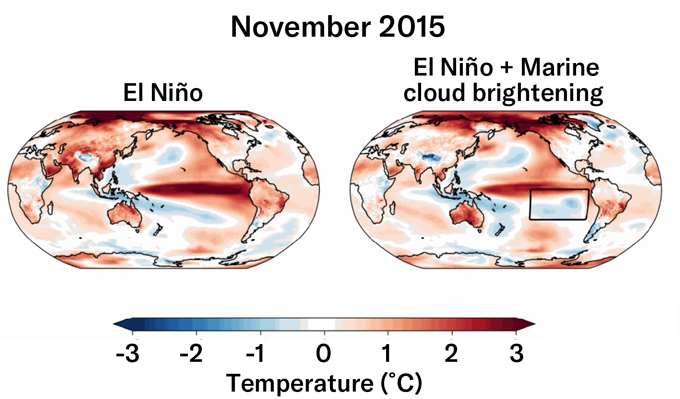
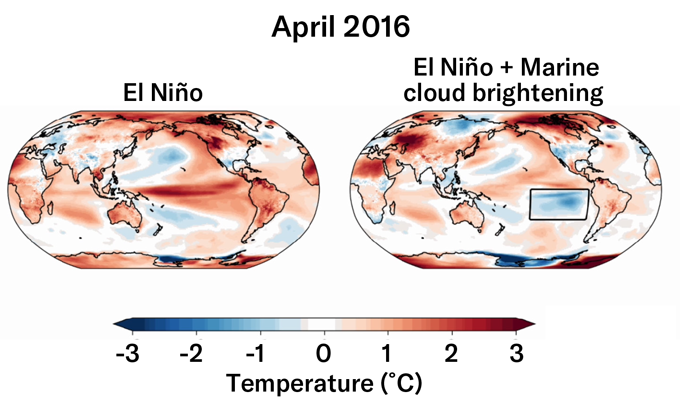
Researchers simulated how marine cloud brightening could reduce the intensity of past El Niños, such as the event that lasted from 2015–2016. Brightening clouds by continuously injecting aerosols over the eastern subtropical Pacific Ocean (boxed region) dramatically changed the trajectory of the El Niño after its onset in May 2015 through the following spring, the simulations showed. By April 2016, the sea surface temperatures were significantly cooler in the simulation (right) compared with the real-world conditions (left).
-
Jessica Wan/Univ. of Chicago -
Jessica Wan/Univ. of Chicago
All of the injections made the simulated El Niños weaker than the actual events. But how much weaker depended on the timing, the team found. For the 2015–2016 event, for example, injecting particles from June through the following February led to the strongest cooling. But starting those injections in December — essentially at the 11th hour — led to the least cooling. That’s probably because by that time, the El Niño dynamics are well under way and any cooling is more localized, the team suggests.
Using MCB to directly target large El Niños “is really interesting and very new,” says Daniele Visioni, a climate scientist at Cornell University not involved in the study. And “the fact that it looks like this could work is a really good indication that it is something worth thinking about.”
Earth officially entered its most recent El Niño phase in June. Computer simulations of current conditions in the Pacific suggest that it has the potential to be a “super El Niño.” MCB isn’t anywhere close to being on the menu to mitigate this year’s El Niño, Wan says — there are big hurdles, including engineering constraints and sociological barriers, such as who should determine whether these interventions are worth any possible negative climate consequences.
Many researchers remain leery about tinkering with the climate. “There are many, many unanswered questions and uncertainties as to the viability of MCB,” says James Haywood, a climate scientist at the University of Exeter in England not involved in the new study. Previous research by Haywood and his colleagues simulating the effects of MCB found that cooling the eastern Pacific might produce a “mega La Niña” many times stronger than previously seen, he says.
La Niña is generally thought of as the gentler sibling — on the whole, it brings cooler temperatures and milder weather events. “But the impacts of both El Niño and La Niña are heterogeneous” around the planet, and not everyone suffers or benefits from either, Wan says.
Visioni notes that “this is in no way the final answer…. But it’s important to have these kinds of studies that keep the door open. Considering that large El Niños produce a lot of damages, I think asking the question is worth it.”
Read the full article here