



Bob Parsons is navigating his golf cart through the twisting dry dirt road of the golf course he built in the Sonoran Desert in Scottsdale, Arizona, avoiding lizards, rabbits and giant saguaros. He stops near the ninth hole, named Catfish, which overlooks a manmade lake and surrounded by three million acres of preserved land. It cost Parsons hundreds of millions of dollars to develop and renovate Scottsdale National, which has two 18-hole courses and the “Bad Little Nine,” a punishingly difficult nine-hole par-three course. He points to the center of the lake where a small black hut sits with the words “Suggestion Box” painted in white.
“This is a marvelous spot to put a suggestion box,” the 75-year-old Parsons tells Forbes. “The vent is painted on. I guess you could try.”
After all, Parsons did not become a billionaire by taking other people’s suggestions. He built his fortune thanks to his nonstop hustle, often working 60-plus hours straight. He sold his first company, Parsons Technology, which made personal finance and tax software, to Intuit for $64 million in 1994 (or about $165 million today). In 1997, he started domain name registrar GoDaddy and sold a 71% stake for $2.3 billion in 2011 (or $3.4 billion today).
Today he has eight companies under YAM Worldwide (Parsons’ acronym for You’re a Mess), including Scottsdale National, a real estate portfolio with 3 million square feet of strip malls, a video production company, a metal manufacturing business, a series of motorcycle dealerships (including the largest Harley-Davidson dealership in the world, which features a wedding chapel, a tattoo parlor and a small movie theater), his golf equipment company PXG, a hedge fund and more.
“I’ll be 76 in November, and I have no intention of stopping,” says Parsons, who is worth $4.1 billion. “When I stop, my nickname will be ‘Mumbles.’ I just like to be in the game. This is what I do.”
It’s a beautiful 100-degree day in summer and only three groups of people are on the course. This is by design. When Parsons bought the struggling Golf Club of Scottsdale in 2013 for $600,000, it had too many members and getting a tee time took planning and skill. He invested more than $300 million into redesigning and expanding it—including using explosives to tear down mountains and raze the land, using enough dynamite that could’ve “cleared a lot of tunnels in Vietnam,” says Parsons, who was stationed in the Quảng Nam province with the Marines in 1969—and he told members he was raising the initiation fee and making other changes.
By 2017, the initiation fee was around $150,000, but not out of line with other top private courses. Last year, that figure reached $1 million, plus $80,000 for annual dues. Not many people can afford a club like this, and the proof is that Scottsdale National only has about 155 members. This means there is no need to schedule a tee time: the course is almost empty every day. And that initiation fee is only going up.
“I will be raising it,” Parsons says. “I haven’t decided it yet, but when I do it’ll get people’s attention.”
Grabbing people’s attention has been key to Parsons’ success. GoDaddy became a household name thanks to its racy Super Bowl commercials. In 2005, during Super Bowl XXXIX, GoDaddy aired an ad starring former Playboy model Candice Michelle spoofing the Janet Jackson “wardrobe malfunction” from the previous year’s halftime show. After it ran, and the controversy exploded, GoDaddy’s market share jumped from 16% to 25%.
The next year he did another high-octane ad with Nascar driver Danica Patrick that teased a lot of nudity. GoDaddy, a company that sold something “as interesting as sawdust,” Parsons says, became successful thanks to its viral commercials.
“I took a beating for them,” says Parsons, “but fine, I laughed all the way to the bank.”
But if wasn’t always so fun for Parsons. He grew up in East Baltimore in a chaotic household. His father was a furniture salesman who spent most of his free time betting on horses at the Timonium Fairgrounds. His mother, who was sharp witted but unstable, loved gambling in Baltimore’s bingo halls.
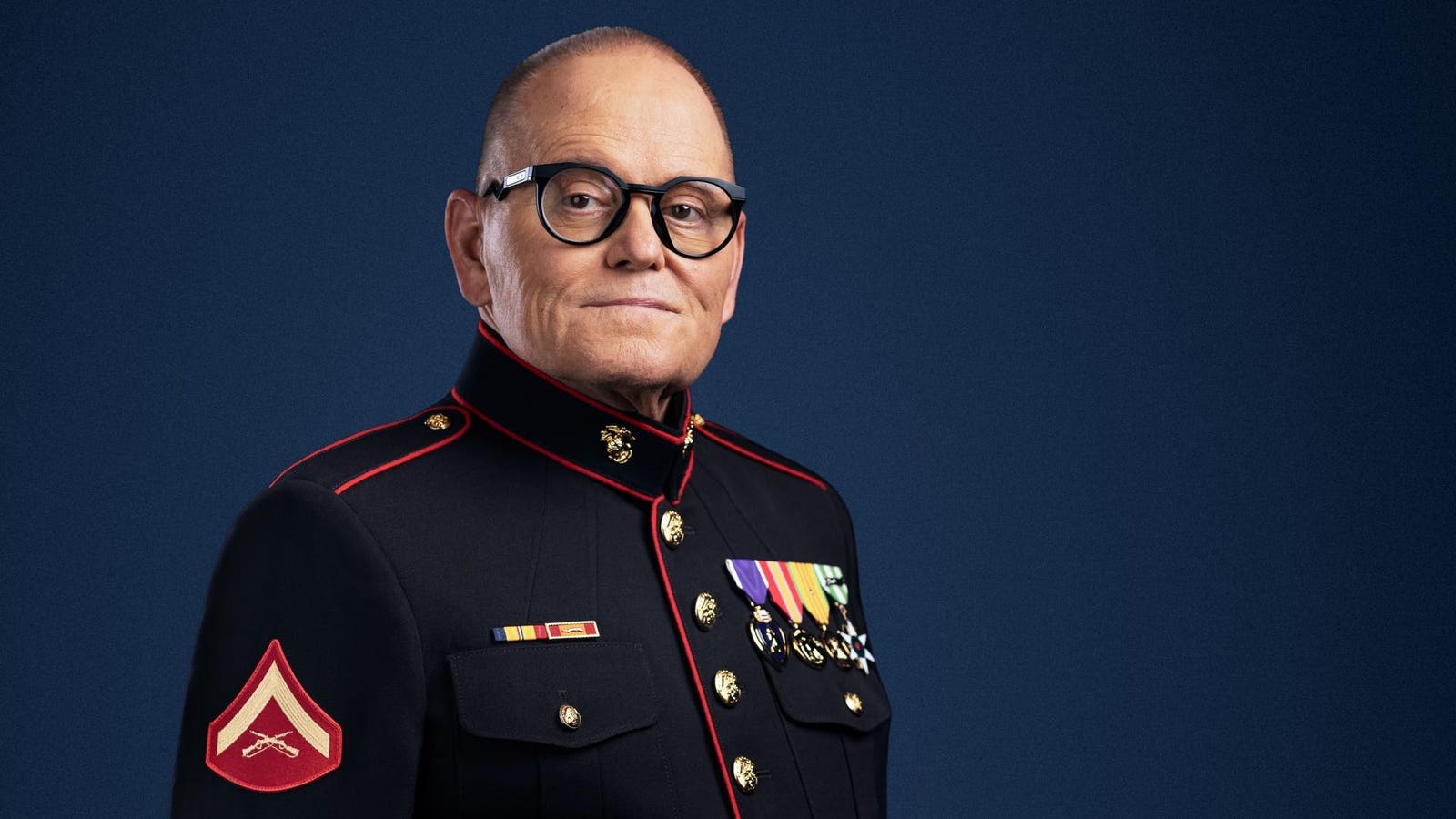
School was no better. Parsons failed the fifth grade but somehow dodged repeating it. He barely graduated high school in 1968 and enlisted with the Marines, serving as an infantryman with Delta Company, 1st Battalion, 26th Marines. In March 1969, he found himself in a rice paddy in Vietnam, clutching a machine gun. He witnessed horror on Hill 190—a fellow infantryman lost an arm to a mine, another was killed, and Parsons was hit by shrapnel and wound up in the hospital. He was awarded the Combat Action Ribbon, a Vietnam Cross of Gallantry for saving the life of a fellow Marine, and a Purple Heart. In March, the Marines presented Parsons with its highest honor, the Semper Fidelis Award, given to an American who represents the key values of the Corps—honor, courage and commitment.
Parsons credits the Marines for his success. When he arrived in Vietnam at 18, he had a realization that he was probably going to die there. But he told himself every day that the only thing he had to do was to get to mail call the following morning. And, somehow, he did.
“One day at a time can get you through anything,” says Parsons, whose tour lasted 13 months. “The Marine Corps taught me responsibility is sacred.”
But as with many veterans, war left him with Post-Traumatic Stress Disorder. He tried therapy to ease his symptoms, but it wasn’t until 2018, when he read Michael Pollan’s book about psychedelic-assisted therapy, How to Change Your Mind, that he thought about using mind-altering drugs to heal PTSD. Parsons third wife, Renee, set up a trip down in Hawaii, where they own a home, and he underwent a multiday therapy session with a trained therapist.
“For four days I was at it: The first day it was ayahuasca, the second day mushrooms,” Parsons told Forbes in 2022. “The third day, I just played golf. I’d never putted so good in my whole life, before or since.”
Parsons says psychedelic therapy made him less of an “asshole,” and easier to get along with. “The thing I like to say is that it’s been 48 years since the war and I finally came home,” he says. “That is no bullshit.”
Since then, has become a prolific donor to psychedelic research. He gave $5 million to create the Parsons Research Center for Psychedelic Healing at the Icahn School of Medicine at Mount Sinai in New York City and $2 million to the Multidisciplinary Association for Psychedelic Studies.
“I purposely do not invest in any psychedelics,” he says. “If I do that, I have less credibility. And to be honest with you, well, I don’t need the money.”
As Parsons drives the cart from one course at Scottsdale National, The Mineshaft, to his other course—named The Other Course—he waves to a foursome on the 12th hole. “Look here, we have some rare golfers,” he jokes.
Scattered throughout the course are plaques memorializing different units in the Marines. Parsons stops by one of them, honoring his unit—he was an 0311 rifleman—and takes a long look.
“Everything I accomplished I owe to the Marine Corps,” says Parsons. “They were my first real family. They taught me everything I know.”
Read the full article here