




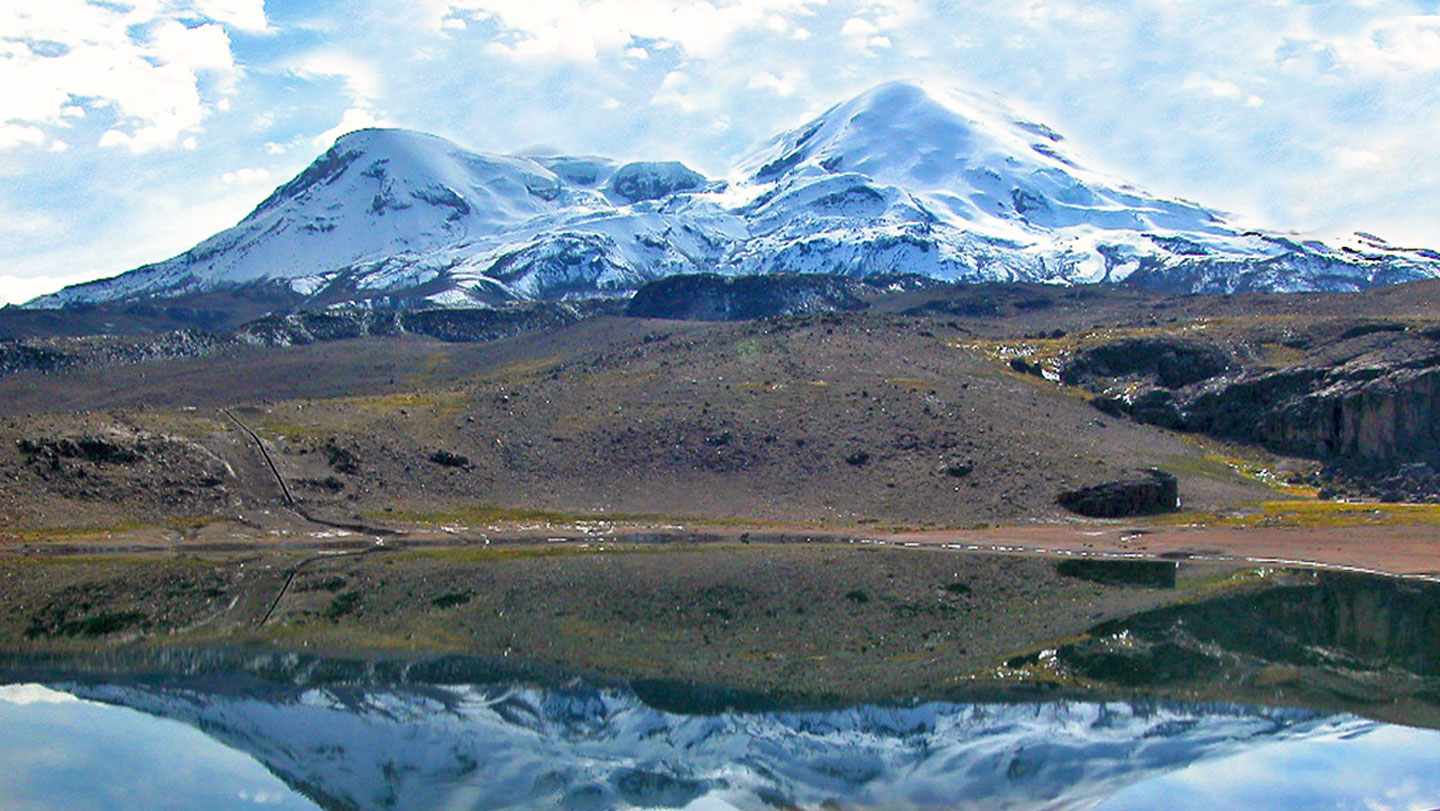
One of the largest tropical permafrost areas in the world may lie beneath the upper flanks of Peru’s tallest volcano — and as nearby glaciers retreat, it may become a regionally important water source.
A layer of frozen ground 15 to 20 meters thick sits two to four meters below the surface on Nevado Coropuna, roughly 5,000 meters above sea level, geographer Ramón Pellitero and colleagues report May 26 in Permafrost and Periglacial Processes. Though the full extent has yet to be mapped, the team suspects that similar conditions extend across the wider area.
“We wanted to know how much ice is stored in these areas and how it will evolve from now to the end of the century in the context of climate change,” says Pellitero, of the National University of Distance Education in Madrid. He and his colleagues suspected there would be some permafrost in the region — but had no idea how much. “How thick it was was surprising,” Pellitero says. “So, the volume is going to be very, very big.”
While not comparable to the massive permafrost found in the world’s colder regions, such as Canada and Russia, this cache could be a lifesaver for local communities in this arid region, the team says. Right now, most get their water from glaciers that are rapidly shrinking. “But you have permafrost underneath,” Pellitero says, “and the water resources from permafrost are becoming more and more important.”
Such resources could be helpful for the region, say geographer Stephan Gruber of Carleton University in Ottawa, Canada. The combination of permafrost and mountains is under-researched, “and there are a lot of important connections with hazards and with water and with ecosystems,” he says. “So I think it’s great that they do research there.”
The researchers used a combination of ground-penetrating radar and vertical electrical sounding, which uses electrodes stuck in the ground to measure electrical resistance. High resistance signals the presence of ice. Because the method needs water to work well and there’s none to be had in the area, the team had to carry it up the mountain themselves — one of the challenges of working in this region.
“One of the reasons that nobody has been doing this fieldwork is because the area is quite far away from everything and we always work at over 5,000 meters,” Pellitero says.
Tropical permafrost is also found in Tanzania’s Kilimanjaro, Hawaii’s Mauna Kea volcano — one patch shrank from about 600 square meters in the 1970s to roughly 200 by the mid-2010s, and continues to melt — and other locations. But none are as large as that of the Peruvian Andes, Pellitero says.
The researchers are continuing their work in Peru. They plan to use electric resistivity tomography — a subterranean imaging technology — to map the permafrost more precisely in the area around Coropuna, where they suspect similar frozen layers extend.
“If you have permafrost at this [5,000-meter] elevation, we can assume that there will be permafrost over there as well,” Pellitero says. “But we don’t know yet.”
Read the full article here