





Four ancient footprints are helping scientists step into a T. rex’s shoes.
The prints form the first set of tracks probably left behind by an adult Tyrannosaurus rex, researchers report September 8 in the Journal of Vertebrate Paleontology. Measurements of the 7-meter-long trackway suggest the ancient predator was ambling along at about 1.6 meters per second, roughly equivalent to a person’s quick walking pace.
A few single adult T. rex footprints exist in the fossil record, as do trackways possibly from T. rex juveniles or other dinosaur species, says Peter Falkingham, a paleontologist at Liverpool John Moores University in England. “But an individual track doesn’t tell you a lot. A trackway tells you more about foot placement as the animal’s moving along.” And younger and older dinosaurs probably walked differently, just as human toddlers and adults do.
“Finding an adult trackway is cool,” Falkingham says. “It’s unique. It brings something new.”
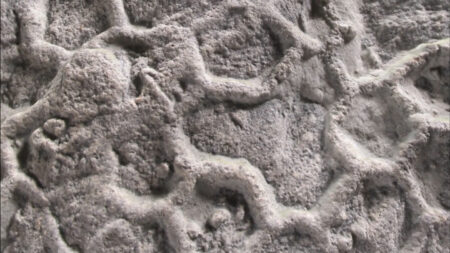
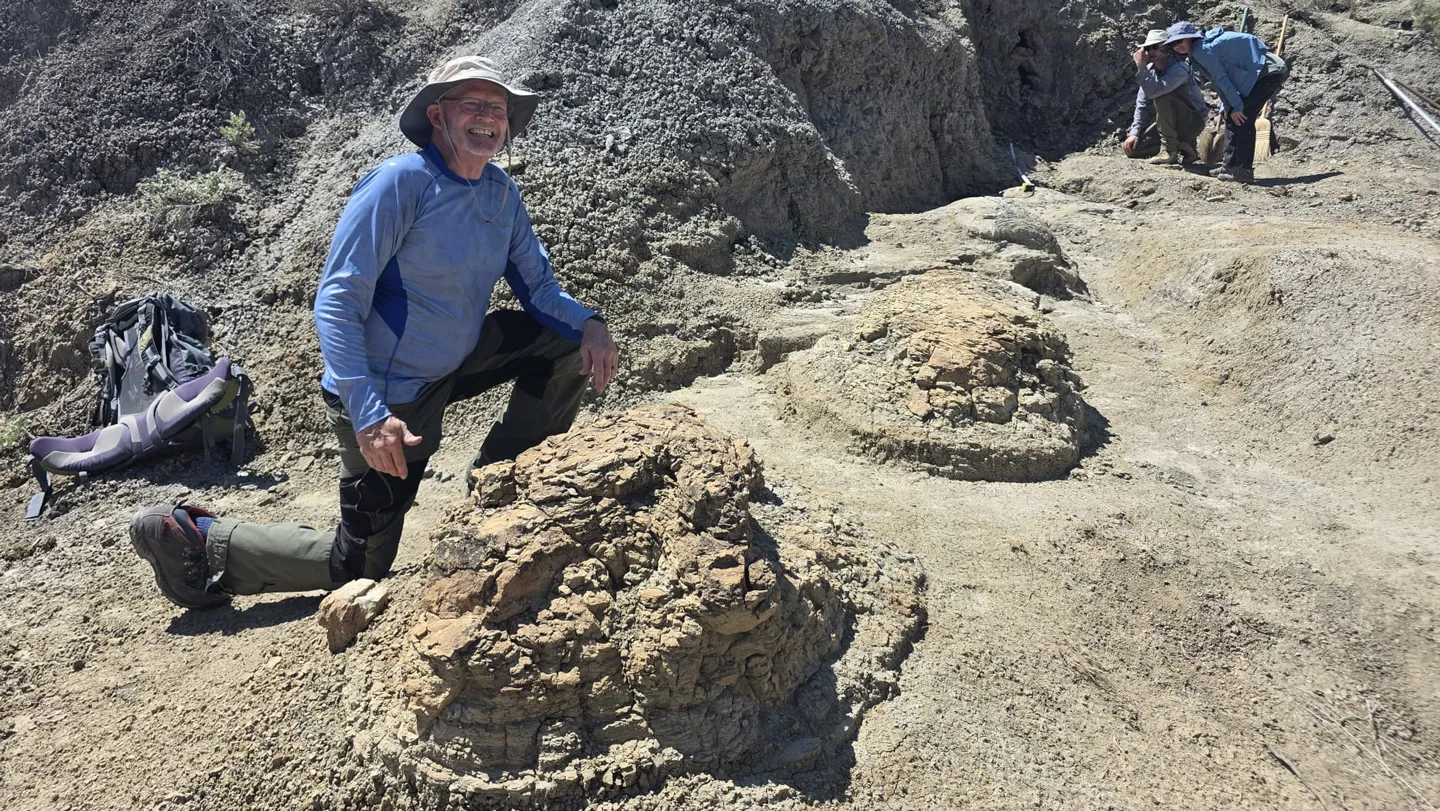
High school teacher and paleontologist Kent Hups stumbled on the footprints in 2025, while fossil hunting along a steep incline in the Hell Creek Formation in North Dakota. The tracks stick up out of the ground because sediment filled in the originally muddy footprints, which then eroded away more slowly than the surrounding rock.
When Hups saw the first track, he noted that it was three-toed and enormous, measuring 80 centimeters across. “I’m going, ‘this has to be a T. rex,’” says Hups, of Northglenn High School in Colo. and the Denver Museum of Nature and Science.
Slender toe impressions and fossils unearthed in the area signal a T. rex left behind the footprints roughly 66.5 million years ago. “There’s always the possibility that we haven’t found the skeletons of some species that we don’t know about,” Falkingham says. “But as far as our knowledge goes, T. rex is about the only track maker that could have made these.”
The team used stride length and body size to calculate the dinosaur’s speed. Unfortunately, the footprints aren’t well-preserved and estimating speed from tracks is tricky, so the T. rex may have been walking slightly faster or slower than calculated. Better tracks could have revealed whether the foot landed flat or toe-to-heel, or how foot pads supported the predator’s weight.
More tracks are sure to follow. In fact, a fifth step may be concealed in the hill. But the team is waiting for Mother Nature to wear away the surrounding rock, Hups says. “I can’t wait to get back out there and keep looking for more.”
Read the full article here