




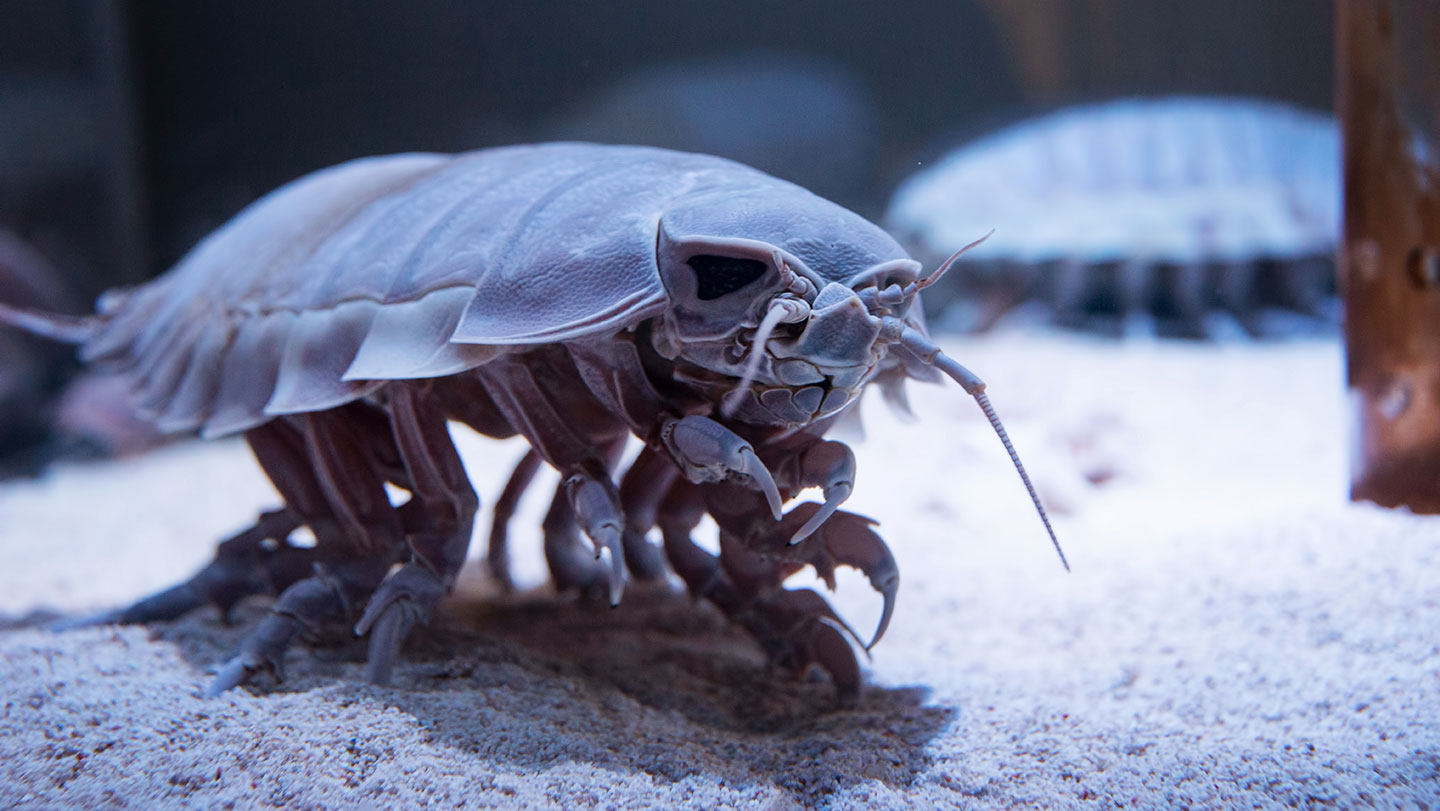
A kilometer down in the ocean, football-sized roly-polies slowly clamber along the seafloor. Their metabolism is so slow that they can go years between meals. Now, researchers have found a genetic quirk that helps explain the evolution of these colossal crustaceans.
Long ago, the creatures stole a gene from a bacterium and welded it into their own set of DNA. This may help the crustaceans tolerate extremely long periods without food in the frigid, abyssal desert, researchers report June 5 in Cell.
Isopods are armored, oblong crustaceans. Land-living species are commonly called woodlice, pillbugs or roly-polies. While many isopods are smaller than a pencil eraser, deep-sea species groups including Bathynomus can grow to comparatively monstrous proportions, with some reaching nearly half a meter long. These giants appear well-adapted to a slow life in the inky black depths where there’s little to scavenge. Some captive giant isopods have been recorded going for more than five years without eating — one of the longest such durations known among animals.
“That is truly remarkable,” says Jianbo Yuan, a marine biologist at the Chinese Academy of Sciences in Qingdao.
After researchers at the Chinese Academy captured some specimens of the giant B. jamesi with a submersible vehicle near China’s Hainan Island, Yuan and his colleagues wanted to know how these animals could grow to a large size in such a barren environment. The team compared these deep-sea isopods with a smaller species from 300 meters deep and another even smaller species that lives along the shoreline. The researchers analyzed details of the isopods’ full set of genetic instructions and their anatomy.
“The results turned out to be even more surprising than we had imagined,” Yuan says.
The giant, deep-sea species had a truly enormous stomach, filling up to two-thirds of the body cavity — far larger than those of more shallowly dwelling species. The researchers think these giant isopods may eat rarely. But when they do, they gorge on as much as they can, filling their bellies with carrion and any slow-moving animals they can catch.
They also have figured out how to make their meals last. The researchers found that the genetic code of the deep-sea isopods included a couple copies of ND1, a metabolic gene that originally came from a bacterium. The gene hopped from the bacterium into an ancestral isopod’s genetic instructions more than 16 million years ago. When the researchers engineered fish in the laboratory to have ND1, it increased their starvation survival rate by 37 percent – but only in the cold. The gene appears to throttle energy consumption in the cells. This may allow the isopods to fuel their big bodies even when food is scarce, Yuan says.
The findings help expand our understanding of how evolutionary innovations develop more broadly, says Yang Li, an evolutionary biologist at the University of Michigan in Ann Arbor not involved with the research. The isopods provide an example of how traits aren’t limited to evolving from modifications of genes. “[The isopods] also acquire and domesticate genes from microbes,” he says.
Li wonders if other ocean creatures have similar stolen genes used to survive the unforgiving deep.
Read the full article here