





Daring tree climbers and researchers have challenged a major assumption in tree drought biology.
In rainforests on the Southeast Asian island of Borneo, water transport systems of a colossal, dominating family of trees are not more impaired than shorter trees in the face of drought, researchers report July 2 in Science. The find counters the notion that gravity makes these giants more vulnerable to drought by stymieing hydration of their higher branches and crowns. The study cannot confirm that this holds true for all tree families. But the findings can help inform conservation efforts, the researchers say.

The path from roots to leaves becomes longer in taller trees. Water traveling up a tree’s vessels, or xylem, encounters more resistance the higher it goes, says plant functional ecologist Arne Scheire, now at the Southeast Asia Rainforest Research Partnership in Kota Kinabalu, Malaysia. And thanks to gravity, lengthier xylems have a more stifled water potential, or the propensity of the water to be sucked up as the plant’s leaves release water.
But no experiments verify that taller trees fall victim to these pressures during drought, Scheire says.
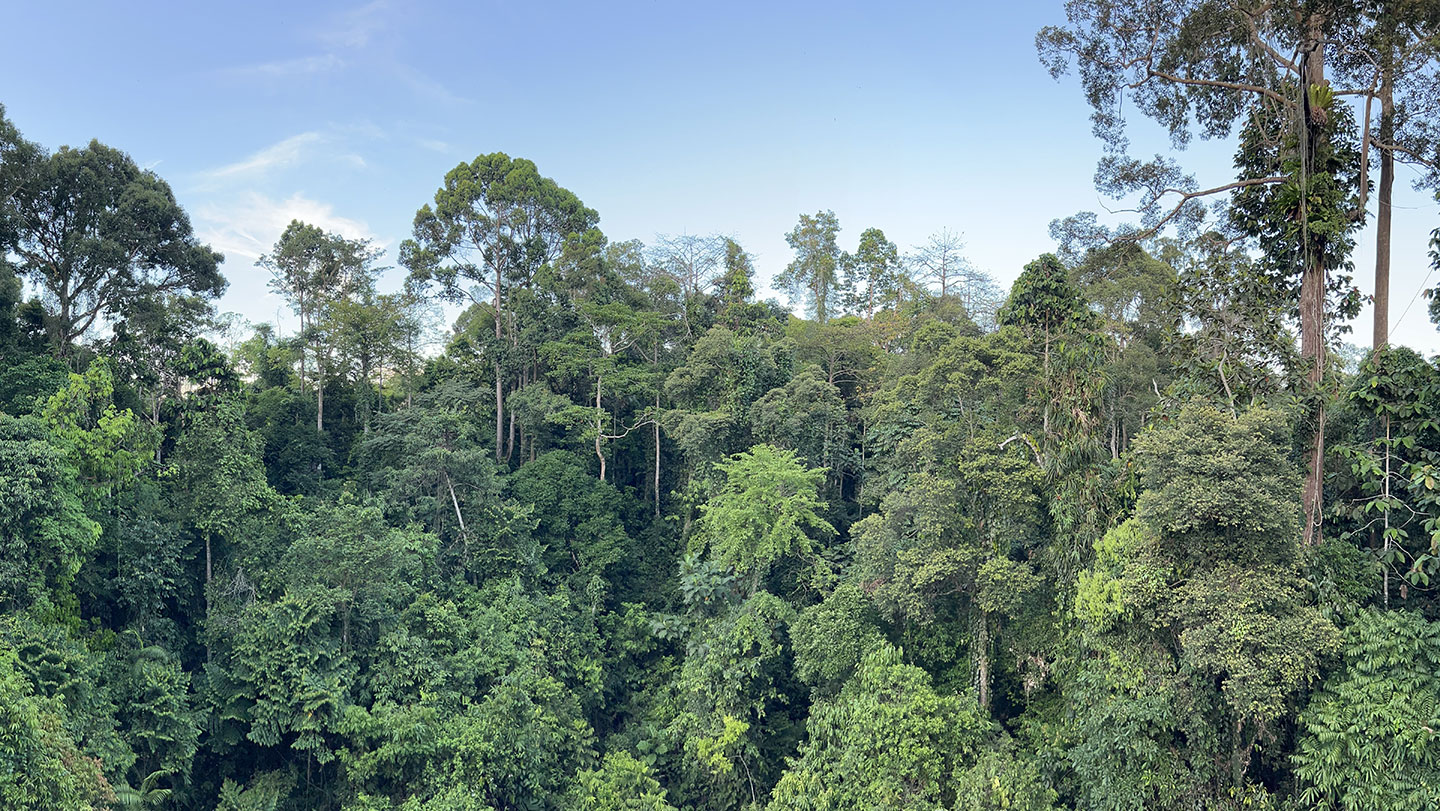
So Scheire, then at the University of Exeter in England, and his colleagues ventured to the lush, humid rainforest of Malaysia’s Kabili Sepilok Forest Reserve. There, the incomprehensibly high crowns of trees in the Dipterocarpaceae family tower over the canopy. The researchers teamed with professional climbers, waking before dawn to sample leaf, trunk and branch samples from different tree heights throughout the day. The 38 trees they studied included five species, ranging from 7.7 meters to 71 meters tall — over three-fourths as tall as the Statue of Liberty. They measured 25 traits related to tree water transport.
On average, taller trees start off with larger xylem widths at their base — a strategy that compensates for increased resistance with height, the team found. And higher leaves adjusted their dehydration limit to accommodate less water being sucked to them.
Those adaptations seemingly helped during an intense drought lasting from 2023 to 2024. The team found that there were no height-related declines in growth rate among their sampled trees, suggesting that drought responses were independent of tree height.
A competing theory already was casting doubt on height impairing water transport. It predicted that larger trees would have adaptations like the ones shown in the study, says Julieta Rosell, a functional ecologist at the National Autonomous University of Mexico in Mexico City who wasn’t involved with the work. It’s neat, she says, that the theory “motivated these researchers to test the uppermost parts of tall trees…. This was never done before.”
Big trees can store massive amounts of aboveground carbon, and they contribute to ecosystems by producing seeds and providing habitats for numerous tropical organisms. Because this tree family is not at greater susceptibility to drought, it “may be a good long-term spot to sequester carbon” in Southeast Asia, Scheire says.
For Rosell, the findings encourage a rethink about trees’ nature.
“They’re doing things all the time, making changes in their anatomy all the time,” she says. “And that gives a different perspective to trees because they seem so quiet.”
Read the full article here