





After nearly a decade in development, NASA’s next big telescope is almost ready to travel into space. The agency has set Aug. 30 as the launch date for the Nancy Grace Roman Space Telescope. This places the project approximately eight months ahead of its original schedule and, according to NASA leadership, significantly under budget.
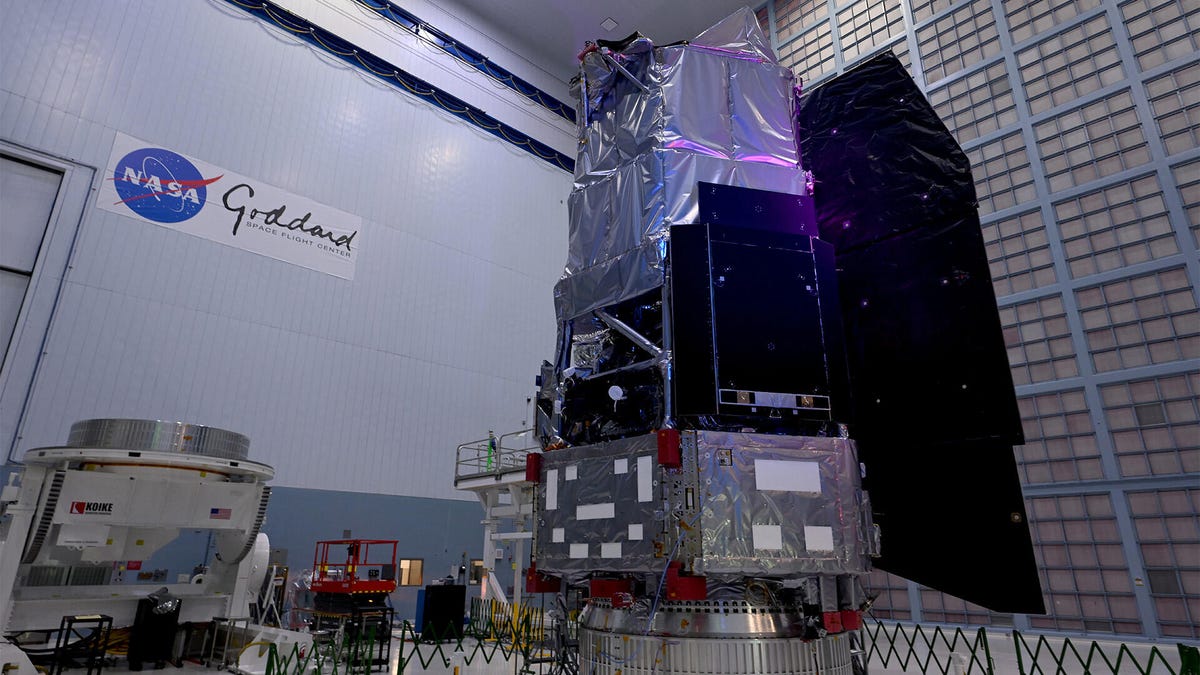
“With less than three months to go, the Roman team now is finishing up tasks,” NASA said in a blog post. “Engineers are currently packing Roman up for a voyage from NASA’s Goddard Space Flight Center in Greenbelt, Maryland, down to the agency’s Kennedy Space Center in Florida later this month.”
Once at the launch site, the telescope will undergo a detailed inspection to verify that it sustained no damage during transit. Engineers will then fuel it with roughly 290 gallons of hydrazine and conduct several dress rehearsals before launching it into space.
The destination for the Nancy Grace Roman Space Telescope is the Sun-Earth L2 Lagrange point, located about 1 million miles from Earth on the far side of the sun. The region is a gravitational sweet spot that allows spacecraft to maintain a relatively stable position while orbiting the sun alongside Earth.
Livestream details are expected to be released closer to the launch date. The broadcast will likely be available on the NASA app, YouTube, and Netflix, which has an agreement with NASA to carry launches, spacewalks and other live programming.
With its wider field of view, the Roman telescope promises to see quite a lot of the universe.
What is the Nancy Grace Roman Telescope looking for?
The telescope is named after astronomer Nancy Grace Roman, NASA’s first female executive and an instrumental voice in the planning and construction of the Hubble Space Telescope.
The two telescopes share more than just a connection to Roman. Both use 2.4-meter mirrors and can produce images with similar sharpness. But Roman is designed to see much more of the sky at once, capturing images at least 100 times larger than Hubble’s. The observatories also specialize in different wavelengths of light: Hubble observes ultraviolet, visible and near-infrared light, while Roman focuses on visible and infrared wavelengths.
The Roman Telescope can see as much of space in just two images as the Hubble does in over 400.
NASA envisions Roman and Hubble working hand in hand. Roman will scan enormous swaths of the sky, uncovering objects and phenomena that can later be examined in greater detail by Hubble. By combining Roman’s panoramic surveys with Hubble’s more focused observations, astronomers hope to build a richer picture of the cosmos.
During its mission, Roman is expected to observe more than 100 billion stars and billions of galaxies, detect tens of thousands of supernovae and transmit nearly 1.4 terabytes of scientific data to Earth every day.
Read the full article here