





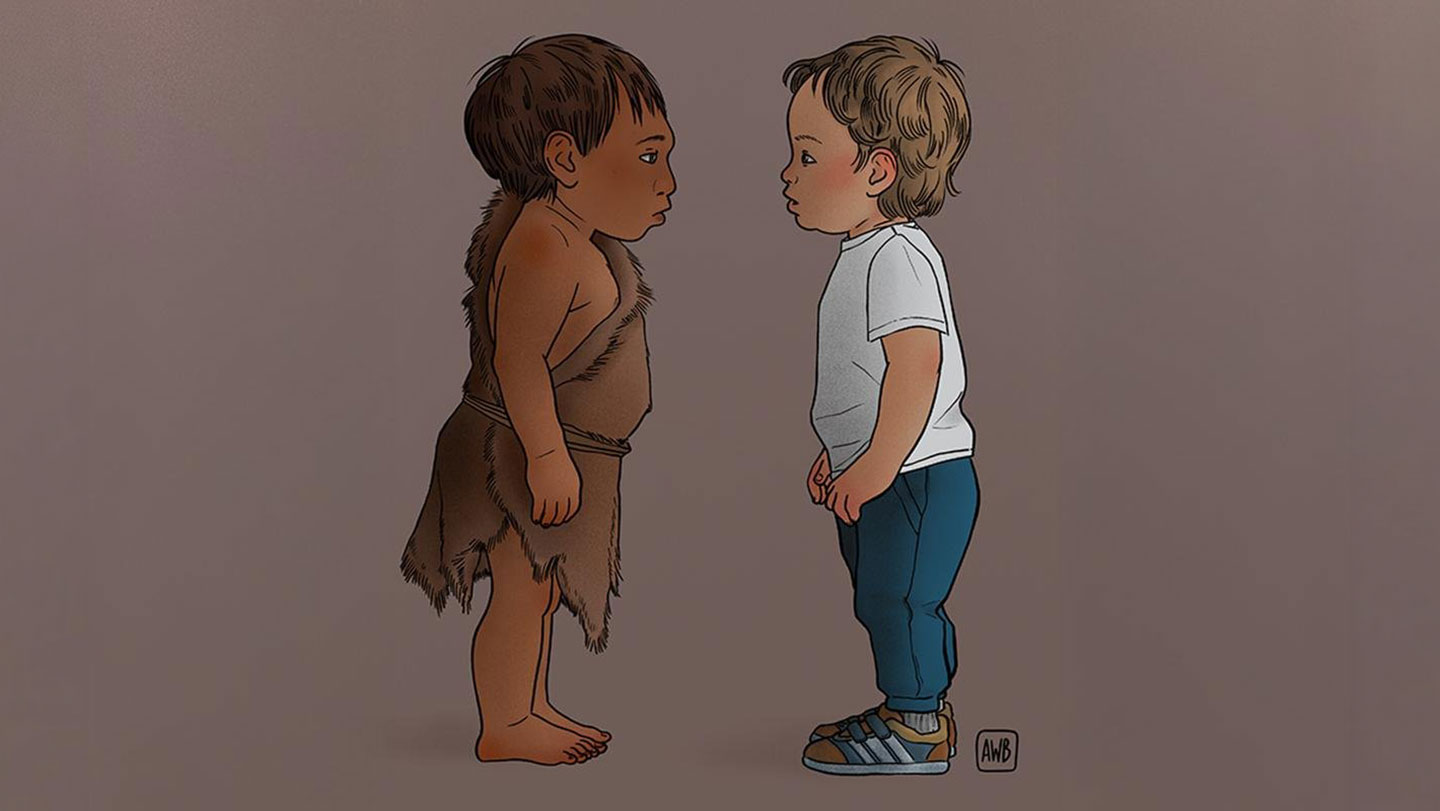
Neandertal babies seem to have started life much the same as modern humans, then grew a lot faster.
The idea comes from two separate studies: one that examined the remains of a Neandertal who died at about the time of birth and another that analyzed the remains of a six-month-old Neandertal. Taken together, the studies suggest that Neandertal babies were about the same size as Homo sapiens babies when they were born but grew almost twice as fast in the months that followed.
One study, published June 17 in Royal Society Open Science, looked at the remains of a very young Neandertal child — a late-term fetus, stillborn or newborn — from a rock shelter in southern Germany. The 12 tiny bones, unearthed decades ago, came from sediment dated to about 55,000 years ago.
Using X-ray imaging to examine the tiny remains, archaeologist and geoscientist Alvise Barbieri and colleagues created digital reconstructions of the bones as they were at death. The team found that the bones of the child would have been about the same size as those of modern human newborns. But they also saw signs of advanced development in the ancient arm and leg bones — they were thicker and denser than in H. sapiens babies.
The study “highlights both similarities and differences in [Neandertal] growth and development compared to Homo sapiens,” says Barbieri, of the University of Algarve in Faro, Portugal.
The other study, published April 15 in Current Biology, examined the remains of a six-month-old Neandertal from a cave in northern Israel. That study also used X-rays to scan and digitally reconstruct several bones and teeth. Scientists don’t know exactly when the infant died, but dating of sediment layers in the cave indicates it was roughly between 51,000 and 56,000 years ago.
While the Neandertal infant’s teeth were like those of a modern human of the same age, its arm and leg bones resembled those of a modern human about twice as old, paleobiologist Ella Been and colleagues report.
Clearly, Neandertal growth trajectories were different from those of H. sapiens, says Been, of Ono Academic College in Kiryat Ono, Israel. “Their [physical] growth in infancy and early childhood is more rapid than that of modern humans.”
Barbieri agrees: “These findings suggest that this faster bone development probably began towards the very end of pregnancy and became more evident during the first years of life.”
Paleoanthropologist Michael Petraglia of Griffith University in Brisbane, Australia, who wasn’t involved in either study, notes that growth rates among Neandertals may have varied at different times during their evolution, as well as in different regions. But the two studies imply that Neandertal and H. sapiens development did not follow the same rate after birth. Neandertal development was certainly like that of modern humans, he says, but with differences in the timing and pace of growth.
Read the full article here