





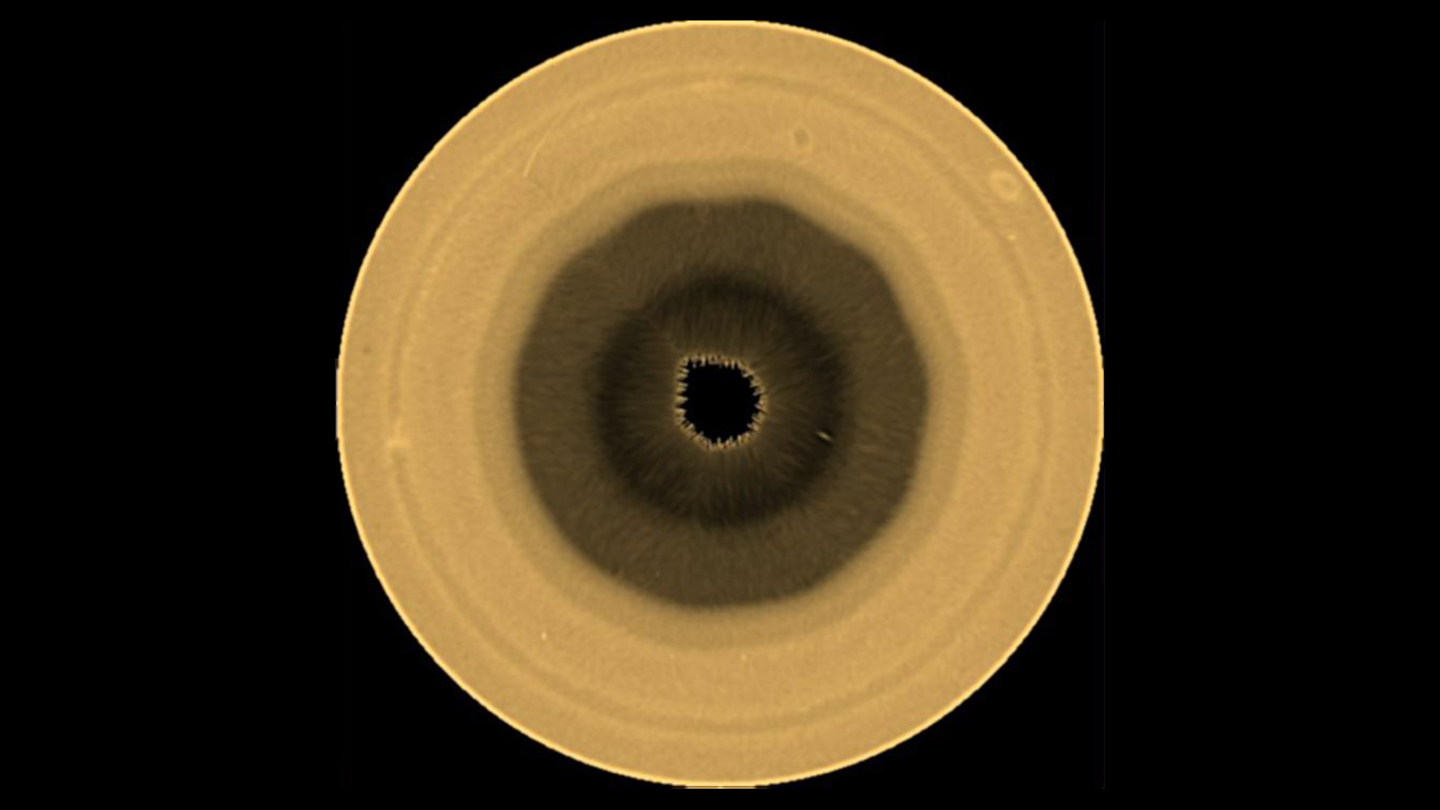
Scientists watching the weather on Saturn have spotted a strange polygon surrounding the planet’s south pole — a feature that would have surprised them less had it appeared years ago, when the planet was under constant surveillance.
The planet’s north pole has been marked by a distinctive cloud-darkening hexagonal jet of gas for at least 45 years — scientists first spotted it when NASA’s Voyager probes zipped past the ringed giant in 1980 and 1981. But NASA’s Cassini mission spent more than 13 years studying the planet in detail and never saw anything similar in the southern hemisphere, puzzling scientists.
Now, scientists using the Hubble Space Telescope and the help of a network of amateur astronomers have identified a similar 10-sided jet moving independently of the rest of the atmosphere circling Saturn’s south pole, researchers report September 2 in Science Advances. “This discovery suggests that the hexagon [at the north pole] is not as extraordinary as previously thought,” says planetary scientist Agustín Sánchez-Lavega of the University of the Basque Country in Bilbao, Spain.
The decagon first became apparent in Hubble images gathered last autumn; astronomers then revisited observations from as early as 2023 and confirmed it was visible then as well, albeit less defined. But it’s impossible to say when the decagon first formed — no spacecraft have been posted at Saturn since 2017 and the planet’s south pole turned away from Earth in 2012, reappearing only in 2023.
In the scant observations scientists have, the decagon seems to change more than the staid hexagonal jet does, says planetary scientist Amy Simon of NASA’s Goddard Space Flight Center in Greenbelt, Md. That makes her hesitant to hypothesize how long the newly identified feature may stick around on the gas giant — an inherently chaotic world — although she hopes it remains for a few more years. Gas giants “look nice and serene, but they’re very windy,” Simon says. Atmospheric features like the hexagon “can last for decades, but on the other hand [things] can change very fast.”
In and of itself, seeing a jet on Saturn is perfectly normal, says MIT planetary scientist Wanying Kang, who wasn’t involved in the new research. That’s because the planet’s combination of large size and superfast spin — a day on Saturn lasts only about 10.7 hours — is a recipe for these stripy bands of gas currents to form. Gas naturally wants to flow from the warmer equator to the cooler poles, but the speedy spin means it can’t travel far before being whipped into a path around the planet. But the decagon’s angular shape rather than a smooth circle is striking and suggests there’s something intriguing to learn, perhaps about the planet’s deeper atmosphere, she says.
The researchers can’t properly explain the feature, although they suggest that perturbations from a nearby storm might have triggered it. They hope that recruiting additional observatories, including the James Webb Space Telescope, and watching the feature over time, will help reveal what’s creating the decagon.
Conveniently, Hubble was already due to check back in on Saturn later this month, Simon says. “We’ll be watching it, and we’ll go from there.”
Read the full article here