





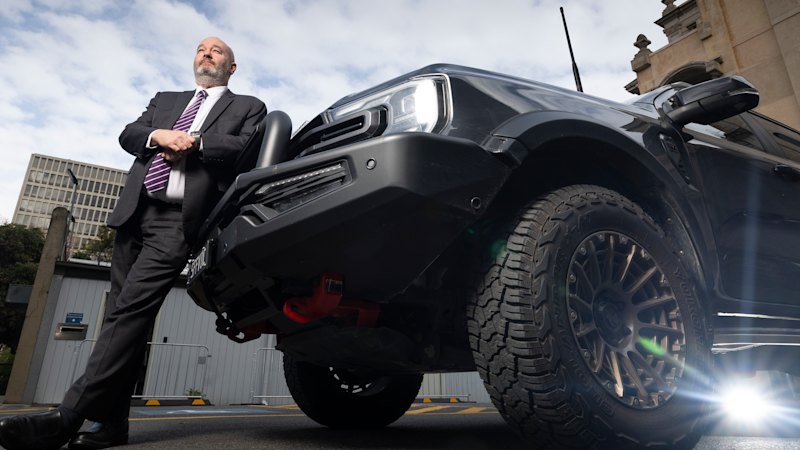
Oversized utes take up more space on roads, pollute more and are less safe for other road users, but a parliamentary inquiry will consider whether charging them more than other cars using Melbourne’s toll roads is unfair.
A new generation of oversized American utility vehicles, including the Ford F-150 series and the Ram 1500, has flooded onto the Australian market, as tax perks encourage motorists to buy bigger vehicles.
These oversized utes are charged more than standard cars to use toll roads. A CityLink day pass for such utes costs $52, compared with $24 for a car.
Shooters, Fishers and Farmers party MP Jeff Bourman believes the higher cost for vehicles classified as light commercial vehicles, which are defined as any two-axle rigid vehicle with a cab chassis construction and weight between 1.5 and 4.5 tonnes, is unfair.
“There are a lot of people in this world driving twin-cab utes because they cannot get another vehicle that will satisfy their needs,” Bourman said. “The problem is that people that are using their cars as a conveyance, not as a commercial vehicle, are getting tolled double the people doing the same thing in a slightly different car that weighs about the same.”
Bourman, who drives a Ford Ranger, said the oversized utes had become common as family cars and should not be charged as commercial vehicles unless they were used for that purpose.
“The average Tesla weighs way more than the Ford Ranger, so it’s not about wear and tear on the roads because the electric vehicles are getting charged a much lesser price,” he said.
Ford Rangers weigh from 1.7 to 2.4 tonnes, while Tesla models sold in Australia weigh from 1.6 to two tonnes.
Bourman has launched a parliamentary inquiry into Transurban’s categorisation and tolling of private use of utility vehicles, with a reporting date of September 30.
“Melbourne motorists paid $1 billion in tolls in the past financial year,” he said. “CityLink’s financial year 2025 revenue was $987 million, or around $2.7 million a day, up 4.1 per cent from $948 million in financial year 2024. The revenue keeps going up.”
Bourman said that in NSW utes were categorised as class 2 motor vehicles and were charged the same amount as smaller passenger vehicles on toll roads.
Former MP and taxi and gig worker advocate Rod Barton said the issues dated back to the original CityLink agreements negotiated in the Kennett government era.
“It does raise broader questions about the relationship between Transurban and successive Victorian governments and whether motorists are getting a fair deal,” he said.
Greens MP Katherine Copsey told parliament’s economy and infrastructure committee that she opposed reducing the charge because heavier vehicles caused “exponentially more” damage to Victoria’s roads.
“Where do all these big utes go once they leave the toll road in question?” Copsey said.
She said many of the utes were too big for standard parking spaces, and it was even an issue on parliamentary grounds, with vehicles bulging over the sides or spread across two parking spaces.
“If people really do want to choose bigger, more harmful, more polluting vehicles that cost more to run and that increase damage to our road surfaces, that is their choice, but we must consider whether it is something we want to keep subsidising through our public policy,” she said.
SUVs and light commercial vehicles including utes made up 84 per cent of new vehicles sold in Australia in April, while sedans and other passenger cars made up only 11 per cent.
Sales data from April shows the top 10 selling cars in Australia were all utes and SUVs.
Hussein Dia, professor of future urban mobility at Monash University, said cars sold in Australia had been getting heavier and continued to grow, a phenomenon sometimes called “auto-besity”.
“It’s only fair that the road operator recovers more revenue from vehicles that are contributing more to the tear and wear of the infrastructure,” he said.
A Victorian government spokesman said under contractual arrangements, Victorian toll road operators were entitled to charge lower tolls for vehicles classified as cars, higher tolls for light commercial vehicles and the highest tolls for heavy commercial vehicles.
“An inquiry into how private utility vehicles are classified on Victorian toll roads is … under way – focusing on making sure tolling remains fair, appropriate and fit for purpose,” he said.
A spokesman for Transurban declined to comment.
Start the day with a summary of the day’s most important and interesting stories, analysis and insights. Sign up for our Morning Edition newsletter.
From our partners
Read the full article here