




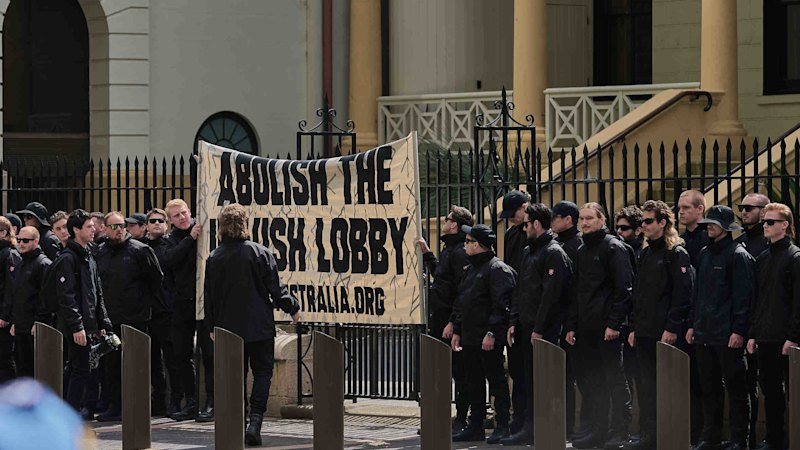
A reformed neo-Nazi has told the Royal Commission on Antisemitism how he went from disillusioned young soldier to extremist, before realising the promises of brotherhood, “Volk”, and the Great White Hope were just a pack of lies by angry men.
The royal commission on Wednesday reconvened to hear evidence on the drivers of antisemitism – chiefly hearing from experts in far-right, religious and online extremism and government responses.
One witness, speaking anonymously under the pseudonym ADC, told the commission he had been raised by a staunchly anti-immigrant mother in Victoria in the 1970s, and felt deeply connected to British culture.
He drifted through school, sitting at the back of the class, and joined the Army Cadets where he met young men with far-right views.
“There were all sorts of kids there, but we were very much a little gang, for lack of a better term. We looked after each other. Once you were part of it, you were part of it,” ADC said.
At 17, ADC joined the Australian Defence Force and then moved overseas to serve in another armed service. He met men with similar, sometimes more “vehement” political stripes than his own.
But the pivotal moment for ADC, he told the commission, was when another soldier attacked him with a steam iron, fracturing his skull.
A few months later, the charges were dismissed against ADC’s attacker. One senior officer told ADC his attacker was in a documentary about minorities “so this is going away”.
ADC left the service in 2002 and fell in with music groups that had neo-Nazi leanings. He returned to Australia shortly thereafter and continued to associate with similar groups.
He covered his body in prominent white nationalist tattoos, melded in with other men angered by migration and united by “Volk” – the German word for “people” – which neo-Nazis use to describe their racially defined community.
But it dawned on ADC, over years, that society saw them as the bad guys – and he started to agree.
“They didn’t hold the ideals that I believed we all should hold. They weren’t good enough,” he said.
ADC left in 2007, then drifted back in to the closed society, struggling to make friends elsewhere.
But by 2013, he told the commission, he had met new people. Some of them were from other ethnicities, and had shown more “brotherhood” than anyone in his neo-Nazi circles.
“When something happens, you think they’ll be there, standing beside you – but they’re the first people to melt away,” ADC said.
“None of these claims about brotherhood or the Volk mean anything to them.
“They’re just angry people with nowhere to direct their anger. Once you see that, you can see it for what it is.”
He handed back his patches to his neo-Nazi mates, and told them they weren’t worthy.
Now, 13 years later, ADC told the Royal Commission he recalled a daunting feeling of leaving something, but leaping into nothing, and trying to reinvent himself.
Support groups did not exist for reforming extremists in 2013, he said, but now Exit Australia was helping him get his tattoos removed so he can take his children swimming.
“They’re not a part of me any more” he said.
Deakin University researcher Josh Roose told the royal commission a sense of anger and conspiratorial beliefs about Jewish people were the defining element of antisemitism.
“Grief plays a role as well in someone’s turn to extremism. Emotions are often overlooked but are absolutely critical,” Roose said.
It has become described a shared destination between far-right and far-left conspiracists, who felt strong emotions around shame and disenchantment with their lives, he said.
Sovereign Citizens, Islamic extremists and almost all extremist groups agreed on Zionists or Jewish people as a common enemy.
Roose said the disintegration of trade union, political and church memberships, had sent such people searching for belonging and moral authority in the dark parts of the internet.
“People have lost a sense of belonging in their community,” he said.
“We are seeing the organisations that bounded the lives of working-class people evaporated… something had to replace that, and we see the internet, social media, the online world.
“There’s a place for extremist narratives to supplant broader ideologies of what it means to be Australian, and to belong.”
The Morning Edition newsletter is our guide to the day’s most important and interesting stories, analysis and insights. Sign up here.
From our partners
Read the full article here