




Architect Peter Besley would like to make one thing clear. He’s not against “typical” Brisbane house design. He especially loves classic Queenslanders.
“I’m very respectful of the older houses. I think that’s a really beautiful language that’s developed here.
“It’s just that, historically, we’ve never thought to do this,” he says.
What Besley has done is designed a house that doesn’t have roof overhangs for shade, floor-to-ceiling windows, or verandah: “all of the things we are taught as architects in Queensland that you have to have”.
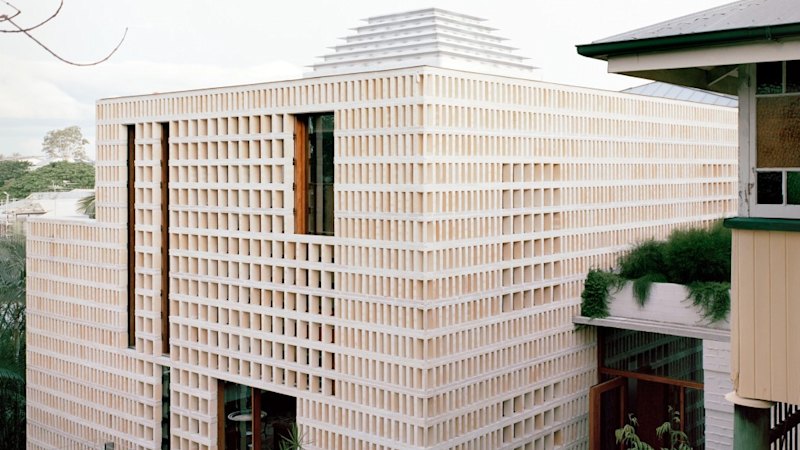
Instead, it uses a self-shading lattice of brickwork with a ziggurat-shaped skylight on top.
The home’s streetfront is deliberately blank and nondescript – brutalist even – and wrapped in stainless-steel netting for safety instead of having balustrades.
It has a backyard pool, but it’s small in diameter, three metres deep, and shaped like a silo (“you can drop like a stone to the bottom in the middle of a really hot Brisbane day, and it’s very refreshing down there”).
The house’s approach to cooling is not to try and catch breezes, but rather to trap cool air overnight and keep it through the heat of the day.
And if it reminds you of African or Middle Eastern architecture, there’s a good reason for that.
Occupying a street on a Mount Coot-tha spur, the house, “Birdwood”, has just won the top prize for a house in the Queensland Architecture Awards 2026.
Given out annually by the Australian Institute of Architects, the awards recognise architectural innovation across the state.
“In the residential winners, we saw examples of houses that are reshaping our preconceived notions of the traditional ‘Queenslander’ home and embarking on ambitious new typologies,” jury chair Professor Michael Keniger said.
Brisbane-born Besley’s design drew upon years of studying housing in Iraq, where he worked on projects for United Nations.
“It’s very hot in Baghdad, hotter than here,” he says.
“You don’t do the intuitive thing that you’d do in Queensland and open all the windows during the day. You actually keep it semi-closed, because you want to keep that cool air in.
“Floors, walls and ceilings need to be heavy, because they have a kind of thermal inertia to them.”
The owners commissioned Besley pre-COVID, and he planned the house “backwards” after acquiring pallets of brick from the closure of the Claypave brickworks in Ipswich.
He also used precast concrete slabs, which use about 40 per cent less concrete than a traditional pour.
The building is groundbreaking not only in its design and reuse of materials but in its flexible, consultative building process.
When COVID hit it brought extreme price rises, so Besley stepped in to negotiate between owner and builder, redesigning the home to avoid engaging expensive exterior contractors.
“The standard situation is to try and hold people to a lump sum contract, then people go out of business, and then the design suffers, everybody suffers in the end.
“I think I did 600 revisions of the drawings to this house because I just kept tweaking things to make them achievable by the people who were available.”
For example, the building has a “hanging” library designed to house 3000 history books. It was designed to be easily built from joinery by the carpenter on site.
The result is a home that Besley says cost about a third of what most people estimate.
Besley says his time in the Middle East changed his thinking on how houses can be occupied, with sleeping and eating taking place in different parts of homes interchangeably.
To his mind, we’re too hung up on things such as kitchen cabinetry, and not thinking enough about homes as great spaces to occupy.
“The way people obsess over their appliances and kitchens, it’s not so much that it’s wrong, it’s secondary, tertiary, it’s not the main thing.”
Other local buildings that won Queensland Architecture Awards include St Joseph’s College Gregory Terrace, commercial skyscraper 205 North Quay, Sunshine Coast University Library, and the Chapel for St Peters Lutheran College, Indooroopilly.
The Brisbane Metro won an award for urban design.
Start the day with a summary of the day’s most important and interesting stories, analysis and insights. Sign up for our Morning Edition newsletter.
 Nick Dent is a Culture Reporter at Brisbane Times, covering arts, entertainment and things to do in the city.Connect via email.
From our partners
Read the full article here