




Opinion
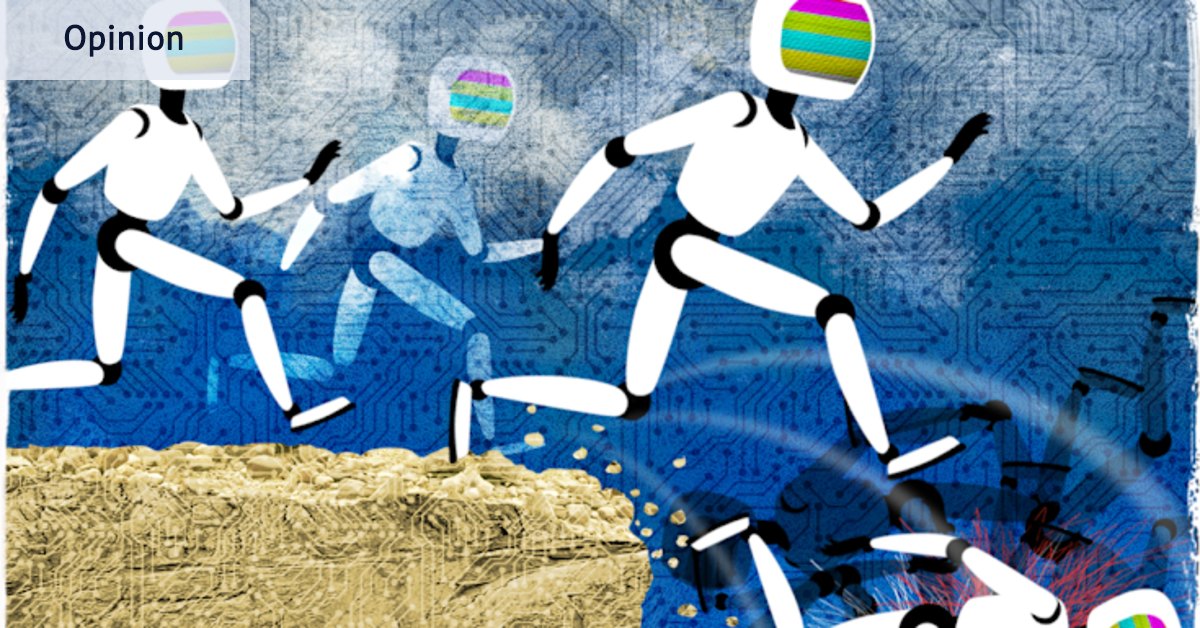
The World Humanoid Robot Games, which have just finished in Beijing, weren’t an event; they were a perfect metaphor. Robots ran the 100 metres faster than Usain Bolt, but kept running until they exploded into a padded wall. We can create technology to do anything. We just can’t make it stop.
The robots are a mirror to our moment: no exit plan. Strongmen start wars and their technology can achieve all their aims except finish what they have started. Putin in Ukraine, Netanyahu in Gaza, and Trump in Iran now lie at the base of their padded wall.
Humanoids replicate humans in their inability to stop. Five Sydney Swans didn’t know how to stop their big night out. Anthony Albanese didn’t know how to finish the “comic” podcast conversation he had started, and, lacking an exit plan, ended up gibbering about melons. He resembled nobody so much as Lionel Essrog, the character in Jonathan Lethem’s novel Motherless Brooklyn, who can’t help pushing and pushing a joke beyond its use-by moment. His mentor Frank Minna calls it “tugboating”. If only Albo could have stopped tugboating.
It would be glib to focus on the trivial side of individuals’ compulsion to tugboat. Humanity tugboats its technology on a grand scale of destructiveness. The artificial intelligence which has been thinking on behalf of some of the robots in Beijing is itself a really big boys’ own adventure without an exit plan. Doomsayers fear that we, humanity, will be the padded wall, just as our planet is the padded wall for the past two centuries of industrial pollution.
What was the aim of the World Humanoid Robot Games? Its thousands of competitors were surely not intending to produce a parable of man’s unlimited limitations. Didn’t it demonstrate something useful, and hopeful?
It certainly produced content for social media and contributed more profit to the booming economy of sharable short videos. Human robots have, for now, replaced cats and children in the category of “Look at the funny things they do”.
The Beijing games provided a steady stream of robots pratfalling, exploding, air-swinging, misfiring, and generally making poor life choices. Many of the competitors looked like they should have been tested for alcohol or recreational drugs. Their likeness to humans made them that much funnier. Along with the crowds in the Beijing arenas, you could laugh at the victims guilt-free. Being robots, they died painless deaths and suffered unembarrassing embarrassments. Best snuff films ever.
In this, the World Humanoid Robot Games offered us a distractingly funny human (or humanoid?) face for Chinese technological development. A global audience of Homer Simpsons, we chuckle at those robots. It’s funny because it’s true. In one hilarious humanoid week, China has achieved more than a decade of soft diplomacy.
But aside from providing laughs, social media content, world records and showing that the fastest way to run is to cradle your arms like you’re stumbling through a crowded bar with a tray of drinks, what have the World Humanoid Robot Games given us?
Thirty of the 50 events in which more than 2000 robots competed were simulations of the Olympics and Paralympics. The other 20 events were modelled on human work, such as shelf stacking, retail service, book sorting, garden management and even fire rescues.
You would have seen few videos and memes of humanoid robots performing in the power tool assembly, powder weighing, bricklaying, cap and lid opening, cable connecting, box unpacking and tweezers bean-picking events, but these are some that offer potentially useful and widespread innovations (just as a person who can set up your internet or fix your phone is more useful than Usain Bolt).
The “dexterous hand events” in the games, with many more competitors than in the sporting events, reveal “where [the organisers] expect humanoid robots to get deployed commercially first”, according to Forbes magazine. “This is essentially a market map in game form.”
By this reading, the World Humanoid Robotic Games were not a metaphor but a demonstration of a reality coming at us faster than a self-driving taxi.
The $US8.7 billion ($12 billion) of venture capital plunged into humanoid robotics so far this year is already double 2025’s investment and exceeds that for the entire previous decade, according to the specialist publication dealroom.co. Next year, investment in humanoid robotics is expected to pass the $US13 billion spent annually on addressing world hunger. This is just the beginning.
Banks Morgan Stanley and RBC have forecast a $US5-9 trillion robotics economy by 2050, with a billion humanoid robots sharing our planet with us. One robot for every 10 humans, and we’ll never have to assemble a power tool or unpack a box again. The “vast sums of money now being invested means maybe that day is closer than we think”, reported Queensland University of Technology’s Jonathan Roberts in The Conversation.
But just like in the human world, while the grunt work takes place in the shadows, the shop window is telling us a very old and enduring fable about ourselves. As futuristic as the Beijing games are, the lessons are ancient. The Greeks told the story of Prometheus, the titan who stole fire from the gods and gave it to humans. With the gift of technology, humans knew how to start but not how to stop. As a cautionary tale, Donald Trump is even older than he looks; he’s as old as classical myth.
Tech capitalism is programmed for endless growth. The science of enterprise knows no horizons. But the art of restraint? As that original (and still the best) humanoid robot, Robot from Lost in Space, said, “It does not compute.”
Zeus punished Prometheus by chaining him to a rock and having an eagle eat his liver, and the liver grew back again overnight so that Prometheus, like the reassembled humanoid robots in Beijing, had to go through it over and over. Prometheus would be re-embodied as Mary Shelley’s Frankenstein, who created a monster of unintended consequences.
Will we ever learn? Hold that thought. I have to show you this hilarious clip.
Malcolm Knox is a journalist, author and columnist for The Sydney Morning Herald.
Get a weekly wrap of views that will challenge, champion and inform your own. Sign up for our Opinion newsletter.


From our partners
Read the full article here