






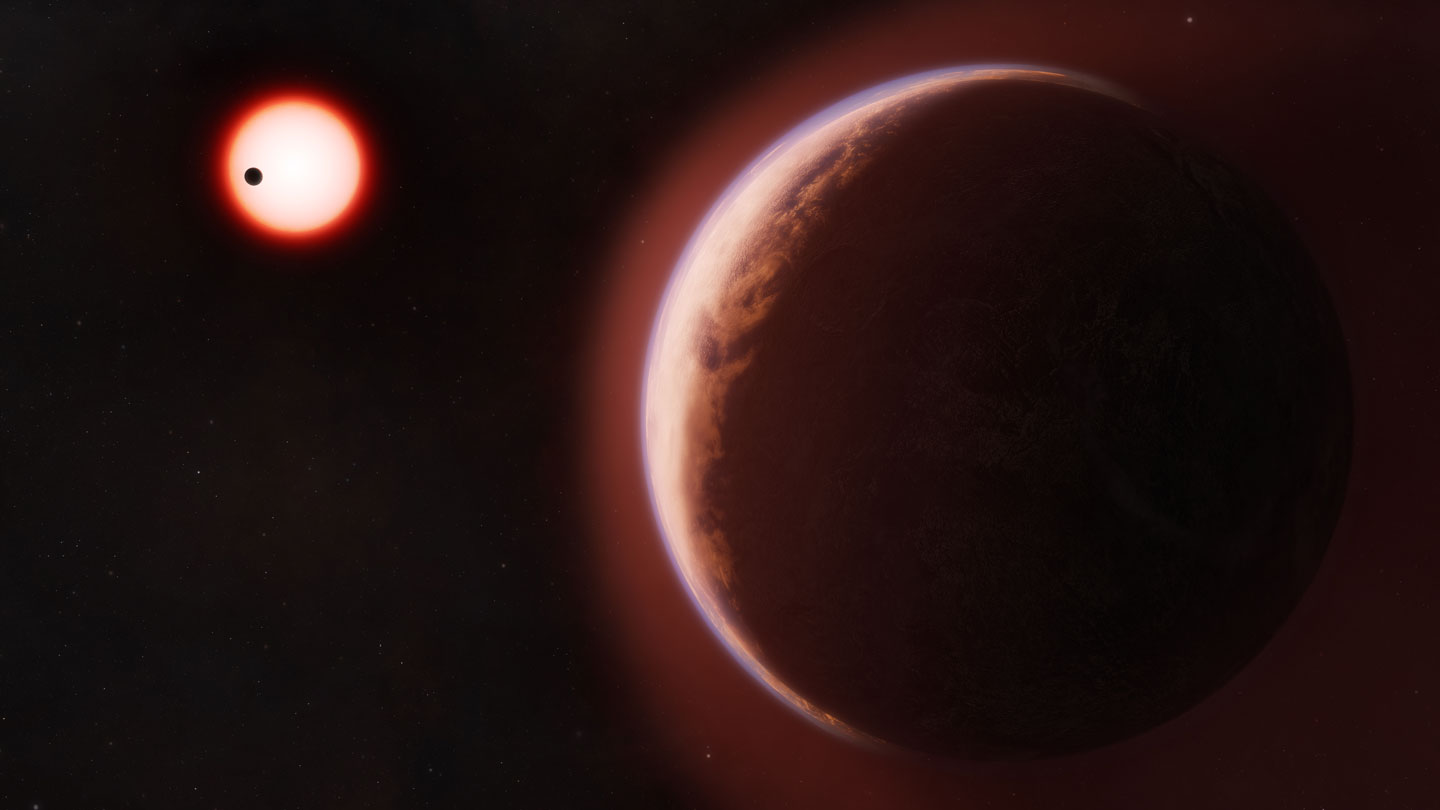
For the first time, astronomers have detected an atmosphere around a rocky planet orbiting in the habitable zone of a nearby star.
Such planets have long been considered the best places in the galaxy to look for signs of alien life. But so far, “the planets looked like bare rocks,” says astronomer Laura Kreidberg of the Max Planck Institute for Astronomy in Heidelberg, Germany. It wasn’t clear if planets like this could even have atmospheres. This study shows that they can, astronomers report in Science July 16.
“I feel more optimistic now about the chances of habitable environments beyond the solar system,” Kreidberg says.
The planet, LHS 1140b, is about 5.6 times as massive as Earth and 1.73 times Earth’s size. Those dimensions are consistent with an Earthlike composition shrouded in a gaseous atmosphere, or perhaps a global ocean of water. It also orbits far enough from its star that its surface temperature could support liquid water.
But the host star is a cool, dim M dwarf, the most common type of star in the galaxy. These stars produce notoriously bad neighborhoods, emitting harsh radiation and brutal stellar flares that could strip their planets’ atmospheres away.
“The open question is, can rocky exoplanets even keep their atmospheres around M dwarfs?” says planetary astronomer Collin Cherubim of the Harvard-Smithsonian Center for Astrophysics in Cambridge, Mass.
Cherubim and colleagues used the Magellan Clay telescope at the Las Campanas Observatory in New Mexico to observe LHS 1140b passing in front of the star and blocking a bit of its light.
Just before this transit began and for a little while after, the researchers observed the molecular fingerprint of excess helium gas absorbing light from the star. That excess is a sign of helium streaming away from the planet’s atmosphere, Cherubim says — which means it has one.
“Really, the most exciting thing here is that the planet has an atmosphere at all,” Cherubim says.
Previous studies had found signs of helium escaping from larger planets than LHS 1140b, called mini-Neptunes. These may be in the process of losing their atmospheres, becoming bare rocks.
LHS 1140b is losing helium, too. “It is slowly changing,” Cherubim says. “On astronomical timescales, billions of years from now, the atmosphere will be quite different.”
But it probably won’t be lost forever. LHS 1140b is cooler than the mini-Neptunes and is losing atmospheric mass at a much lower rate. The planet has already held on to its atmosphere for more than 3 billion years and could be stable for a billion more, Cherubim calculates. Even then, the planet could maintain an atmosphere made of heavier gases like carbon dioxide or nitrogen.
Follow-up observations with the James Webb Space Telescope will help determine other features of the atmosphere, like how much helium it contains and what other molecules are in there. Another detection would also confirm the atmosphere is really there, Kreidberg says.
A rocky planet with a helium-rich atmosphere is a surprising finding, she adds. “This is a kind of planet that we’ve never seen before,” she says. Its atmosphere is thicker than expected for a rocky planet, but not thick enough to be a gas giant. “Because it’s such an exotic weirdo planet, it never occurred to me to go look for it.”
Read the full article here