





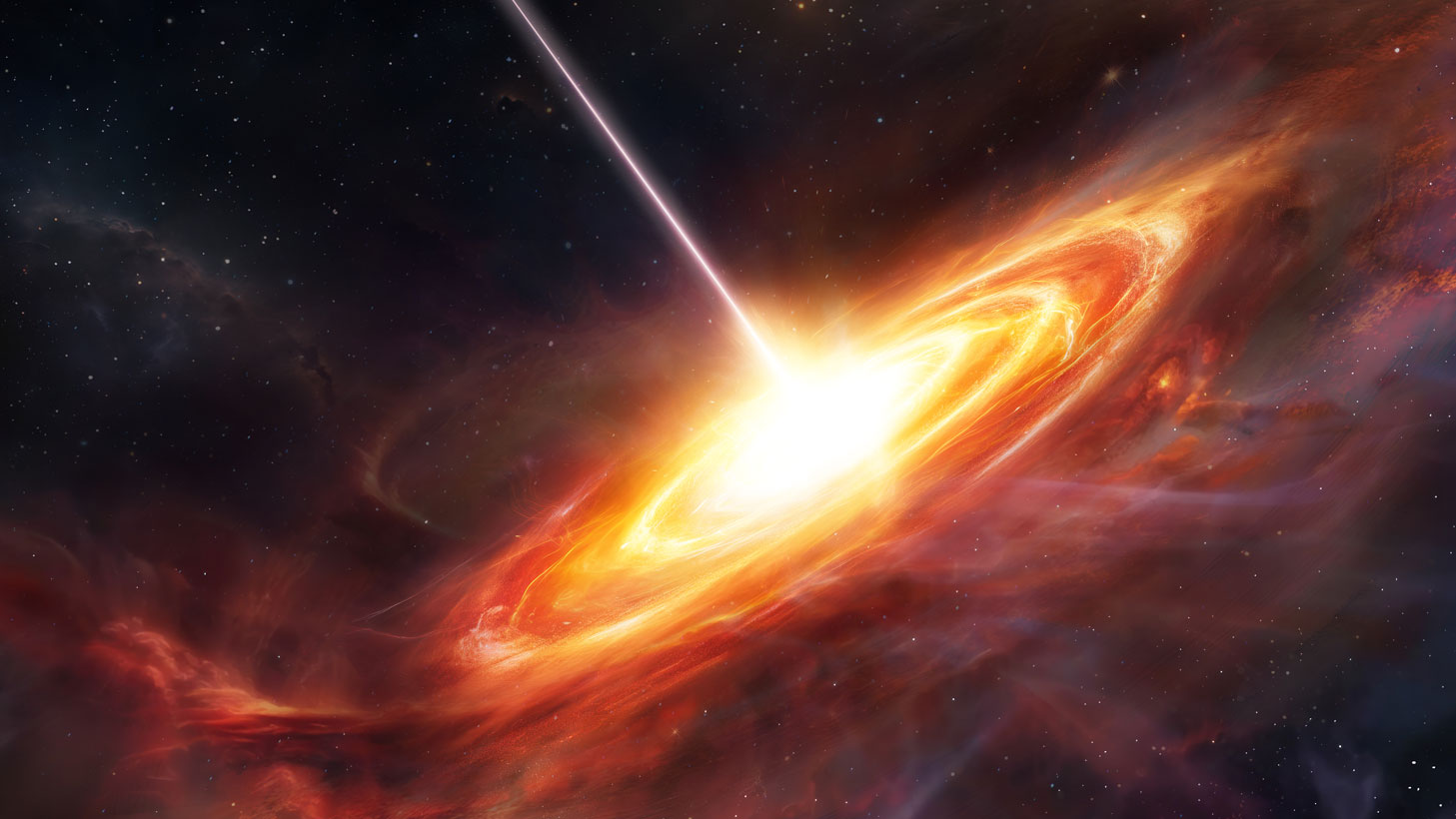
There’s a new record holder for the most distant supermassive black hole. A newly spotted quasar — a black hole that is gobbling matter so quickly it glows white-hot — sends light from just 662 million years after the Big Bang, astronomers report July 6 in Astronomy & Astrophysics. The previous record holder, discovered in 2021, is from 15 million years later.
The discovery ratchets up the tension on a longstanding mystery of how early black holes got so big so fast, says astronomer Daming Yang of Leiden University in the Netherlands. “Every step further back in time is making this question even harder to explain.”
The new champ was spotted by the European Space Agency’s Euclid space telescope, which embarked on a six-year mission in 2024 to map about a third of the sky in infrared wavelengths of light.
Those wavelengths are crucial for finding distant objects, because light gets stretched, or redshifted, as it traverses the expanding cosmos. If a quasar emits visible light in the early universe, it will appear infrared when it reaches our telescopes.
Before Euclid, telescopes could detect only the brightest quasars out to about 770 million years after the Big Bang, which was 13.7 billion years ago. Until now, astronomers knew of only nine quasars earlier than that. In its first 18 months, Euclid found 12 more, Yang and colleagues report.
“This turns the field from studying a few outliers to studying the earliest massive black holes as a population,” Yang says. “That’s equally as important as breaking the record.”
The new record holder, called EUCL J1729, is not alone. The quasars ranked second and third in distance were also in this crop. They are much fainter than other quasars spotted at similar distances, probably because the bright ones are easier to see. Finding more faint ones to study will help reveal what most quasars in that era were really like.
The next steps are to follow up with the James Webb Space Telescope and other observatories to learn more about the quasars’ masses and environments. Aside from that, “the search will just keep going,” Yang says. Euclid could spot the first quasars out to 645 million years after the Big Bang – possibly as soon as this year.
Read the full article here