





At 19, Tucker Francis was living his dream.
About a decade earlier, he had sailed around the northwest Atlantic with his family, and his passion for the ocean and adventure blossomed. He loved snorkeling and recreational freediving, the loose term for diving deep underwater with no breathing gear. He would head down after the colorful creatures he spotted and stay underwater as long as possible to see as much as possible.
Then, while chaperoning a 2017 snorkel trip in the U.S. Virgin Islands, Francis did one last freedive and disappeared. The boat’s captain found his body 10 meters down an hour later.
Investigators later determined that Francis had suffered from a hypoxic blackout, also often called a shallow water blackout: He passed out when his brain couldn’t get enough oxygen — a problem that can come on without warning even among experienced swimmers. Once unconscious, the body sinks and the lungs can fill with water.
The grieving Francis family decided to try to do something to reduce the risk of such blackouts among other freedivers. So they turned to integrative physiologist Erika Schagatay of Mid Sweden University in Östersund. She studies people who risk blacking out every day as they dive deeper than the Statue of Liberty is tall: competitive freedivers, also known as breath-hold divers or apneists. With help, the best of these divers can hold their breath for nearly 30 minutes — about as long as it takes to sing “The 12 Days of Christmas” 10 times.
Indigenous peoples in Japan, Korea, the Philippines, Indonesia and elsewhere have been freediving to forage underwater for sea urchins, fish, seaweed and shellfish for thousands of years. Freediving competitions didn’t get off the ground until the 1970s. In this increasingly popular competitive sport, athletes swim as far, dive as deep or hold their breath as long as possible, either in pools or in open water. Today, an estimated 4 million people around the world like to test how far they can go underwater in one breath.
These athletes combine mental, physical and social strategies that rival or even surpass what high-altitude climbers employ. As such, “freediving really does offer a unique window into human performance,” Schagatay says.
Research into freedivers from all backgrounds is providing a better sense of how to treat and perhaps one day prevent serious health problems related to lung and heart function in the general population. The work may also help the Francis family realize their goal of providing a warning device for swimmers that will prevent deaths like their son’s.
An extreme endeavor
Competitive freedivers push the body well beyond what was once thought humanly possible. At a depth of 70 meters, water pressure shrinks the lungs to about the size of a soda bottle. Blood oozes into the thorax, which caves in, leaving skin flapping around the rib cage. Go deeper, and blood leaving the brain resembles black sludge because it contains so little oxygen. Yet freedivers usually return to the surface, no harm done, and as such have been “rewriting the medical textbooks,” says physiologist Damian Bailey of the University of South Wales in Pontypridd.
Freedivers “must balance the unpredictable, rapidly-changing, and interdependent physiological, psychological, and environmental demands with their own motivations for the dive,” Suraiya Luecke, an anthropologist at UCLA and the University of Southern Denmark who studies Indigenous freedivers, wrote in 2022 in Phenomenology and the Cognitive Sciences.
In 1976, French diver Jacques Mayol set the competitive freediving record with a 101-meter descent. In 2023, the deepest descent with fins was 136 meters. Some competitors also see how far they can swim in a pool while staying submerged. In 2025, a swimmer using a fin reached 326.5 meters. Another diver surpassed a total time of 11 minutes underwater while not moving in 2009. And by breathing pure oxygen in advance of his attempt, a different stationary apneist reached 29 minutes in 2025, setting a controversial world record.
Such attempts to push the body’s limits can be perilous, as a few high-profile deaths have shown. After reaching 72 meters in 2013, American freediver Nicholas Mevoli surfaced and soon began bleeding from the mouth. He died later that day.
And Russian freediver Andrey Matveenko died last November of complications after blacking out during a training dive at a world championship competition in Greece in September.
Elite athletes aren’t the only ones succumbing: Shallow water blackout is an insidious risk for many other experienced swimmers, says Britt Jackson, executive director of Underwater Hypoxic Blackout Prevention, a nonprofit based in Norcross, Ga., that educates the public about the risks of breath-holding. For instance, it also affects synchronized swimmers, as well as underwater rugby and hockey players.
Coming up with hard numbers is difficult because there’s usually no distinction made between blackouts and other forms of drowning. Nonetheless, by combing the internet and investigating drowning death reports, Jackson’s group has documented 110 blackout deaths over the last two decades. Those may be just a drop in the bucket, she points out. More than 50 such deaths supposedly occurred in Hawaii alone in the last decade.
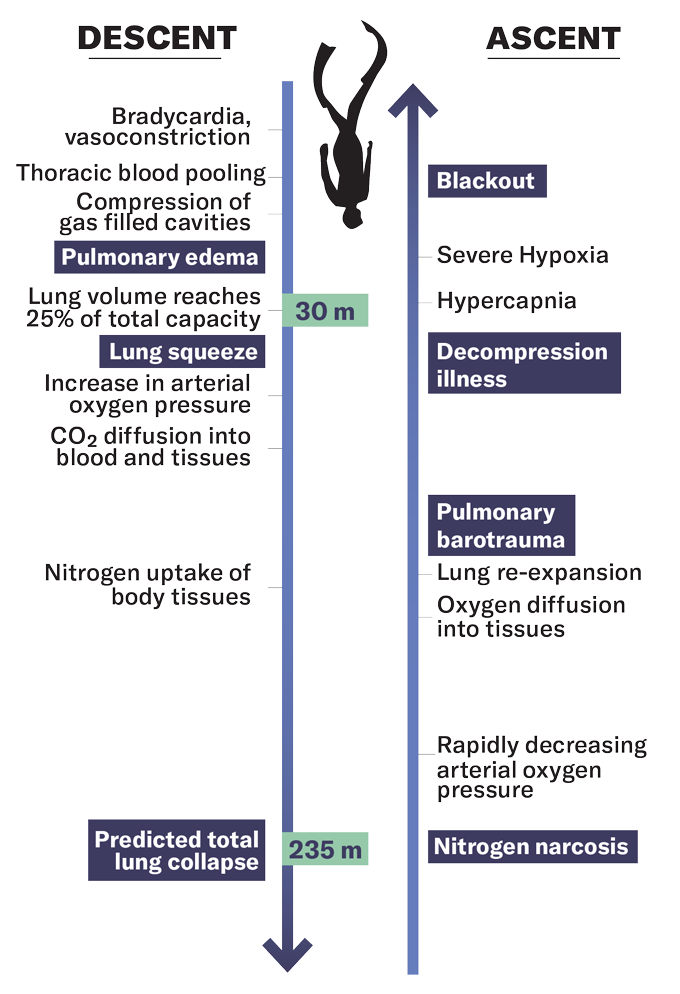
Deep Breath-Hold Diving
The body experiences several physiological changes during the descent and ascent of a deep breath-hold dive. Health risks (text in boxes) are not related to certain depths but rather to depth ranges during the descent or ascent. Trained freedivers can survive these extremes, but for some risks, like shallow water blackout, the signs can be difficult to sense until it’s too late.

“We don’t have reliable data,” Jackson concludes. But the data they do have show that males ages 15 to 45 are at greatest risk, presumably because they try too hard to last underwater. Those who have survived a blackout say they felt as if they could hold their breath forever. “It’s like a runners’ high,” Jackson says.
Schagatay herself began freediving for fun at age 13 off the coast of Portugal. “There were many more fish than in Sweden,” she recalls. Over and over, she would dive down until she was blue and shivering.
Schagatay never dreamed that someone could stay submerged for multiple minutes until 1982, when she watched a Bedouin diver disappear in the Red Sea. The dive lasted longer than what had been considered the maximum time humans could go without a breath and not die or suffer brain damage. “I was afraid the person I saw was going to need my help, but then he came up with a moray eel in his spear,” Schagatay says. She wondered how was that possible.
So in graduate school at Lund University in Sweden, Schagatay began focusing on marine mammal physiology. She eventually turned her attention to freedivers to see how much their bodies mimic a seal’s or dolphin’s as they dive.
Even before the Francis family approached Schagatay six years ago, she had been attending freediving competitions and outfitting athletes with monitors that tracked their oxygen consumption by measuring oxygen in the blood. She also tracked heart rate, lung volume and the rise of carbon dioxide levels in the body as measured in exhaled air. Her goal has been to understand what the body experiences and how it copes with the stresses of diminishing oxygen and increasing CO2.
With new funding from the Francis family, Schagatay built a portable lab, which she sets up in places such as Dahab, Egypt. There, along the Red Sea, a 100-meter-deep sinkhole called the Blue Hole attracts freedivers of all skill levels. In some of her experiments, amateurs and skilled freedivers repeatedly held their breath for specified time periods on land; in others they swam successively greater lengths underwater in a pool. She compared the land-based results with the underwater swims to get a sense of how well dry-land tests reflected these swimmers’ and divers’ in-water abilities. If we know how long we can last underwater compared to how long we can hold our breath on land, “this could allow us to predict how long one can safely hold the breath,” she says.
One problem Schagatay noticed with some freedivers, especially beginners, is that they involuntarily hyperventilate — taking a few quick breaths — right before they submerge. That increases the risk of blacking out because they expel CO2 that would otherwise give the body an urgent “BREATHE NOW” command.
“Carbon dioxide is our best friend,” says Juan Valdivia-Valdivia, a neurosurgeon at BayCare Medical Group in Tampa, Fla., who practices freediving.
When CO2 levels in the body get high enough, the diaphragm begins to spasm to force inhalation. Freedivers learn to control this impulse. But, especially if they hyperventilate, novice divers can blow out so much CO2 that the body doesn’t start to spasm and they “extend the dive too long,” Schagatay says. Then the divers are more likely to black out.
A stationary bike and a tub of water
Back in Östersund, Schagatay’s university lab is just a few kilometers away from the Swedish national biathlon center. In the same building as her lab, Sweden’s top Nordic skiers are studied on a custom treadmill, and there’s a special chamber where oxygen content and temperature can be controlled to create near Everest-like conditions. In a room one floor above, Schagatay’s postdoc Frank Pernett has set up a stationary bike with a basin of water strategically placed above the handlebars.
The goal is to test a common safety practice among swimmers or spearfishers who repeatedly submerge to explore coral reefs or attempt to catch fish. When these freedivers surface to take a breath, they tend to rest on the surface twice as long as they had just spent underwater to “catch their breath,” so to speak, before diving again. But it was unclear whether this rest length offered adequate recovery time. If that time was too short, the body would become more susceptible over time to blacking out.
In the lab, volunteers pedal slowly — a substitute for swimming motion — as they place their face in the water and hold their breath for a fixed duration, then pull out and breathe normally for twice as long as they were underwater. They do this 10 times, and at the end of each submersion, they exhale into a tube attached to a machine that measures oxygen and CO2. They have an oxygen meter on a finger and an electrocardiogram monitor around the chest. After a few submersions, the researchers collect a finger prick blood sample to measure lactic acid accumulation, which indicates how oxygen-deprived the body has become.

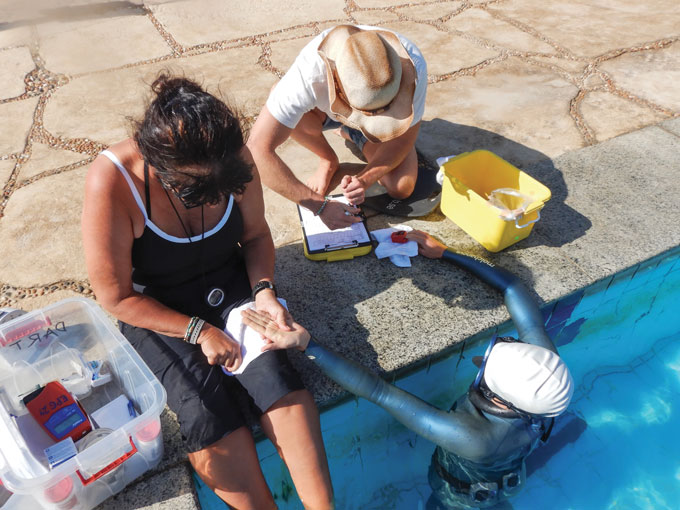
The researchers found that the double rest time technique is sufficient in only about 70 percent of the study participants. That means almost a third of the divers do not replenish their oxygen adequately and could be at greater risk of blacking out, Schagatay and Pernett reported last year in Helsinki at the annual meeting of the European Underwater and Baromedical Society. They plan to publish those results later this year.
The team had assumed that the amount of oxygen in the body would be key to lasting the full time underwater during each attempt. Indeed, good freedivers tend to have large lungs. But how long the oxygen stored in lungs, blood and tissue lasts varies depending on metabolic rate and to some degree, heart rate. Experienced divers also tend to have low heart rates. But once the body runs low on oxygen, it begins to accumulate lactic acid, which means the body will need a much longer time to recover. So, Pernett says, beginner divers or those facing rough conditions need to pace out their dives even more, breathing on the surface three times as long as the time submerged.
A superpower of the spleen
Additional factors can influence the blood’s oxygen supply, studies show. For instance, there’s the spleen, which is a reservoir of red blood cells, which carry oxygen. Under stress, this organ contracts and floods the blood with these cells, providing an oxygen boost to the body. This contraction is part of what’s known as the human dive reflex, says evolutionary genomicist Melissa Ilardo of the University of Utah School of Medicine in Salt Lake City. When the mammalian body submerges in water, this reflex kicks in to maintain the brain’s oxygen supply. The heart rate slows, blood pressure in the arteries increases and capillaries in the limbs constrict, shifting blood flow to the body’s core, particularly the brain.
The spleen-provided boost during the dive reflex is so critical that the Bajau, an Indigenous freediving group in Indonesia, Malaysia, and the Philippines, have evolved bigger spleens, which helps them forage for fish and other seafood. They carry a genetic mutation that affects the spleen’s growth, Ilardo and colleagues reported in 2018 in Cell.
“Freediving really does offer a unique window into human performance.”
Erika Schagatay
integrative physiologist & freediver
Training still makes a big difference. Schagatay’s team had previously shown that practice leads to a stronger dive response in the Bajau. Then, last year in Cell Reports, Ilardo and her team reported that the Haenyeo, a group of Korean women who freedive to depths of about 10 meters to harvest seafood, also have bigger spleens than their land-based peers. But that seems to be because diving is a way of life; they start as youngsters and continue through pregnancies and well into their ninth decade. So far, scientists have found no genetic component to their spleen size difference.
Practice can similarly help competitive freedivers enhance other aspects of the dive reflex so they can better cope with the strain of low oxygen and high CO2.
A freediver’s health also affects their success, especially those trying to reach record depths. Any active or recent respiratory infection seems to predispose the lungs’ air sacs to clog with fluid as a diver swims back to the surface. That can impede normal breathing even after surfacing.
Other studies had concluded that divers with heart issues or problems compensating for changing pressure in their ears are more likely to black out, according to a review published in 2009 in the Journal of Applied Physiology by environmental physiologists Peter Lindholm and Claes Lundgren of the Karolinska Institute in Stockholm. Fasting and too much exercise prior to diving can be detrimental too, as both can affect the amount of CO2 in the body. In at least one case documented by Schagatay and colleagues, an erratically beating heart seemed to lead to the blackout.
Freediving teaches about disease
Data about freedivers have already provided clues about the health of nondivers.
“Freediving is the perfect model to understand what happens with low levels of oxygen in the blood,” Pernett says. This deficit is a problem in many conditions — lung infections, chronic obstructive pulmonary disease, lung scarring or thickening and sleep apnea. He and others think applying the lessons learned from freediving research can improve the quality of life of patients with these conditions.
For example, freediver training exercises that help expand the lungs and take in more air for holding the breath longer could help asthmatics breathe better, Pernett suggests. Likewise, people with sleep apnea might benefit if they have a strong dive reflex.
Studies of freedivers can also inform clinicians about how the heart works. The low oxygen and high CO2 and lactic acid levels associated with deep dives seem to predispose athletes to irregular heartbeats. If that’s the case, similar changes may increase the risk of irregular heartbeats in nondivers.
Bradycardia, a slow heart rate, is another condition better understood through the lens of freedivers. During a dive, the heart slows down as part of the dive reflex and thereby conserves oxygen. “In the ambulance, they shouldn’t try to cure this problem,” Schagatay suggests. “The [low] heart rate is the body trying to cope.”
Juan Valdivia-Valdivia
“It’s addicting to feel disconnected from normal thoughts.”
neurosurgeon & freediver
Freediving research is also helping to improve our understanding of the blood-brain barrier. This cellular and molecular “wall” keeps toxins out of the brain. Bailey, the University of South Wales physiologist, finds freedivers useful for understanding how the barrier works — and why it fails. His subjects tend to be very healthy. So, the brain “is not contaminated by any form of disease, and we can decode” what happens when the barrier gets stressed.
During very long breath-holds, blood pressure and blood flow rise sharply to get precious oxygen into the brain, “which has one heck of an appetite for this gas,” Bailey says. In his work with freedivers, Bailey discovered that low oxygen really stresses the brain, causing a temporary disruption of the blood brain barrier. “When it breaks down, harmful proteins can slip into brain tissue,” Bailey says. Over time, the repeated stress of deep dives can lead to effects that resemble neurodegeneration, both his and Schagatay’s teams have shown.
“Freediving may act as a kind of accelerated model of brain aging,” Bailey says. “It’s like stress-testing a machine to see where it cracks. That teaches us about vulnerability, and ultimately resilience.”
The brain may have ways to cope with low oxygen to some extent, says physiologist Anthony Bain of the University of Windsor in Canada. He has done studies showing that high levels of CO2 might help a stressed brain slow its energy use, temporarily lowering its needs for oxygen.
There’s also an important psychological component to breath-holding that could be helpful for people with anxiety, panic disorders, PTSD or, for that matter, anyone feeling stressed. “These athletes have a phenomenal ability to cope with stress,” Bailey says. While there is only scant anecdotal evidence, the breath control that comes out of freediver training may help these people, he adds.
Oleg G. Melikhov agrees. “The ability to control oneself, concentrate and relax are skills that are very helpful in everyday life,” says the medical and science officer for the International Association for the Development of Apnea, an international organization that oversees freediving competitions.
Breath-holding, like meditation, seems to activate calming nerve circuits, a feeling that makes freediving appealing. “The deeper you go, the more relaxed you get if you really know how to do it,” says Valdivia-Valdivia, who both competes and studies freedivers. He thinks his freediving has made him a better surgeon not just because of the discipline required to go deep but also because of what happens to his mind when he does.
At greater depths, self-awareness and a sense of detachment from the rest of the world soar. “It’s addicting to feel disconnected from normal thoughts,” he says. “Almost every time, I feel joy.”
On the way to a warning device
Although the implications of freediving research can be broad reaching, the goal of the Francis family is quite narrow. They want to develop a watch or similarly sized device that will warn when blackout could be imminent. But they are also realistic. Schagatay “is doing terrific work,” says Peter Francis, Tucker’s dad. “But whether it will lead to a device, I don’t know.”
Schagatay’s experiments and other work have provided much of the data needed to compute when a person’s blood oxygen is approaching critically low levels, but turning these insights into a practical device is still a daunting task. “There are some 30 factors that affect these things,” Schagatay says.
Divers in whom oxygen drops early in the dive are at greater risk of blacking out, Schagatay says, and that can happen even in moderately deep dives that freedivers don’t feel are risky. People don’t reach the surface in time.
Pernett has also been working on developing devices that detect if someone about to dive underwater is hyperventilating, though more testing is needed. Meanwhile, “there’s a lot [that can be done] with education,” Pernett says. “I don’t think there’s a chance that a device can be the only solution.”


Tucker’s parents agree. “We wouldn’t suggest that people not freedive, but there’s certain things you have to do to do it safely, not least of which is to make darn sure that you have somebody watching you who can pull you out,” Peter Francis says.
Valdivia-Valdivia knows all too well the value of not diving alone. He’s blacked out but was okay because safety divers nearby immediately pinched his nostrils shut and covered his mouth to close the airways and quickly brought him to the surface. “I didn’t know it was happening until I was rescued.”
“I wish more people would be aware [of blackouts],” Valdivia-Valdivia says. “Freediving can give you a very wholesome life, or it can take your life.”
Read the full article here