






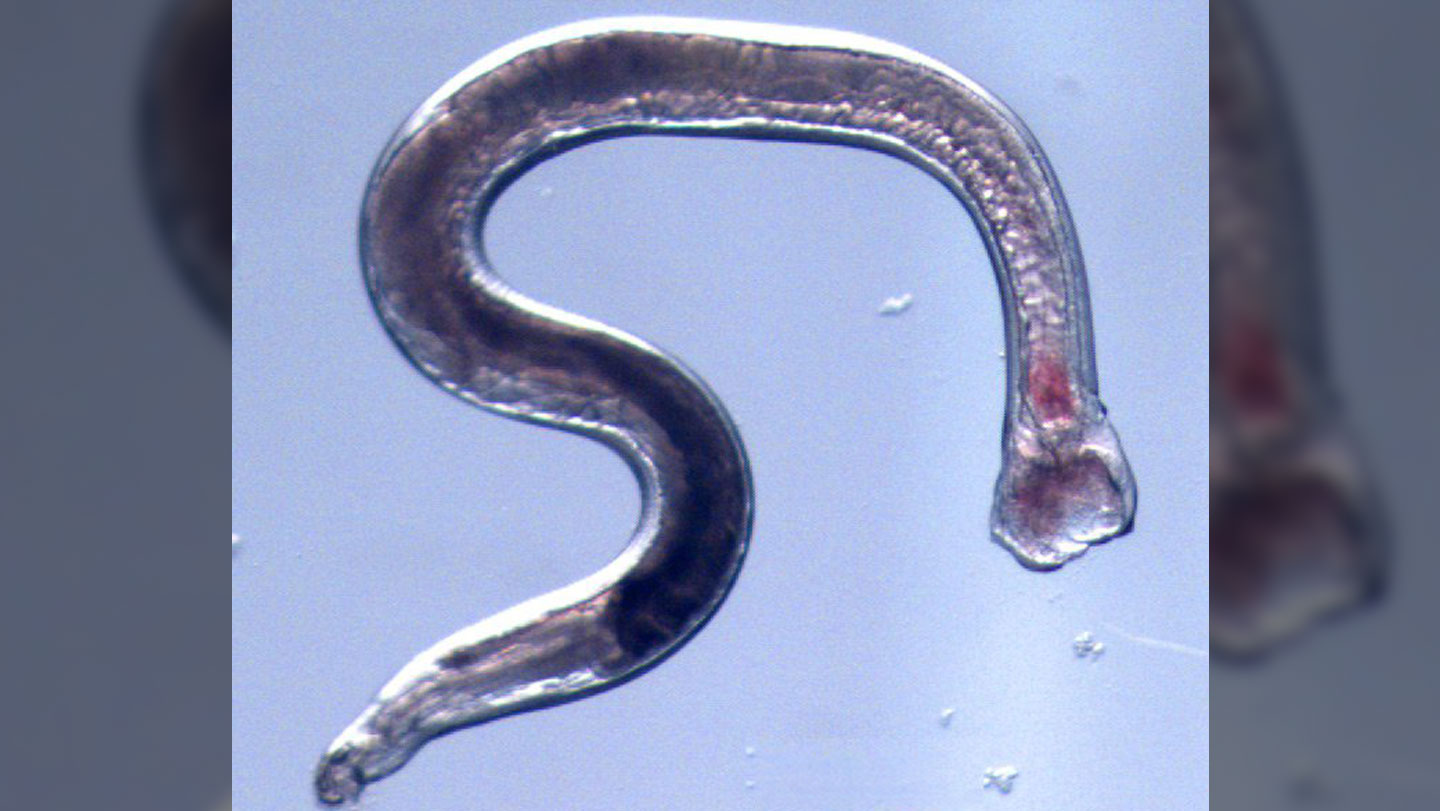
A parasite is one step closer to becoming a drug dispensary.
Using CRISPR-based gene editing, scientists have engineered hookworms that live in the human gut to make an antibody against a deadly toxin, researchers report June 3 in Nature Communications.
Eventually, small numbers of hookworms may secrete drugs or other substances into people’s bloodstreams to treat a wide variety of diseases from allergies to obesity, says Makedonka Mitreva, a molecular geneticist at Washington University School of Medicine in St. Louis.
Taking pills or doing daily injections is a burden for many people with chronic diseases, Mitreva says. But, she says, “What if every person at risk of suffering from chronic disease carries their own pharmacy inside of them?” Small numbers — maybe 50 or so — of hookworms could provide that service without harming the host’s health, she says.
Hookworms naturally work to keep their hosts healthy enough to provide long-term homes for the parasites, Mitreva says. And some research suggests parasitic worms can be beneficial by reducing inflammation in the gut and curbing autoimmune diseases and allergies.
But scientists have been limited in their understanding of parasites partly because there are few species that can be genetically manipulated, says parasitologist Elissa Hallem of UCLA, who wasn’t involved with the new work.
Mitreva and her team learned firsthand that it’s not easy to tinker with hookworms’ DNA. Getting molecular tools into the worms was a challenge, she says. Adults have a thick cuticle that surrounds and protects the worms from hosts’ digestive juices and other challenges of life in the gut. Mitreva and colleagues collected eggs from the Ancylostoma ceylanicum hookworm and zapped them with electricity to deliver the desired genetic payload. The technique, called electroporation, opens tiny, temporary holes in cell membranes, allowing the engineered DNA to get in.
In this case, the payload included CRISPR/Cas9 and instructions to make an antitoxin against tetrodotoxin, a deadly toxin produced by pufferfish for which there is no antidote. DARPA, the U.S. Defense Advanced Research Agency, which funded the research, is interested in developing countermeasures because the toxin is a potential biochemical weapon.
Once the researchers had inserted the antibody gene into hookworms, the team then infected hamsters with either the engineered worms or with regular hookworms. Hamsters hosting engineered worms had some antibody fragments in their blood, enough to neutralize about 20 percent of the toxin in a test-tube assay, Mitreva and colleagues found. That is evidence that engineered hookworms can make and secrete the desired protein into the blood.
But the worms may not make sufficient antitoxin for hamsters directly exposed to the toxin, says Cornelis Hokke, a parasitic infectious diseases researcher at Leiden University Medical Center in the Netherlands, who was not involved in the study. “Would [the antibody] then have had sufficient neutralizing capacity to save the hamster? The answer there might be no.” The pufferfish toxin is so deadly that it may need to be completely neutralized for full protection.
The project is still in its infancy but is proof-of-concept that hookworms can be engineered. “The fact that here [the team] could introduce DNA to the [hookworm] eggs raises the possibility that you could use this technique for a wide variety of parasitic worms,” Hallem says, “and that would be huge,” for understanding parasite biology and learning how to stop infections in addition to developing hookworms as drug delivery systems.
There is still a lot of room for improvement, and many steps before hookworms could even be tested as internal pharmacies in humans. For instance, the researchers need to engineer worms that can pass down the introduced genes for many generations to create a consistent product that could be prescribed to patients, Hallem says. Mitreva says her group is working to optimize the levels of therapeutic molecules hookworms can make and secrete, so that a small number of worms can supply sufficient doses.
The work is going in the right direction, Hokke says. “It’s moving a bit from science fiction to science.”
Read the full article here