





Motor neurons, the nerve cells that control muscles, have a reputation as passive messengers. But growing evidence suggests they do more than simply relay the brain’s commands.
Work in fruit flies suggests that motor neurons can send signals back to the brain to help organize the very movement sequences they carry out, researchers report August 24 in Nature Neuroscience.
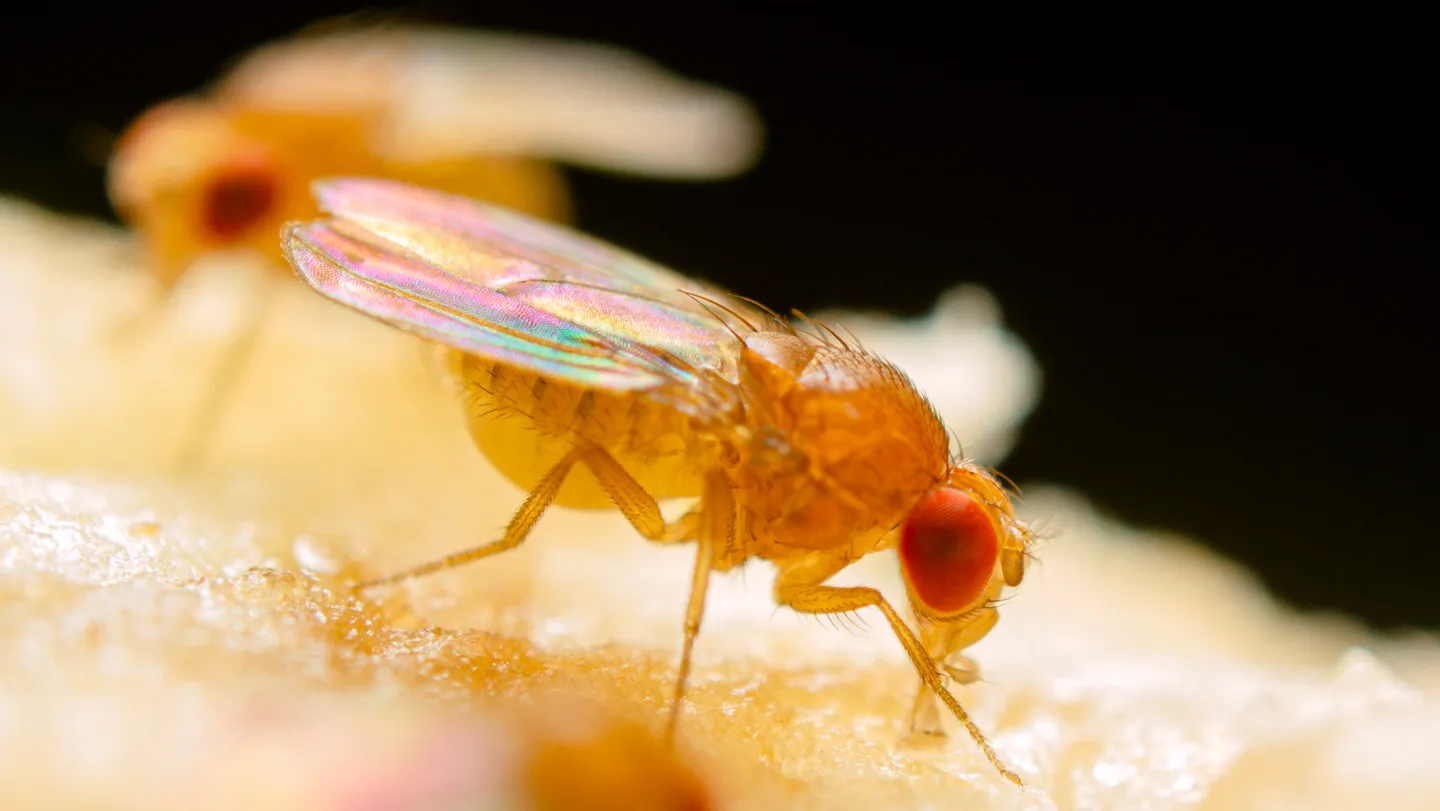
Even when the muscles and motor neurons involved in a movement are mapped out, scientists still do not fully understand how the nervous system generates coordinated sequences of movement. For instance, the sucking motion fruit flies (Drosophila melanogaster) use to feed requires seven pairs of muscles in the fruit fly’s mouth, each controlled by a pair of motor neurons. The muscles contract in a precise sequence, generating fast rhythmic pressure changes that draw food inward. “It closely resembles the way an infant suckles,” says Dong-Gen Luo, a neuroscientist at Peking University in Beijing.
In 2016, Luo’s group was studying taste perception, not movement. But when neuroscientist Xiu-Wen Sui, then a Ph.D. student at Peking University, accidentally triggered repetitive sucking, the team found the behavior fascinating and decided to study it.
Sui, Luo and colleagues recorded the activity of individual motor neurons while the flies were feeding, a tricky task that involved inserting tiny electrodes into their brains. The team found that some motor neurons were not simply carrying out commands, but also sending signals back to the brain. These signals, in turn, helped determine when the next motor neuron in the sequence would become active.
Luo likens this process to a chain of falling dominoes. The motor neurons controlling the third pair of muscles receive commands from the brain and do two things at once: they activate their target muscles while also telling the brain to release the “brakes” on the next pair of motor neurons. Then the next pair repeats the same step, passing the sequence along to the fifth pair of neurons. The paper does not explain how all seven pairs of muscles are coordinated during sucking.
Motor neurons’ movements
While fruit flies are feeding, seven pairs of muscles in their mouths must contract in a precise sequence, generating rapid, rhythmic pressure changes that draw food inward. This slow-motion video shows the cyclical feeding process in flies fed sugar water dyed blue (animated dark patch).

The ability to release the brake only when needed, and when actual conditions allow, could enhance the stability and precision of motor control, Luo says. It’s a principle that could potentially be harnessed to help robots achieve smoother and more adaptive movements, he says.
The finding brings together two previously separate lines of research, says neuroscientist Maarten Zwart of the University of St. Andrews in Scotland. Imagine motor neurons as soldiers on a battlefield. Scientists already knew that soldiers were guided by their commanders to act in a coordinated sequence. Other studies had also shown that these soldiers could send messages back to the commanders. What this study reveals is that those messages can help determine when the next soldier is allowed to act.
Some details of the underlying neural mechanisms may differ between flies and vertebrates, Zwart says. So “there is no straightforward answer” as to whether similar principles apply to humans, too.
Read the full article here