





A buoy with googly eyes was supposed to scare seabirds away from Danish fishing nets. The buoy, named Bobby, sported wind-spun eyes that loomed over the birds as a predator might. But less than a month later, no bird gave a hoot about Bobby, researchers report May 13 in Royal Society Open Science. The negative results show just how hard it is to picture a pest’s perspective.
Anyone who’s had a seabird steal their fries knows that birds can be persistent and consummate pests. But when preying on fishing catch, the birds themselves risk getting caught in nets. Seabird snacking bothers lots of fishermen, but “the problem is really more passive gear like longlines and gillnets,” says Gildas Glemarec, a fisheries scientist at the Technical University of Denmark in Kongens Lyngby. Birds going after fish get caught in the nets and drown. Seabirds in Denmark are also protected by the European Union, so efforts to deter them need to be harmless.
Seabirds are sensitive to predators flying over them, and some antibird designs use this as an advantage. The “Looming Eye Buoy” is a yellow buoy with a pole sticking up in the air. Two aluminum flags are placed at the top of the pole, painted with small and large eyes. The flags whip in the wind, making it look like the eye size is changing. “It’s to give this impression of something approaching,” Glemarec says.
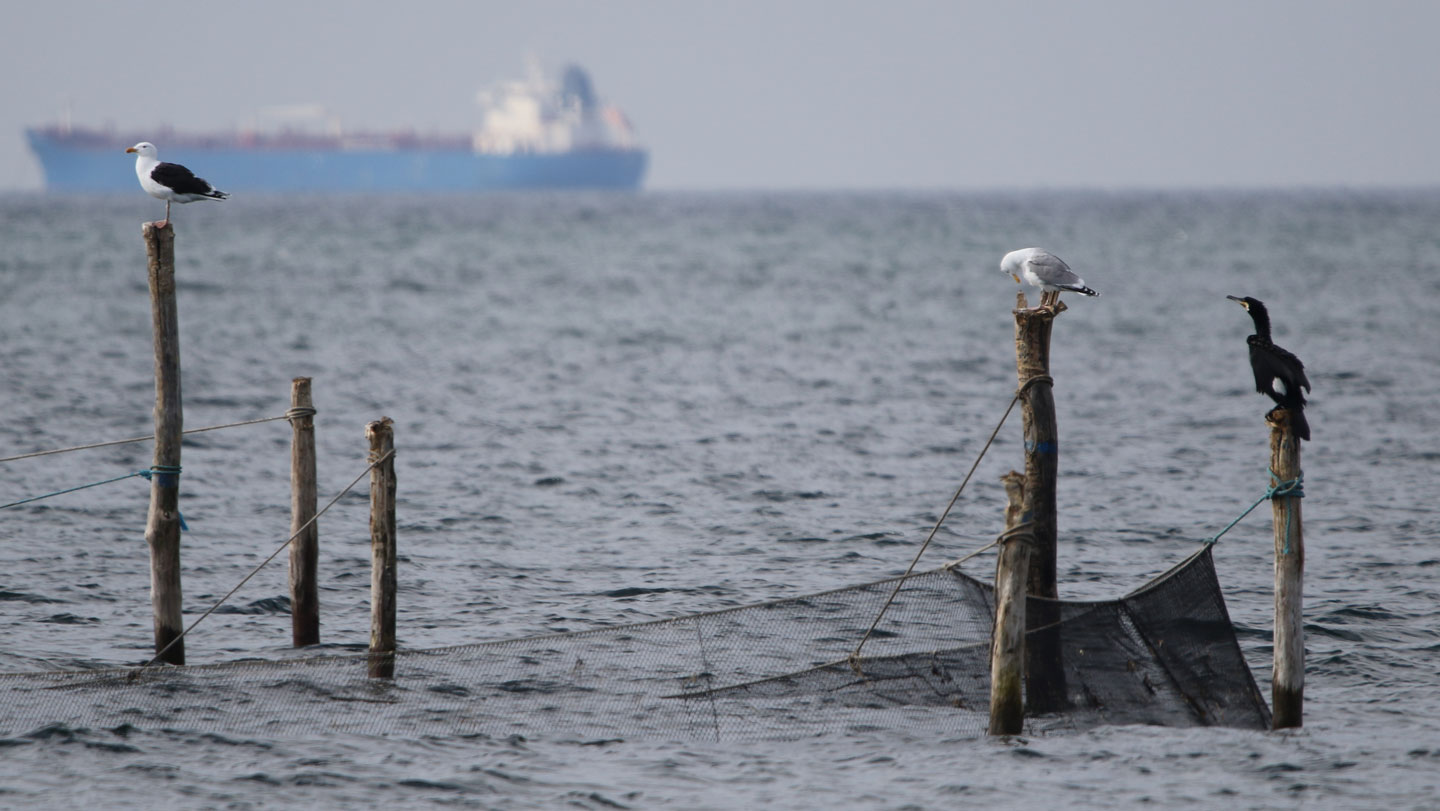
He and his colleagues tested the buoy at pound nets off the coast of Korsør, Denmark. These nets catch migrating garfish (Belone belone), which swim into a penned-off area where the humans can scoop them out at leisure. But the birds can scoop too, and the wooden poles anchoring the nets make great perches for greater cormorants (Phalacrocorax carbo) and several species of gull.
The scientists tethered Bobby the buoy in one pound net, kept the other as a control and counted birds. After 46 days and more than 1,000 birds, the verdict came in: Bobby was a failure. At first, “it did end up reducing the number of birds around one pound net compared to the other,” Glemarec says. But 23 days later, the birds knew Bobby was no threat. Cormorants perched right next to it. “They couldn’t care less about the eye turning next to them.”
Sebastian Wszelaki, an environmental biologist at the Wrocław University of Environmental and Life Sciences in Poland, says birds come to regard stationary objects like scarecrows “as a harmless part of their surroundings.” Moving parts raise the perceived threat, he says, but if the movement is repetitive, the birds will adapt in the end.
A brave bird might also inspire others, says Marina Papadopoulou, who studies group behavior at the Max Planck Institute for Human Development in Berlin, Germany. “Maybe one individual out of five would actually be a bit more prone to risk taking,” she says, and through social cues — seeing another bird perched safely on a scarecrow’s head, for instance— the rest of the group can adapt faster.
Because birds adjust to deterrents, humans must stay on their toes, Wszelaki says. People could play bird alarm calls and put out a robotic owl or a moving scarecrow, varying them so the birds don’t get wise. “Unfortunately, there is a lack of research that precisely determines the effectiveness of a given deterrent against specific species,” he says. That’s why publishing negative results is key, Wszelaki says. It helps researchers learn what not to try and saves fishermen money.
Now, Bobby the buoy has been relegated to Glemarec’s office. While useless against birds, Glemarec says, it does sometimes sport a little Christmas hat.
Read the full article here