





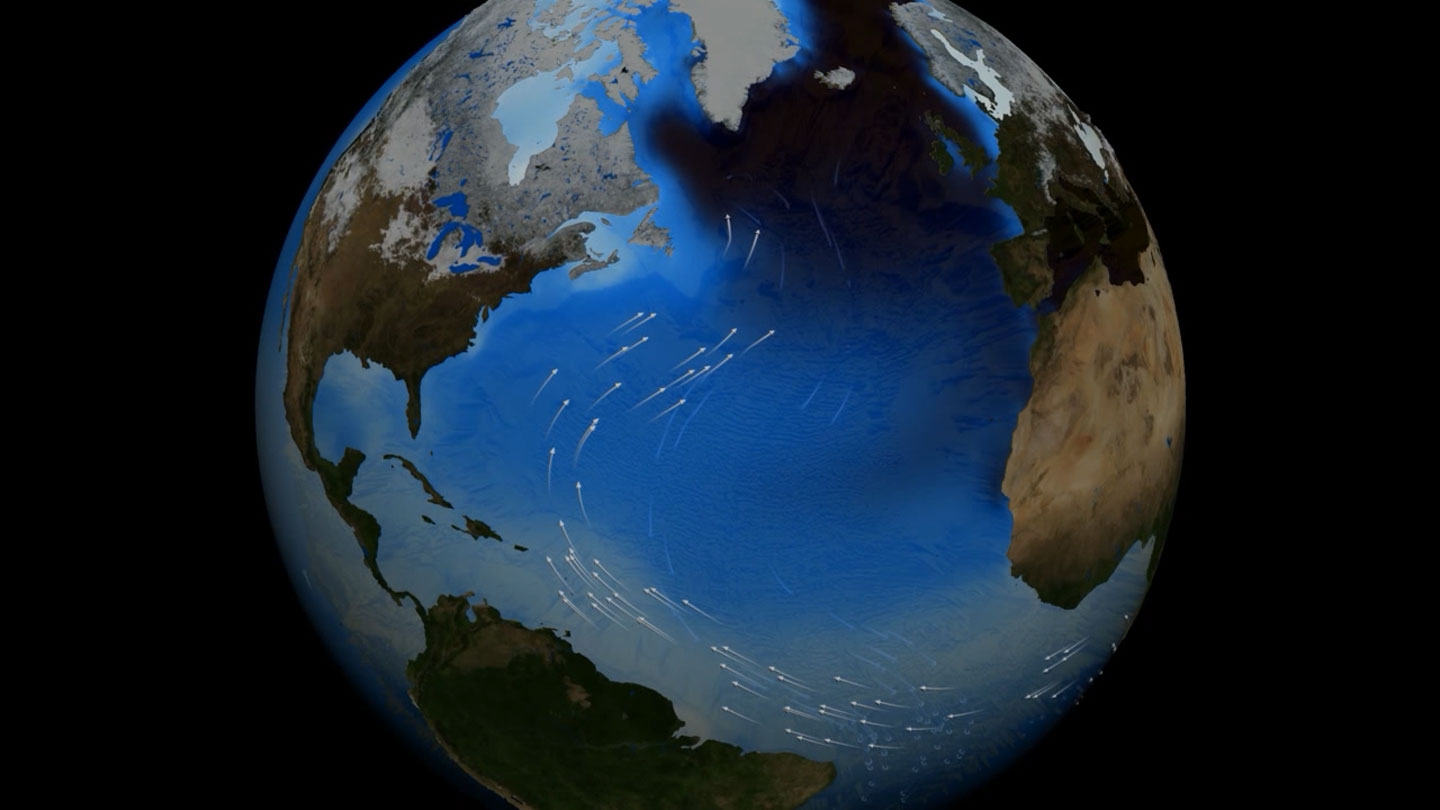
One of Earth’s most vital ocean currents is rapidly weakening in response to global warming. Its collapse could send devastating ripples through the planet’s climate system.
The potential consequences of the shutdown of this current, called the Atlantic Meridional Overturning Circulation, or AMOC, are wide-ranging. The AMOC moves warm surface waters from the tropics northward toward Europe, ferrying a massive amount of heat.
If that transport shuts down, scientists say, the world might see more extremes of both cold and heat in Europe, warming in the Southern Hemisphere, stronger storms in the North Atlantic, increasing drought in Africa’s Sahel and a decrease in summer precipitation in Europe with potentially devastating consequences for agriculture.
Researchers have rung warning bells about the AMOC for decades; its hypothesized shutdown was even the disastrous premise of the 2004 movie The Day After Tomorrow. But scientific predictions of its fate have been all over the map — and it’s only in the last couple of years that scientists have been able to figure out which way the current is really trending.
The consensus is not good. The AMOC is getting weaker.
The stakes are alarming enough that some scientists are even proposing geoengineering the AMOC back to health. One idea: building a roughly 80-kilometer-long series of dams to seal off the Bering Strait between Russia and Alaska. Cutting off water flowing into the AMOC from the strait could help stabilize the current’s strength, researchers report April 24 in Science Advances.
Proposed climate intervention solutions are highly controversial, due to the many unknown impacts they might have. And the Science Advances paper “is very much a conceptual study,” not a ready-to-implement fix, says coauthor and physical oceanographer Jelle Soons of Utrecht University in the Netherlands.
What such proposals can do is cast a stark light on how grave the problem is — and how little time remains to address it.
A statistics trick illuminates the AMOC’s future
The system of currents that circumnavigates the planet — including the AMOC — is driven by density. Salty water masses sink relative to fresher waters; colder waters sink relative to warmer. The constant shifting between these masses keeps conveyor belt–like currents on the move.
As the AMOC releases heat to the atmosphere at its North Atlantic destination, the water becomes colder, causing it to sink. That cold, dense water heads back southward along the seafloor, and warmer surface water is pulled northward along the surface to fill the vacuum.
For decades, researchers have worried that Earth’s changing climate would affect the AMOC’s strength. Climate simulations suggested that it might weaken as the planet warms, but by how much was difficult to pin down without observational data from the current itself. Now, scientists have about two decades of direct observations to work with — enough to begin to ascertain which way the current is trending.
On April 15 in Science Advances, researchers came to a bleak conclusion: The AMOC will become about 50 percent weaker by 2100.
Predicting how the AMOC will change over time is “not as easy as predicting global temperature,” says Stefan Rahmstorf, a physical oceanographer at the Potsdam Institute for Climate Impact Research in Germany. “It’s notoriously difficult to get right.”
The uncertainty about the AMOC’s fate turns out not to be strongly linked to future greenhouse gas emission scenarios, says Valentin Portmann, a climate data scientist at the University of Bordeaux in France and a coauthor on the study. Instead, the issue is differences between the climate models themselves.
The U.N. Intergovernmental Panel on Climate Change uses about 50 different climate simulations from different scientists worldwide in its comprehensive climate assessments. Each climate model incorporates observations of the current climate differently in its projections.
“The IPCC takes the mean of these to estimate what will be the future climate,” Portmann says. “Around this mean, you have a standard deviation.” For projections of Earth’s future heat, climate models show little disagreement. But for the AMOC, “this spread is very high.”
The biggest problem with projecting the fate of the AMOC, scientists say, is correctly simulating the Atlantic Ocean’s future salinity, which makes the water denser and helps it sink. “You have to get the salinity all over the Atlantic Ocean right,” Rahmstorf says. That means, in turn, correctly simulating changes in precipitation as the climate changes. And with precipitation, he says, “you’re talking about clouds, the biggest uncertainty in atmosphere models.”
Given those challenges, past computer simulations have varied widely when it comes to how much the AMOC will weaken by 2100. The average reduction hovers around 32 percent — plus or minus 37 percent.
Portmann and colleagues addressed the AMOC conundrum with classic statistical approaches. One approach, called ridge-regularized linear regression, is “not often used in climate science, but is very well known in statistical science,” Portmann says. That approach is specifically designed to simplify complex statistical problems that have a lot of variables, many of which may be correlated with one another.
It was also the approach that turned out to provide the best statistical match to the problem. That approach favored climate simulations with starker predictions, suggesting the AMOC will weaken by about 51 percent, plus or minus 8 percent, by the end of the century.
“What they have shown very convincingly is that, unfortunately, the simulations with the strongest decline are the most realistic ones,” says Rahmstorf, who was not an author on that study.
The biggest factor in this correction came from how one factor was weighted: the future surface salinity of the South Atlantic Ocean. Researchers have long suggested that the higher the salinity in the South Atlantic’s surface waters, the weaker the AMOC is projected to become — and this analysis supports that link. Meanwhile, observational data show that these waters have been getting saltier, thanks both to increased evaporation from the ocean as the atmosphere warms and to more salty water leaking in from the Indian Ocean as wind patterns shift.
The AMOC’s ins and outs are a lot to grasp
Besides South Atlantic surface salinity, scientists have identified many factors that impact the AMOC. Those include circulation in the Nordic Seas and freshwater influx through places like the Bering Strait.
To get a handle on such problems, oceanographers sometimes start by simplifying them into box models, simple representations of regions of ocean divvied up into hypothetical boxes with a given chemical makeup. Other water parcels entering the box mix in, and water exiting the box has an altered chemistry. Though highly simplified, box models can reveal fundamental forces at play. For example, as far back as 1996, Rahmstorf published a study based on a box model that pointed at the likely importance of the South Atlantic Ocean’s salinity when it comes to the AMOC’s strength.
The influence of Greenland’s melting ice sheet is also fairly straightforward: A big glut of freshwater entering the ocean is going to have a huge impact on its density, the driver of motion.
There’s data on that: A 2025 study in the Earth ArXiv revealed that hundreds of thousands of years ago, meltwater from a decaying Greenland ice sheet triggered a weakening of the AMOC that lasted about 1,000 years. And the island’s rapidly melting ice sheet is thought to be contributing huge amounts of freshwater to the North Atlantic today.
Other inputs are harder to understand. There’s a northern branch of the AMOC known as the Nordic Seas Overturning Circulation, or the NOC. Even as the AMOC has weakened over the past century, the NOC appears to be stable. Some computer models even project that the NOC will strengthen slightly in the future.
That might seem like good news, says Sasha Roewer, a physical oceanographer now at the Max Planck Institute for Meteorology in Hamburg, Germany. “It makes sense to say that if one part of the current is strengthening, maybe the system is stable, and we don’t really have anything to worry about.”
However, the NOC’s strengthening might actually be another warning sign, she says.
Roewer, Rahmstorf and other researchers simulated what would happen as the North Atlantic Ocean became fresher. On April 20 in Ocean Science, they reported that this would — for a time — strengthen the NOC current, because it also alters the density difference between the North Atlantic Ocean and waters further south.
But “eventually it reaches a tipping point where convection in the Nordic Seas breaks down. And that’s where both currents collapse,” Roewer says.
Scientists ponder a controversial tack
The idea to dam the Bering Strait “really was a very spontaneous one; it just started with a thought experiment,” Soons says. It was sparked by a 2025 study in Geophysical Research Letters that analyzed which factors contributed to a strong AMOC during the mid-Pliocene Epoch, about 3 million years ago.
The Bering Strait is narrow and shallow, just 82 kilometers wide and averaging between 30 and 50 meters deep. Changing sea levels alter how much water can flow through the strait. During ice ages, when sea levels drop, the Bering Strait becomes a land bridge, offering a pathway for human or animal migration between the continents. Three million or so years ago, reduced freshwater flow through the Bering Strait helped keep the AMOC stable, the study that inspired them had found.
“It made me think: Could we close the Bering Strait again?” Soons says.
Simulations from Soons and Utrecht University colleague Henk Dijkstra suggest that damming the Bering Strait is time sensitive. If the closure is applied when the AMOC is already severely weakened, this stabilizing effect could become counterproductive, they found.
Soons acknowledges that reactions to the proposal have been mixed. “There are debates of whether we should even research geoengineering, because it would distract from the real problem — give people a way out” of focusing on emissions reductions.
He says that he and Dijkstra also didn’t consider ecological impacts and other factors in their proposal. “It’s just another direction to explore instead of a finished solution.”
Even if the AMOC is speeding toward its tipping point, it’s in no way clear that a dam is the solution, other researchers say.
“I’m not a great fan [of the dam proposal], to put it mildly,” says Rahmstorf. “The most important thing we can do is stick to the Paris Agreement” to reduce emissions and forestall more warming, he says — although in 2026 the world’s average temperature is likely to pass that accord’s 1.5 degree Celsius warming target.
The world — probably — isn’t past the AMOC’s tipping point yet, and it’s hard to know when exactly that will be, Rahmstorf says. But based on the most recent studies, that time may come as soon as the 2040s. “That means we have no time to lose.”
Read the full article here